

Stop Digital Targeting Risk in Fair Housing Advertising for Agents
Stop Digital Targeting Risk in Fair Housing Advertising for Agents

Never write, publish, or target an ad in a way that expresses a preference or limitation based on a protected class. Before anything goes live, strip out exclusionary language, add the Equal Housing Opportunity notice, and double check your ad platform’s targeting settings for demographic filters. That standard comes straight from HUD’s guidance and 24 CFR §100.75, and it applies whether you’re writing a listing description or setting up a Facebook campaign.
TL;DR:
- Avoid demographic language and images that imply preferences or exclusions, especially related to family status, age, race, or religion.
- Digital advertising tools can unintentionally produce discriminatory delivery through inferred traits, lookalike audiences, or geographic exclusions, requiring careful monitoring.
- Maintain internal compliance by documenting ads, training staff, and displaying fair housing notices, which helps prevent violations and legal penalties.
- Run every draft through a checklist: review language for protected class references, verify images, confirm targeting settings, and keep records of final ads.
- Acceptable ads focus on property features and objective requirements, while phrases implying applicant demographics or community preferences often violate fair housing laws.
Table of Contents
- What Federal and State Fair Housing Laws Prohibit in Advertising
- Words, Images, and Placements That Commonly Trigger Violations
- Digital Platforms and Algorithmic Targeting: Where Advertising Goes Wrong
- Building Organizational Compliance Into Your Ad Process
- A Practical Audit Checklist and Ready-to-Use Ad Templates
- Enforcement, Penalties, and Simple Compliance Tests
- Why Inclusive Advertising Is Both Legal Protection and Better Marketing
- Agentwrite: Write Compliant Listings Without the Second-Guessing
- Sources
- FAQ
What Federal and State Fair Housing Laws Prohibit in Advertising
The Fair Housing Act, through 24 CFR §100.75, makes it unlawful to make, print, or publish any notice, statement, or ad that signals a preference, limitation, or exclusion tied to a protected characteristic. That regulation lists seven federally protected classes: race, color, religion, sex, disability, familial status, and national origin.
Many states and cities go further. Source of income, sexual orientation, gender identity, age, and marital status show up as protected classes in a growing number of jurisdictions, so a phrase that’s legal under federal law alone can still get you in trouble locally.
The definition of “advertising” is broader than most people assume. It covers:
- Print flyers, brochures, and newspaper listings
- MLS remarks and syndicated portal descriptions
- Website copy, social media posts, and paid digital ads
- Yard signs and window displays
- Verbal statements made over the phone or in person
A verbal comment to a prospective tenant, “this building is really more for young professionals,” carries the same legal exposure as a printed ad with the same message.
Words, Images, and Placements That Commonly Trigger Violations
Certain phrases show up again and again in fair housing complaints because they describe people instead of the property. “Perfect for a single professional,” “no kids,” “ideal for a Christian family,” and “walking distance to [specific ethnic] shops” all imply a preference, even when the writer meant no harm.
Photo and model selection carries its own risk. Marketing images that consistently feature only one race, age group, or family type can suggest a preference, especially across a portfolio of listings rather than one photo in isolation.
A few situational traps deserve special attention:
- Roommate ads specifying gender preference are legal in most jurisdictions under a narrow shared-living exception, but the exception doesn’t extend to race, religion, or disability.
- “Adult-only” or “no children” language almost always violates familial status protections outside of qualified 55+ housing communities.
- Neighborhood description fair housing pitfalls are common: describing an area as “family-oriented,” “up-and-coming,” or naming nearby churches and clubs edges into coded steering language.
Pro Tip: Run every draft through a simple test: would this sentence make sense if you swapped out “professional” or “family” for “applicant”? If the phrase only works because it’s describing a type of person, cut it.
Digital Platforms and Algorithmic Targeting: Where Advertising Goes Wrong
Modern housing ads rarely fail because of a bad sentence. They fail because of how a platform’s algorithm decides who sees the ad. HUD’s guidance on digital advertising platforms warns that audience-selection tools and automated ad delivery can produce discriminatory effects even when the advertiser never intended to exclude anyone.
Three mechanisms drive most of the risk:
- Inferred characteristics. Platforms build behavioral profiles that correlate with race, religion, or family status, then optimize delivery toward users who resemble your past engagers.
- Lookalike audiences. If your seed audience skews toward one demographic, the lookalike expansion will too, quietly narrowing who ever sees the ad.
- Geographic exclusions. Drawing a radius or excluding certain zip codes can function as digital redlining, even when race is never mentioned in the setup.
The Justice Department’s settlement with Meta put the industry on notice that liability attaches to delivery outcomes, not just ad copy.
Statistic Callout: HUD’s own guidance recommends advertisers run housing campaigns through a separate ad workflow or specialized interface designed to minimize the risk of accidental discriminatory targeting.
Practical controls that lower your exposure: avoid any demographic exclusion in targeting menus, ask your platform rep for delivery disclosure reports, and run paired-ad tests comparing identical creative under different targeting setups to see if delivered audiences skew unexpectedly.
Building Organizational Compliance Into Your Ad Process
A compliant ad is a one-time win. A compliant process is what protects your brokerage or team long term. Start with visible commitments, then back them with internal structure.
- Display the Equal Housing Opportunity logo and, where applicable, the HUD fair housing poster in offices, on websites, and in printed materials.
- Adopt a written nondiscrimination advertising policy that spells out banned language and requires sign-off before an ad publishes.
- Maintain records of every ad’s copy, images, and targeting settings, since documentation is what protects you if a complaint surfaces later.
- Train staff and any outside vendors, including photographers and social media managers, on what phrases and image choices to avoid.
None of this needs to be complicated. A shared checklist and a single approval step before publishing catches the majority of violations before they ever reach a prospective renter or buyer.
A Practical Audit Checklist and Ready-to-Use Ad Templates
Run this sequence on every listing before it publishes:
- Language check. Scan for demographic descriptors, coded neighborhood language, or family/age references.
- Image check. Confirm photos represent the property, not a curated demographic of who should live there.
- Targeting check. Review platform audience settings for exclusions tied to age, gender, or location that could correlate with protected classes.
- Logo check. Confirm the Equal Housing Opportunity notice appears on the listing or ad creative.
- Documentation check. Save a copy of the final ad and targeting settings for your records.
Safe phrasing always leads with the property, not the person: “spacious two-bedroom with updated kitchen” beats “great for a young couple” every time. Eligibility criteria like income requirements or credit checks are fine to state; guesses about who fits the space are not.
Three quick templates to adapt:
- Rental listing: “Bright 2BR/1BA unit, in-unit laundry, walk to transit. Income verification and credit check required. Equal Housing Opportunity.”
- Roommate ad: “Seeking roommate for shared 3BR house, private bath, off-street parking. $50 application fee, background check required.”
- Social post: “Just listed: renovated 3BR ranch with fenced yard and new HVAC. Wheelchair-accessible entry available. DM for a private showing.”
Enforcement, Penalties, and Simple Compliance Tests
Complaints route through several channels: HUD’s administrative process, DOJ civil enforcement actions, state and local fair housing agencies, and private lawsuits filed directly by aggrieved renters or buyers.
Outcomes vary by case, but they commonly include injunctions against future violations, mandated outreach or training programs, and financial penalties.
- Run paired-ad experiments comparing identical listings with varied targeting.
- Periodically pull delivery demographics from your ad platform’s reporting tools.
- Schedule a quarterly internal audit of published ads against your written policy.
Why Inclusive Advertising Is Both Legal Protection and Better Marketing
Compliant ads reach more qualified buyers and renters, not fewer. Every exclusionary phrase you cut is a chunk of the market you stop accidentally shutting out. Tools like Agentwrite that flag risky wording as agents write can speed this up, but they don’t replace a human final check. Build the audit habit anyway, and train your team on it.
— Tyler
Agentwrite: Write Compliant Listings Without the Second-Guessing
Some platforms offer alternatives to writing every listing from scratch, generating listing descriptions, MLS remarks, and social captions from property details while flagging wording that could raise fair housing advertising concerns before publication.
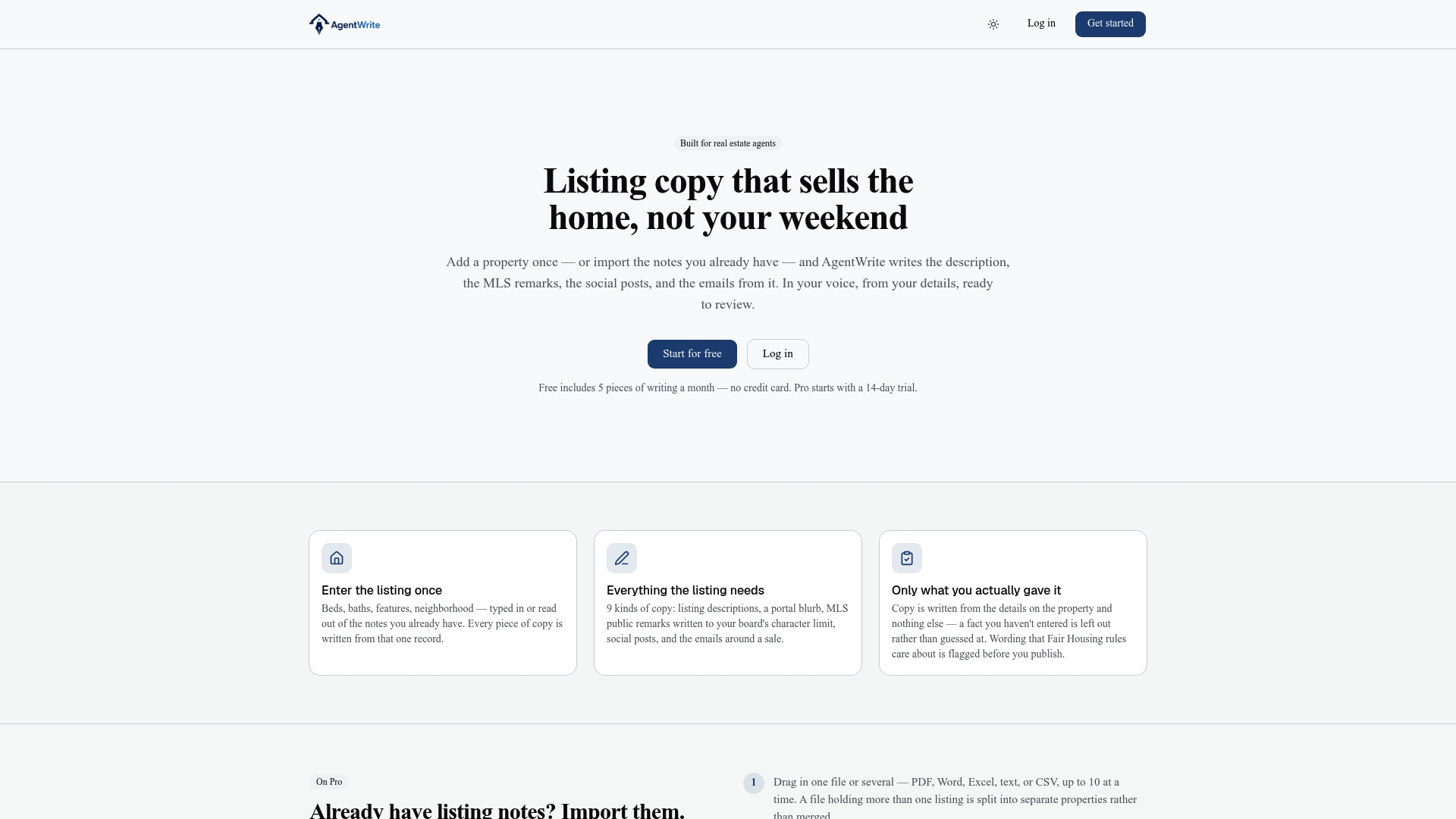
That matters most on the ads written under deadline pressure, the ones most likely to slip past a tired eye. Agentwrite handles the repetitive work of turning property details into polished copy for every channel, so your review time goes toward the judgment calls, not retyping the same square footage into five formats. For rental teams juggling multiple portals, a partner platform like HomeRent shows how listing-heavy workflows benefit from the same discipline. Start a free trial at Agentwrite and run your next listing through it before you publish.
Sources
Consult HUD’s digital platform guidance for targeting rules, 24 CFR Part 100 for statutory text, and the NFHA for practical wording guidance.
- 24 CFR § 100.75 - Discriminatory advertisements, statements and notices (LII / Cornell Law School)
- Guidance on Application of the Fair Housing Act to the Advertising of Housing, Credit, and Other Real Estate-Related Transactions through Digital Platforms (HUD FHEO)
- Justice Department secures settlement agreement with Meta Platforms (press release)
FAQ
What does the Fair Housing Act say about advertising for housing?
It prohibits any notice, statement, or ad that indicates a preference, limitation, or discrimination based on a protected class, under 24 CFR §100.75.
Which of the following ads is acceptable under the Fair Housing Act?
An ad describing property features, amenities, and objective eligibility criteria like income or credit requirements is acceptable; an ad referencing a tenant’s ideal demographic, family type, or religion is not.
What are examples of fair housing violations in advertising?
Common violations include phrases like “no kids,” ads that only picture one demographic group, coded neighborhood descriptions, and digital ad targeting that excludes protected groups by age, gender, or location.
What is a requirement for the Fair Housing poster?
Housing providers and their advertising materials should display the Equal Housing Opportunity logo or slogan in visible locations, including offices, printed materials, and websites.
Does a 55+ housing community have different advertising rules?
Yes. Qualified 55+ communities can advertise age restrictions under the Housing for Older Persons exemption, but they still must avoid excluding people based on race, disability, or other protected classes.