

Agents: 5 Step Pre Publish Audit to Pass Google Housing Ads Policy
Agents: 5 Step Pre Publish Audit to Pass Google Housing Ads Policy

Keep every listing description and housing ad focused on the property, never the people you imagine living there. Cut any word tied to race, religion, family status, disability, national origin, sex, or a proxy for those traits, and skip audience targeting that narrows who sees your ad based on protected characteristics. Document your review before publishing, add the Equal Housing Opportunity statement where required, and consider a tool like Agentwrite that flags risky wording before you hit publish.
TL;DR:
- Housing ads must focus on property features and avoid mentioning or implying demographic preferences, targeting, or suitability for specific groups.
- Using coded language like “family friendly” or mentioning ethnicity, religion, or age can unintentionally violate fair housing laws, even when done with good intentions.
- Digital platforms’ targeting algorithms can create discriminatory outcomes without intentional bias, so ads must be reviewed carefully before publishing.
- Including identifiable models of diverse demographics in photos and avoiding language linked to individual backgrounds help ensure compliance.
- A thorough pre-publication review involving screenshots, targeting checklists, and documenting decisions is essential to avoid violations and legal liability.
Table of Contents
- What Is the Google Housing Ads Policy for Real Estate Agents?
- Checklist: Do’s and Don’ts for Listing Copy and Ad Text
- How to Write Safe Listing Descriptions
- Do Digital Ad Platforms Create Discrimination Risk on Their Own?
- Do Listing Photos Need to Show Diverse Models?
- Pre-Publication Review: A Short Compliance Workflow
- How AgentWrite Helps With Compliant Listing Copy
- Overview of Google’s Housing Ads Policy Purpose and Legal Basis
- How Does This Differ From General Advertising Policies?
- What Happens If You Violate the Google Housing Ads Policy?
- What to Do If Your Housing Ad Gets Disapproved
- How Has the Google Housing Ads Policy Changed Over Time?
- Compliant vs. Non-Compliant Housing Ad Examples
- What Agents Get Wrong About Fair Housing Compliance
- Draft Compliant Listings Faster With Agentwrite
- Sources
- FAQ
What Is the Google Housing Ads Policy for Real Estate Agents?
For agents, the practical version of this policy has nothing to do with advertiser verification or bidding rules. It comes down to one standard: describe the dwelling, not the demographic you picture buying it. That standard traces back to the Fair Housing Act, and HUD’s Office of Fair Housing and Equal Opportunity has made clear that liability applies to intentional discrimination and to practices that simply produce a discriminatory effect, whether or not anyone meant harm.
That second category trips up more agents than outright slurs ever do. A listing that mentions a “family friendly” complex, targets an ad only to people the platform infers are a certain age, or leans on ethnic-neighborhood shorthand can violate housing advertising standards even when the copywriter had good intentions. The fix is procedural: build a habit of screening copy and targeting settings before anything goes live, the same way you’d screen a contract before a client signs it.
Checklist: Do’s and Don’ts for Listing Copy and Ad Text
Run every draft through this before it leaves your inbox.
Avoid these:
- “Perfect for a young professional” (implies age preference) → say “close to downtown offices and nightlife”
- “Great for a Christian family” or any faith reference → say “near three houses of worship within a mile”
- “No section 8” or “no kids” → simply state your actual, lawful screening criteria in the application process, never in the ad
- “Walking distance to the Chinese market” as a coded ethnic cue → say “walking distance to the international grocery on Fifth Street”
- “Ideal for a bachelor” or “mother-in-law suite” framed around who should live there → describe the layout instead
Do this instead:
- State square footage, bedroom and bathroom counts, lot size, and year built
- List accessibility features by name: zero-step entry, wide doorways, grab bars, roll-in shower
- Quote pricing and availability dates exactly, with no vague qualifiers that could mislead
- Include the Equal Housing Opportunity statement or logo, sized comparably to your other branding
- Skip any phrase that limits who should “picture themselves” in the home
How to Write Safe Listing Descriptions
Skip references to who lives there now, who lived there before, or who you imagine buying it. That single discipline removes almost every phrase that gets agents in trouble.
Use these as starting templates to create effective exit strategies in luxury real estate:
- Bedrooms: “Three bedrooms, two full baths, primary suite with walk-in closet.”
- Transit and location: “Half a mile from the Blue Line stop; 10 minute drive to the interstate.”
- School district: “Located in the Lincoln Unified School District” (naming the district is factual; describing who should want that district is not).
- Accessibility: “Single story layout with a zero-step entry and 36 inch doorways throughout.”
- Neighborhood tone: “Quiet cul-de-sac with mature trees” instead of “safe neighborhood” (which can imply a coded judgment about who lives nearby).
Red flags to catch on your own copy before anyone else does: any mention of “no children,” “adults only” outside a legitimate qualified senior-housing exemption, religious or ethnic descriptors, phrases like “exclusive” or “private” that hint at exclusion, and any reference to a resident’s appearance, accent, or background.
Pro Tip: Read your draft out loud and ask, “Am I describing the house, or am I describing a person I imagine in it?” If the sentence answers the second question, rewrite it.
Do Digital Ad Platforms Create Discrimination Risk on Their Own?
Yes, even when your copy is spotless. HUD’s guidance on advertising through digital platforms warns that targeting tools and delivery algorithms can produce discriminatory outcomes without anyone intending to discriminate. A platform’s algorithm can decide, on its own, to show your rental listing to fewer people in a particular zip code or age bracket, and that delivery pattern alone can create liability. Automated systems trained on historical data can reproduce old patterns of exclusion, sometimes using variables that look neutral, like inferred interests or browsing history, but that function as proxies for protected characteristics.
Here’s what to actually do about it:
- Mark every housing ad as a housing ad using the platform’s dedicated ad category or flow, not a generic business promotion.
- Never build custom audiences around age, gender, ZIP codes chosen for demographic reasons, or “interest” categories that function as stand ins for race or religion.
- Ask the ad platform what disclosures or restricted-category protections it applies to housing listings, and use them.
- Run paired ad tests: launch two versions of an ad with identical budgets and neutral copy, varying only the targeting, then compare who actually saw each one.
- Review delivery reports after the campaign runs, not just before it launches.
Save your targeting configuration, the audience composition report, and a dated screenshot of the ad preview every time you launch a campaign. That file is your evidence if a complaint ever surfaces, and it costs you five minutes now versus weeks of reconstruction later.
Do Listing Photos Need to Show Diverse Models?
Yes, when you use human models at all. A listing that repeatedly shows the same demographic group in every lifestyle photo signals, intentionally or not, who the home is “for.” Fair housing advertising manuals recommend rotating models across ages, family structures, and abilities so no single group appears to be the target audience.
- Rotate model demographics across your campaigns rather than reusing one stock photo set repeatedly.
- Include at least occasional images showing accessibility features in use, like a walk-in shower or a ramp.
- Drop religious symbols, flags, or cultural iconography from staged photos unless the seller specifically wants them shown as a factual fixture.
- Write captions that describe the room or feature, not the imagined resident: “Updated kitchen with quartz counters,” never “perfect kitchen for a growing family.”
Pre-Publication Review: A Short Compliance Workflow
Before anything publishes, run it through a fixed sequence rather than a mental gut check.
- Scan the copy for words on a prohibited or cautionary list, cross-checking against published word and phrase guidelines.
- Confirm the Equal Housing Opportunity statement or logo appears, sized appropriately for the format.
- Verify the ad platform’s housing certification or housing-specific flow was used, not a general business ad type.
- Get a second set of eyes to sign off on targeting settings before launch.
- Save screenshots of the final ad, the targeting configuration, and the publish date in a shared compliance folder.
Assign one person on the team, whether that’s a broker, transaction coordinator, or compliance officer, as the final reviewer, and keep those audit records for as long as your brokerage’s retention policy requires. Escalate to counsel any time you’re marketing a legitimate senior-housing exemption, copy that reads ambiguous even after a rewrite, or a targeting set up a platform’s own disclosures don’t clearly cover.
How AgentWrite Helps With Compliant Listing Copy
A platform that generates listing descriptions, MLS remarks, social posts, and emails from a single property input, offering wording checks that flag risky phrasing and suggest safer rewrites in place, can help reduce errors and streamline the process.
That matters most under deadline pressure, when a listing needs to go live in twenty minutes and there’s no time for a careful read through. The platform’s outputs are also structured to be edit friendly, so your review step feeds directly into an audit trail: you can see what was flagged, what was changed, and when. It won’t replace legal judgment on an ambiguous case, but it catches the routine mistakes before a client, a portal, or a regulator does.
Overview of Google’s Housing Ads Policy Purpose and Legal Basis
The underlying purpose of any housing ad policy, whether enforced by a platform or a publisher, is to prevent advertising from becoming a tool for exclusion. That principle didn’t start with digital platforms. It comes directly from the Fair Housing Act, which makes it unlawful to publish any advertisement “that indicates any preference, limitation, or discrimination” based on race, color, religion, sex, disability, familial status, or national origin. Digital ad platforms built their housing-specific policies to operationalize that law inside an automated system, because algorithmic delivery and audience targeting can create the exact discriminatory effect the statute prohibits, even when the advertiser never wrote a discriminatory word.
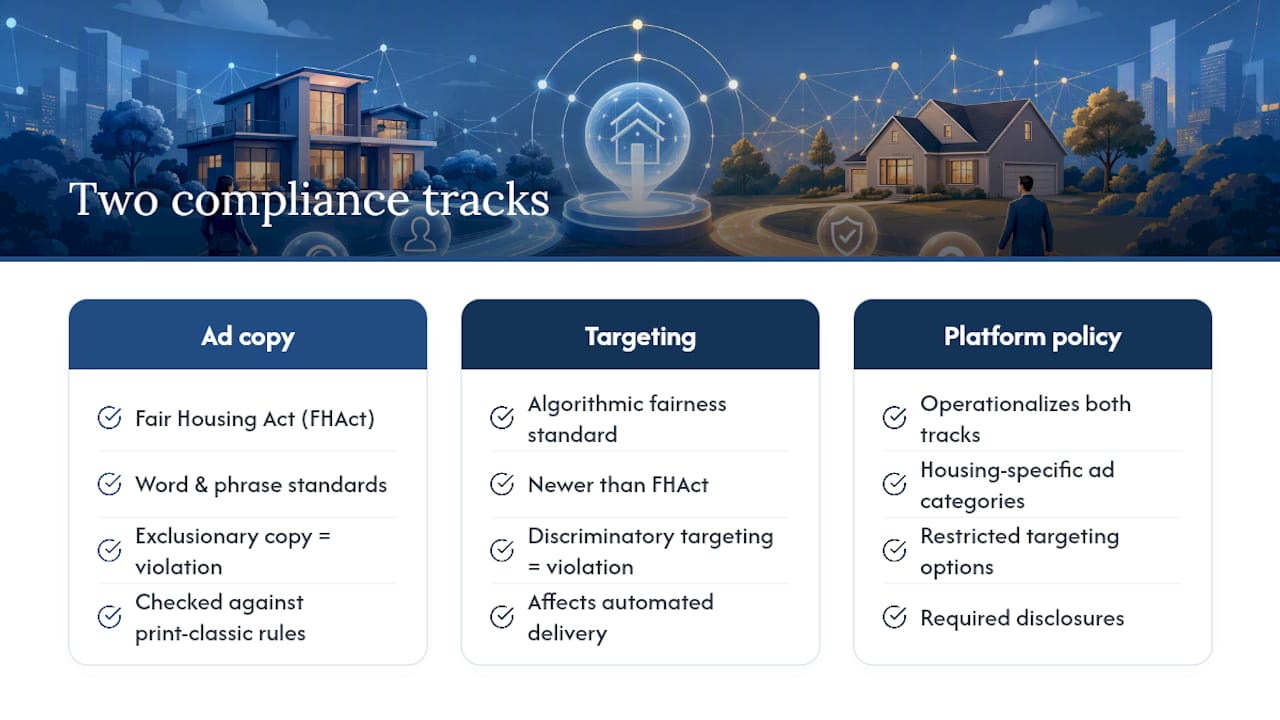
For agents, the legal compliance basis works on two tracks at once. Your ad copy has to clear the same word and phrase standards that have applied to print classifieds for decades. Separately, your targeting settings have to clear a newer standard built around algorithmic fairness, one that didn’t exist when those classified-ad rules were written. A platform’s own policy exists to give advertisers a structured way to comply with both tracks inside one ad-creation flow, using housing-specific ad categories, restricted targeting options, and required disclosures.
Ignoring either track creates exposure. Clean copy paired with discriminatory targeting is still a Fair Housing Act problem. Neutral targeting paired with exclusionary copy is too. Real estate ad policies exist precisely because these two failure modes require different fixes, and most agents only think to check one of them.
How Does This Differ From General Advertising Policies?
General ad policies on any platform focus on things like prohibited products, misleading claims, and intellectual property. Housing-specific rules add an entirely separate layer built around protected-class discrimination, and that layer changes what “acceptable targeting” even means.
A general ad for, say, a mattress company can target by age, income bracket, or parental status without any legal exposure. A housing ad targeting those same categories can violate the law, because housing is one of a small number of categories (alongside credit and employment) where targeting itself is regulated, not just the content of the ad. That’s the core distinction agents need to internalize: for most advertising, the message matters most; for housing, the audience selection matters just as much as the message.
This also changes what counts as a violation. A general ad gets flagged for false claims or banned content. A housing ad can get flagged for perfectly true, perfectly polite copy if the delivery pattern skews toward or away from a protected group. Google ad guidelines account for this by walling off real estate, credit, and employment ads into restricted categories with narrower targeting options than a typical retail campaign gets, precisely because the compliance for housing ads standard is legal, not just editorial.
The practical takeaway: never assume a targeting trick that works fine for your other business ads is safe to reuse on a listing campaign. Treat every housing ad as governed by its own rulebook.
What Happens If You Violate the Google Housing Ads Policy?
Violations of housing ads policies carry consequences on two separate tracks, and agents often only prepare for one. On the platform side, expect ad disapproval, account level restrictions on running future housing ads, or in repeated or severe cases, suspension of the advertising account entirely. Platforms increasingly require a one-time housing certification before you can run any housing, credit, or employment ad at all, and violating the policy can strip that certification.
The legal track is separate and more serious. Discriminatory advertising is unlawful regardless of the medium it runs in, whether that’s print, radio, television, or a digital ad campaign. Both the advertiser and, in some cases, the publisher carrying the ad can face liability under the Fair Housing Act, which opens the door to a HUD complaint, a private lawsuit, or state-level fair housing enforcement, depending on jurisdiction. None of that liability disappears just because a platform’s algorithm, not the agent, decided how the ad was distributed.
Reputational cost compounds both of those. A disapproved ad or a fair-housing complaint tied to your name follows you in a small industry, and brokerages increasingly treat a documented violation as a training or disciplinary event, not a minor slip. The combination of platform penalties, statutory liability, and professional consequences is exactly why the pre-publication review workflow earlier in this piece isn’t optional paperwork. It’s the cheapest insurance available against all three at once.
What to Do If Your Housing Ad Gets Disapproved
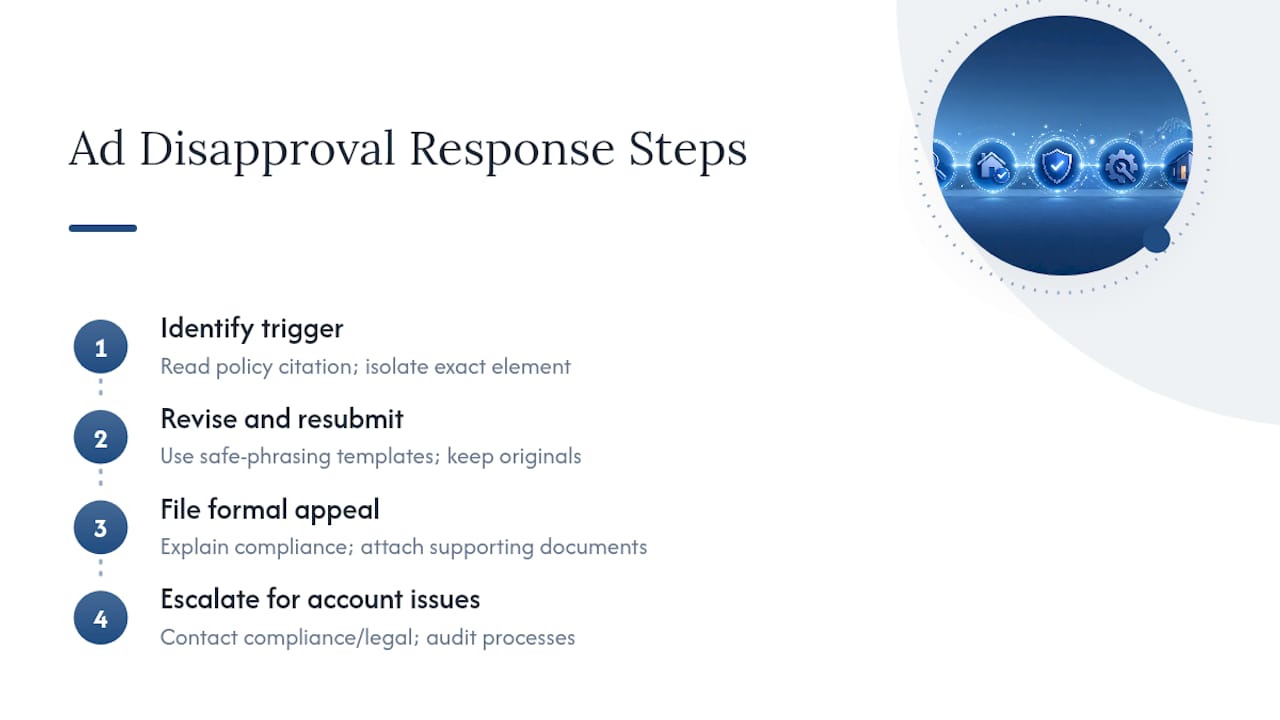
Most disapprovals aren’t dead ends. Start by reading the specific policy citation the platform gives you rather than assuming it was the whole ad. Disapprovals are usually tied to a specific phrase, image, or targeting setting, not the entire campaign, so isolate exactly what tripped the review before you touch anything else.
Once you’ve identified the trigger, revise that specific element using the safe-phrasing templates and word list covered earlier in this piece, then resubmit through the platform’s standard appeal or edit-and-resubmit flow. Keep a copy of the original ad, the disapproval notice, and your revised version, since that record matters if the same issue recurs on a future campaign.
If the disapproval seems to have flagged neutral copy, or you believe the enforcement action was triggered by an algorithmic misread rather than an actual policy violation, most platforms offer a formal appeal path separate from a simple resubmission. That process typically asks you to explain why the content complies with housing advertising standards, sometimes with supporting documentation. Escalate here rather than repeatedly resubmitting unchanged copy, which can extend account-level restrictions rather than resolve them.
For enforcement actions tied to account status rather than a single ad, involve your brokerage’s compliance officer or legal counsel immediately, especially if the platform references a pattern of violations rather than an isolated incident. A single disapproved ad is a copy problem. A pattern flagged across multiple campaigns is a process problem, and it needs a different kind of fix, usually a full audit of how your team drafts and reviews housing ads before you launch another one.
How Has the Google Housing Ads Policy Changed Over Time?
Housing-specific advertising policies have tightened steadily rather than loosening, and the direction of travel matters more than any single update. Early digital ad targeting tools let advertisers exclude audiences by age, gender, ZIP code, and inferred interest categories, the same tools used for any other product category. Fair housing complaints and subsequent guidance made clear that applying those same tools to housing, credit, and employment ads created exactly the kind of exclusion the Fair Housing Act was written to prevent.
That pressure led to structural changes: dedicated housing-specific ad categories with restricted targeting options, mandatory housing certification before an advertiser can run housing ads at all, and removal of ZIP code radius targeting and many demographic targeting options for this ad category specifically. HUD’s own guidance on digital platform advertising has evolved alongside these changes, extending fair housing principles built for print classifieds into an explicit framework for algorithmic delivery and targeting.
The practical lesson for agents is that these rules keep evolving as enforcement catches up with new ad technology, and a targeting option that was available two years ago may simply not exist anymore. Compliance for housing ads isn’t a one-time training you complete and forget. Check your platform’s current housing ad policy before every major campaign launch rather than relying on what worked last quarter, since targeting restrictions in this category change more frequently than in general advertising.
Compliant vs. Non-Compliant Housing Ad Examples
| Element | Non-compliant example | Compliant version |
|---|---|---|
| Headline | “Perfect starter home for a young family” | “Three bedroom home near Lincoln Elementary and the greenway trail” |
| Neighborhood description | “Safe, quiet area, great for retirees” | “Cul-de-sac location, 0.3 miles from the community park” |
| Targeting | Custom audience built on age range and parental status | Broad geographic targeting with no age, gender, or family-status filters |
| Accessibility mention | Omitted entirely | “Zero-step entry, 36 inch doorways, roll-in shower in primary bath” |
| Photo caption | “Ideal for a growing family” | “Updated kitchen with new appliances and quartz countertops” |
| Closing statement | No EHO logo or statement included | Equal Housing Opportunity logo displayed at a size comparable to other branding |
The pattern across every row is the same: the compliant version describes something you can point to and measure, square footage, distance, a fixture, a filter setting, while the non-compliant version describes a person or group who supposedly belongs there. That’s the entire test, applied consistently.
What Agents Get Wrong About Fair Housing Compliance
Most compliance training treats this like a vocabulary problem: memorize the banned words, swap in the approved synonyms, done. That’s necessary but nowhere near sufficient, and it’s the gap that gets experienced agents in trouble more often than rookies. A clean listing description paired with sloppy ad targeting is still a violation, and the word-list mentality gives agents false confidence that they’ve covered the whole risk.
The bigger blind spot is treating the Equal Housing Opportunity logo as a compliance checkbox rather than what it actually is: a required signal that has to be backed up by genuinely inclusive copy, imagery, and targeting. Slapping the logo on discriminatory ad delivery doesn’t cure anything. If your targeting settings are quietly excluding people, the logo just makes the ad look compliant while it isn’t.
What actually moves the needle is documentation discipline, not vocabulary. Screenshotting your targeting settings, saving your audience reports, and logging your pre-publication review takes five minutes and creates the paper trail that separates a good-faith mistake from a pattern of neglect if a complaint ever lands on your desk. Agents who skip that step aren’t necessarily writing worse copy. They’re just leaving themselves with nothing to point to when it matters.
— Tyler
Draft Compliant Listings Faster With Agentwrite
Such AI writing tools can provide a compliant first draft quickly by generating various listing-related texts from property details entered once, while flagging Fair Housing wording concerns during generation instead of after.
You still make every editorial call. These writing tools can surface risky phrases and suggest safer alternatives, but final publishing decisions remain with the user, maintaining control over the endorsed language. If you’re managing a full listing pipeline and rewriting the same property facts into five different formats every week, that repetition is exactly what the tool exists to eliminate. Try the free tier at Agentwrite on your next listing and see how the draft compares to what you’d write from scratch.
Sources
- Guidance on Application of the Fair Housing Act to the Advertising of Housing, Credit, and Other Real Estate-Related Transactions through Digital Platforms
- Fair housing advertising word and phrase guidelines (excerpted word list)
- Fair Housing Handbook (advertising and model guidance)
- Fair Housing Advertising Manual (publisher notice and EHO logo guidance)
FAQ
What Words Should I Avoid in a Housing Ad?
Avoid any word tied to race, religion, national origin, sex, familial status, disability, or age, along with coded terms like “exclusive,” “perfect for a family,” or neighborhood descriptors that hint at ethnicity, and check drafts against a published prohibited-word list.
Does the Equal Housing Opportunity Logo Protect Me From Violations?
No. The logo signals nondiscrimination, but it doesn’t offset discriminatory targeting or exclusionary copy elsewhere in the same ad, so it has to be paired with compliant language and neutral targeting settings.
Can Ad Targeting Alone Create a Fair Housing Violation?
Yes. HUD guidance confirms that targeting features and algorithmic delivery can produce discriminatory outcomes even when the ad copy itself is completely neutral and no one intended discrimination.
What Should I Do if My Housing Ad Gets Disapproved?
Identify the specific phrase, image, or targeting setting cited in the disapproval notice, revise only that element, and resubmit or appeal through the platform’s standard process rather than rewriting the whole ad from scratch.
Can a Tool Like Agentwrite Help Me Avoid Fair Housing Violations?
Agentwrite flags risky wording as it generates listing descriptions and suggests safer alternatives, which gives agents a faster starting point for compliant copy, though final editorial responsibility always stays with the agent.