

Fill Your Pipeline: 30 Day Real Estate Social Calendar for Agents
Fill Your Pipeline: 30 Day Real Estate Social Calendar for Agents

A real estate social calendar is a repeatable posting schedule built around buyer and seller behavior instead of generic holidays. This article gives you a copyable 30-day calendar, a 90-day rollout plan, a four-pillar content framework, a batching workflow, and a short checklist for measuring what’s working.
TL;DR:
- A 90-day social media plan helps agents test, optimize, and scale their content, with most leads appearing between weeks 6 and 10.
- Consistently posting one Reel, three Stories, and one carousel weekly builds algorithm favor and sustains engagement over time.
- The four content pillars—Educate, Showcase, Connect, Convert—should rotate weekly to prevent stagnation and maintain audience interest.
- Focusing on two social platforms with three feed posts weekly, one Reel, and daily Stories maximizes visibility and avoids spreading resources too thin.
- Batch creating content, using compliance checks, and aligning posts with market triggers enhances efficiency and relevance in real estate marketing efforts.
Table of Contents
- Real Estate Social Calendar: A Copyable 30-Day Schedule
- The 90-Day Plan: Test, Optimize, Scale
- What Are the Core Content Pillars for Real Estate?
- How Many Times a Week Should Realtors Post on Social Media?
- How to Batch, Approve, and Schedule Posts Without Errors
- Aligning Your Calendar With Market Triggers and Seasonality
- What Metrics Should You Track Every Month?
- What Winning Agents Do Differently
- How AgentWrite Speeds Up Your Weekly Batching Session
- Sources
- FAQ
Real Estate Social Calendar: A Copyable 30-Day Schedule
Most agents fail here for one reason: they only post listings, then vanish for two weeks between closings. A 30-day calendar built on rotating pillars fixes that. Guides that use a four-pillar structure (Educate, Showcase, Connect, Convert) with a consistent weekly rhythm give you a sustainable posting baseline instead of a scramble.
Here’s the skeleton, rotated across four weeks:
- Monday (Educate): A market myth busted in 60 seconds, “no you don’t need 20% down.”
- Tuesday (Showcase): A listing detail most buyers miss, closet space, natural light, walkability.
- Wednesday (Connect): A local business shoutout or a “ask me anything” Story sticker.
- Thursday (Educate): A step in the buying or selling process explained simply.
- Friday (Showcase): New listing or open house announcement.
- Saturday (Connect): Behind-the-scenes, client story, or community event recap.
- Sunday (Convert): A soft ask, book a valuation, DM for a private tour.
Turn any prompt into a Reel by filming it as a 15-second talking point, into a carousel by breaking it into three slides, or into a Story sequence with a poll sticker for engagement. Keep the ratio near four value posts for every one direct ask. Skip that rule and your Convert-day posts stop working within weeks.
The 90-Day Plan: Test, Optimize, Scale
A single month of posting tells you almost nothing reliable. A 90-day content plan gives you enough runway to test formats, measure what resonates, and adjust before you commit real effort to any one direction.
- Month 1, test: Run the 30-day calendar as written. Track which pillar and format gets the most saves, shares, and DMs.
- Month 2, optimize: Double down on the two best-performing formats. Cut whatever got zero engagement across four straight posts.
- Month 3, scale: Turn your top-performing post into an “anchor” piece each week, then reformat it into a Reel, a carousel, and a Story series.
Realistic benchmarks matter here. Inbound DMs and consultation requests typically start showing up in weeks 6 through 10, not week one. Agents expecting overnight leads from a fresh Instagram account usually quit right before the compounding starts.
What Are the Core Content Pillars for Real Estate?
The fastest way to kill engagement is posting nothing but listings. A four-pillar framework, sometimes labeled Inventory, Local Authority, Market Logic, and Lifestyle, keeps your feed resilient even when inventory dries up, which prevents the “Listing Loop” that stalls most agent accounts. Whether you call them Educate/Showcase/Connect/Convert or the Inventory-based set, the function is identical: rotate topics so no single well runs dry.
A sample week might look like:
- Educate/Market Logic: One post explaining a rate move, tax rule, or closing cost myth.
- Showcase/Inventory: One listing highlight, video walkthrough preferred over static photos.
- Connect/Lifestyle: One community or personal post, client win, neighborhood feature.
- Convert/Local Authority: One direct call to action, valuation offer or open house RSVP.
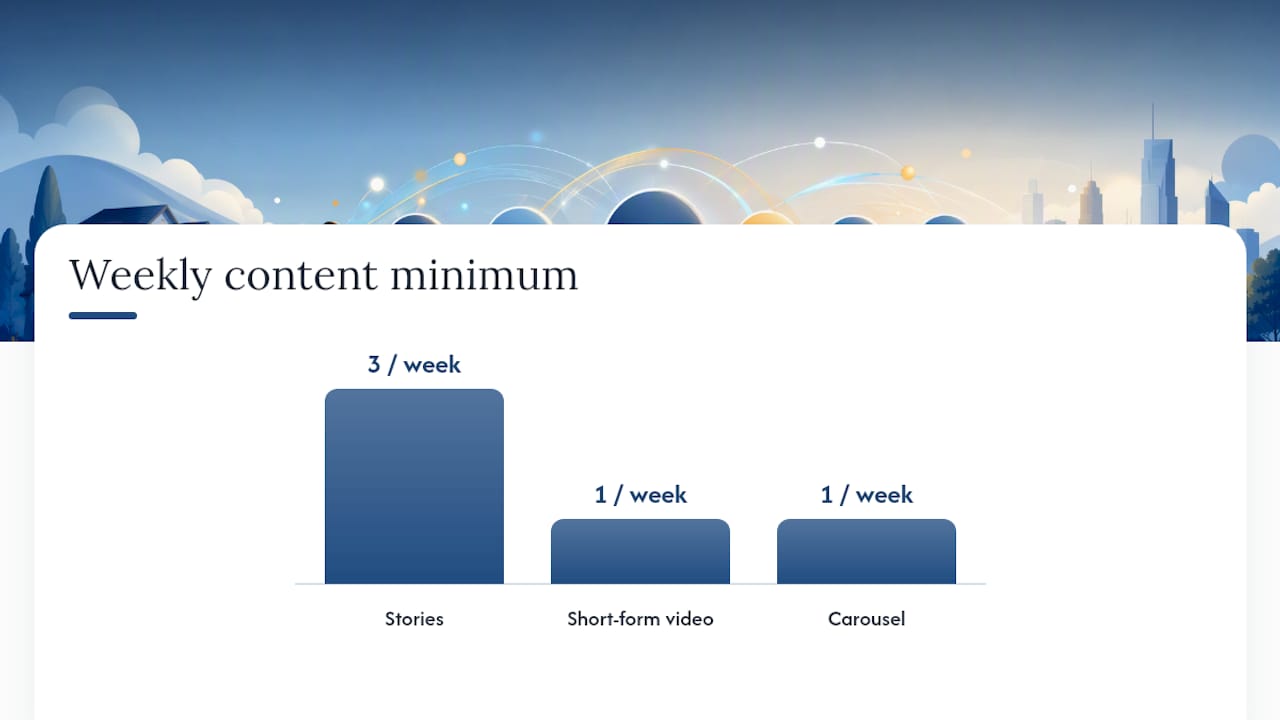
Pro Tip: A sustainable weekly minimum is one short-form video, three Stories, and one carousel. Below that, algorithms deprioritize your account faster than most agents realize.
How Many Times a Week Should Realtors Post on Social Media?
Pick one or two platforms and post there consistently rather than spreading thin across five. Instagram works best for consumer-facing buyer and seller audiences, Facebook still wins for sphere-of-influence and referral relationships, TikTok reaches younger first-time buyers, YouTube suits long-form neighborhood guides, and LinkedIn fits relocation or commercial deals.
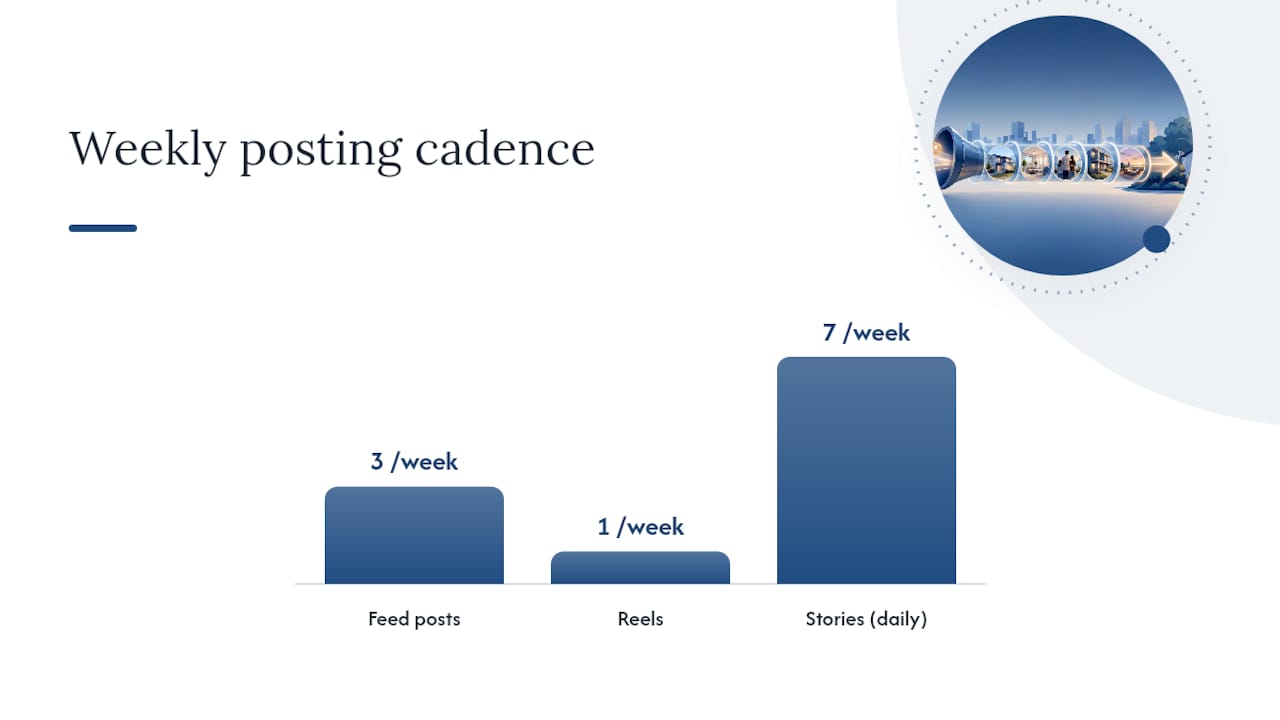
A workable cadence many agents settle into: three feed posts per week, one Reel per week, and a daily Stories baseline for visibility between bigger posts. Platform adoption data from NAR confirms most agents already lean on a small handful of channels rather than spreading across every app.
- Instagram: primary channel, Reels plus feed posts
- Facebook: sphere-of-influence and local groups
- TikTok: younger demographics, casual tone
- LinkedIn: relocation and commercial clients
Adapt each 30-day prompt to its platform’s format, but keep the compliance language and the call to action identical everywhere.
How to Batch, Approve, and Schedule Posts Without Errors
Set aside 90 minutes once a week for batching. Anything less and you’ll be writing captions at 11 p.m. before a showing.
- Draft five to seven captions in one sitting using your pillar rotation as the outline.
- Pull listing photos and videos, checking each one against current MLS status.
- Run every caption through a Fair Housing compliance check, no language implying preference for or against a protected class.
- Route drafts through one approval step, broker or team lead, before scheduling.
- Schedule everything at once, verifying aspect ratios and caption length per platform.
Treating your calendar as an operational system with a real approval step and media validation prevents the worst version of this mistake: a post celebrating a listing that went under contract yesterday.
Pro Tip: Build a reusable template for your most common post types. Reusable frames with disclosures baked in cut approval time roughly in half compared to writing from scratch every time.
Aligning Your Calendar With Market Triggers and Seasonality
A calendar built around holidays instead of buyer behavior rarely produces a real inquiry. Content aligned with rate changes, school calendars, and listing launches performs better because it matches the moment someone is actually deciding to move.
High-impact triggers worth reserving slots for:
- Interest rate announcements and refinance windows, where tracking rate trends helps you post before competitors do
- Local school enrollment deadlines, which drive family relocation timing
- Spring and fall listing surges
- Open house weekends and new listing launches
- Property tax deadlines and refinancing seasons
A curated key-dates calendar with more than 160 entries makes this planning step far faster than building your own list from scratch.
What Metrics Should You Track Every Month?
Likes tell you almost nothing about revenue. Track profile visits, link clicks, DMs or booked consultations, and appointments tagged with campaign UTMs instead.
Run a short monthly review:
- Identify your top three performing posts by saves and DMs, not likes
- Note which pillar generated actual consultation requests
- Kill or revise anything that underperformed for three straight weeks
- Shift next month’s batching time toward whatever pillar converted best
Add a simple CRM field logging which post or campaign sourced each lead. That one habit turns vague “social is working” impressions into a number you can defend.
What Winning Agents Do Differently
Consistency beats sporadic perfection, full stop. An agent who posts four mediocre times a week for three months outperforms one waiting for the perfect Reel that never gets filmed. The minimum viable routine is one weekly batching session and one pillar rotation, nothing more elaborate.
The traps are predictable: posting only listings, skipping the approval step because “it’s just a caption,” and never tracking which post actually sourced a lead. Each one is fixable by week’s end. Pick your two platforms, block 90 minutes this week, and run the 30-day calendar as written before you touch anything more advanced.
— Tyler
How AgentWrite Speeds Up Your Weekly Batching Session
The slowest part of any social calendar isn’t the planning, it’s writing five platform-ready captions from one property without repeating yourself or missing a compliance flag. The tool can generate listing descriptions, social captions, and MLS remarks from a single property input and includes checks for Fair Housing wording concerns before a post goes live.
For teams running the batching workflow above, that means fewer rewrites and a faster path from “listing just went live” to “caption ready for approval.” It fits inside the same weekly batching block, not as an extra step, but as the tool that fills it faster. AgentWrite isn’t required to run a real estate social calendar well, but if writing five variants of the same listing update is what keeps you from batching consistently, it removes that specific bottleneck. Try AgentWrite during your next batching session and see how much of that 90 minutes it gives back.
Sources
- Real estate marketing calendar: how to create an annual revenue-driving plan (including template)
- Real Estate Social Content Calendar: A Practical Framework
- Real Estate Content Calendar: 90-Day Social Media Plan
- 30-Day Real Estate Social Media Content Calendar (2026)
- 2026 Key Dates Calendar: 160+ Essential Dates for Property Marketers
FAQ
What Is the 3-3-3 Rule in Real Estate?
It’s a lead-generation habit some agents use: three social media posts, three new contacts, and three handwritten notes or calls every day to keep pipeline activity consistent.
How Much Does a Real Estate Agent Make on a $300,000 Home Sale?
Commission structures vary widely by market and brokerage split, so there’s no single fixed figure, agents should confirm their exact commission rate and split with their broker before estimating earnings on any sale.
What Are the Important Real Estate Marketing Dates in 2026?
Key planning windows include spring and fall listing surges, back-to-school relocation deadlines, and rate announcement periods; a curated key-dates calendar lists more than 160 specific dates worth building into an annual plan.
What Is the 80/20 Rule for Realtors?
It typically refers to spending roughly 80% of content on value, education, community, lifestyle, and only 20% on direct sales asks, closely mirroring the 4:1 value-to-ask ratio used in the 30-day calendar above.
Can AgentWrite Help Manage My Social Media Content Calendar?
AgentWrite doesn’t schedule or plan your calendar, but it speeds up writing the captions and listing variants your calendar calls for, while flagging Fair Housing compliance concerns along the way.