

Agents' 5 Point Checklist for Bilingual Listing Descriptions
Agents’ 5 Point Checklist for Bilingual Listing Descriptions

If a meaningful share of buyers in your market speaks another language, publish a professionally translated bilingual listing description and put the full translation on your property landing page or the portal’s dedicated language field. The payoff is real: better discoverability, faster buyer trust, and fewer wasted showings. The catch is just as real: sloppy translation and careless wording create Fair Housing exposure fast, so treat translation quality and compliance review as one job, not two.
TL;DR:
- Publishing high-quality, professionally translated bilingual listings boosts discoverability and buyer trust without risking Fair Housing violations.
- Place full translations on your landing page or MLS-specific fields to ensure search engines index them properly and avoid duplicate content issues.
- Use verified property data for all languages, and review translations carefully to prevent errors in key details like square footage, fees, and dates.
- Match the second language to your local buyer demographic and market-specific search behavior, not just national or general language trends.
- Automate initial drafts with tools like AgentWrite, but always perform human review to catch nuances, tone, and compliance issues before publishing.
Table of Contents
- Why Bilingual Listing Descriptions Matter for Discoverability and Trust
- Where Translated Listing Content Should Live
- Translation and Localization Best Practices
- A Bilingual Listing Description Template You Can Reuse
- Fair Housing Guardrails for Bilingual Copy
- Building a Quality Workflow That Catches Errors Before Publication
- Quick Do’s and Don’ts for Bilingual Listing Copy
- Where Automation Fits and Where Human Judgment Still Wins
- How AgentWrite Supports a Compliant Bilingual Workflow
- Sources
- FAQ
Why Bilingual Listing Descriptions Matter for Discoverability and Trust
Buyers gravitate toward listings written in their own language, and that preference shows up in how they search, click, and follow up. Portals index language-specific text separately, so a Spanish-language remark or French listing description in Canada can surface in searches an English-only listing never reaches.
In some markets, bilingual presentation is not optional. Canada’s federal bilingual requirements shape how public-facing content gets presented in English and French, and the Canada Gazette’s regulatory guidance offers a useful precedent for agents working near Quebec or in federally regulated contexts. Outside those zones, bilingual copy is a competitive edge, not a mandate.
Use this quick rule when deciding which second language to add to a listing:
- Check the buyer demographics of your immediate market first, not the region as a whole.
- Match the language to your MLS’s actual traffic data if it reports language-specific views.
- Prioritize the language with the highest concentration of active buyers, not the most commonly spoken language nationally.
- Add a third language only when a specific listing (luxury, new construction, investment property) draws international buyers.
Where Translated Listing Content Should Live
Placement determines whether a translation actually gets found or just sits unread in a field nobody indexes. Follow this order:
- MLS bilingual remarks field. Many MLS systems support a secondary remarks field for supplemental language content; check whether yours accepts full paragraphs or just a short summary.
- Property landing page. This is where the complete, unabridged translation belongs. A dedicated page gives you room for full-length copy in each language without truncation.
- Portal-specific short variants. Sites like Zillow or Realtor.com often limit character counts, so write a condensed version rather than pasting a truncated full translation.
- Social captions. Keep these to 15 to 40 words per language, matched to the platform’s own audience language settings where available.
Avoid publishing near-identical text on multiple indexed URLs. Search engines can treat a mirrored translation as duplicate content if it lives on two crawlable pages with no language tag distinguishing them, so use your CMS’s language attributes or separate URL paths whenever the platform allows it.
Translation and Localization Best Practices
Machine translation gets you a first draft, not a publishable listing. Tools like Google Translate or DeepL handle grammar reasonably well but routinely produce literal phrasing that reads as awkward, or worse, off-putting, to a native speaker. A professional translator or a bilingual agent familiar with your specific market should review every listing before it goes live, especially remarks referencing square footage, HOA fees, or legal disclosures.
Treat each language as its own search environment. A French-language buyer in Montreal and a French-language buyer in Paris do not search the same way, so keyword research per language matters as much as it does in English. Skipping this step means a technically correct translation that never surfaces in the searches your buyers actually run.
Common mistakes to watch for:
- Untranslated abbreviations (HOA, sq ft, MLS#) that mean nothing to a non-English reader.
- Literal translations of idioms that lose their meaning entirely (“move-in ready” translated word for word rarely lands).
- Numeric drift, where the square footage or price in the translated version doesn’t match the English original because of a copy-paste error made before a correction.
Pro Tip: Generate your base listing copy from verified property data first, then produce every language variant from that single source of truth. Editing translations independently, in parallel, is how a $450,000 listing quietly becomes $540,000 in the French version.
A Bilingual Listing Description Template You Can Reuse
A workable structure repeats across strong listings regardless of language: headline, hook, features, close.
- Headline: property type, bedroom count, and one standout feature. (“Renovated 3-Bed Craftsman with Rooftop Deck”)
- Block 1, the hook: two to three sentences leading with the strongest verifiable fact.
- Block 2, features: three to six short lines covering layout, updates, and systems.
- Block 3, neighborhood and close: one to two sentences on location plus a call to action.
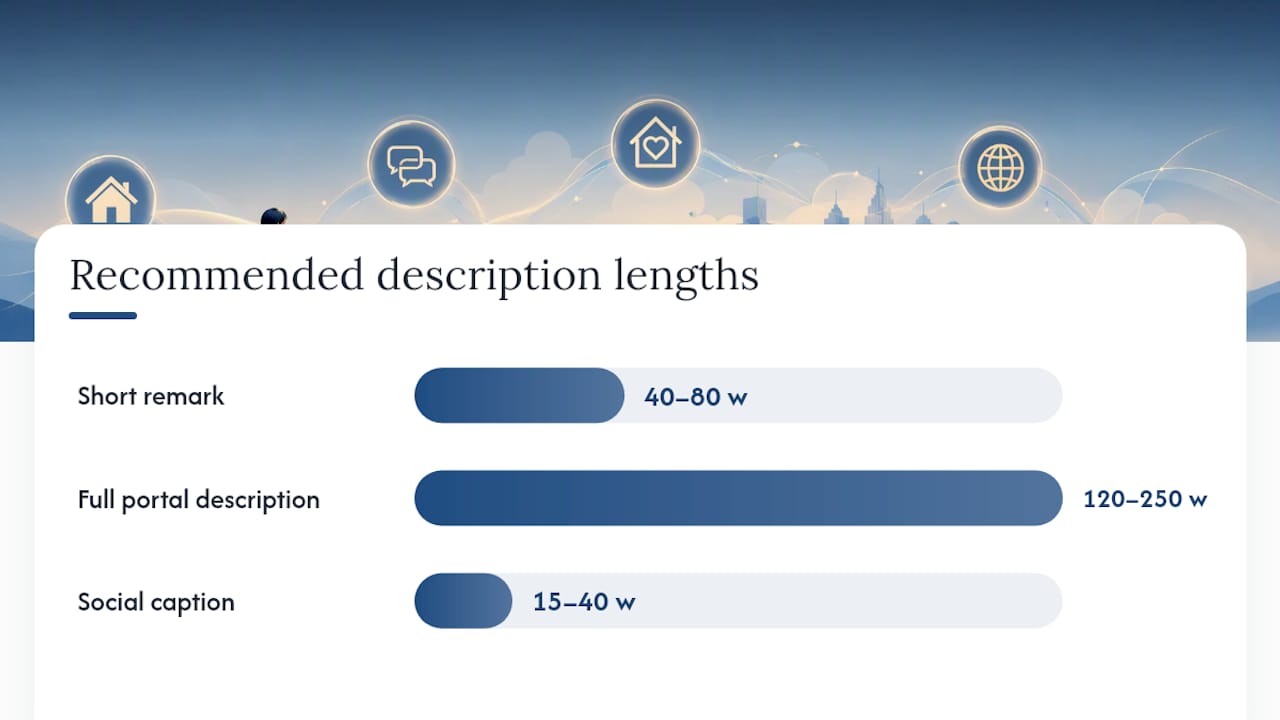
Match length to placement:
- Short remark: 40 to 80 words
- Full portal description: 120 to 250 words
- Landing page: complete translation, no length cap
- Social captions: 15 to 40 words
Here’s the structure applied in miniature, with a common literal-translation trap flagged:
English: “This sun-filled 2-bed condo features an updated kitchen and private balcony, steps from the metro.”
Spanish, done wrong: “Este condominio soleado de 2 habitaciones tiene una cocina actualizada y un balcón privado, pasos del metro.” (The English idiom “steps from” translated literally reads oddly in Spanish.)
Spanish, corrected: “Este luminoso condominio de 2 habitaciones cuenta con cocina renovada y balcón privado, a pocos metros del metro.” Small fix, much better flow for a native reader.
Fair Housing Guardrails for Bilingual Copy
Fair Housing rules vary by jurisdiction, but the underlying principle holds everywhere: describe the property, not the people you imagine living in it. That rule doesn’t relax just because the copy is in a second language. Translated phrasing can accidentally introduce demographic or familial-status language that the English original avoided, so every translated draft needs its own compliance pass, not just a grammar check.
Safer alternatives to common red flags:
- Instead of “perfect for a young family,” write “spacious layout with three bedrooms.”
- Instead of “walking distance to churches,” write “near multiple houses of worship” only if factually neutral, or omit entirely if it risks steering.
- Instead of “quiet, established neighborhood,” write “low-traffic street” or cite a specific, verifiable amenity.
When a translation touches legal or disclosure language, remember that regulatory agreements, like the one facilitating cross-listing between Ontario and French regulators, treat both language versions as equally binding. Real estate listings don’t carry that same legal weight, but the lesson transfers: if you’re not certain a translated phrase is compliant, get a second read from local counsel or a compliance-aware drafting tool before it publishes.
Building a Quality Workflow That Catches Errors Before Publication
A repeatable sequence keeps bilingual listings accurate: collect verified property data, write the base English copy, translate it, run a human fact-check, publish each variant, then watch for buyer questions that reveal gaps.
- Confirm the raw data (square footage, HOA fees, listing dates, parking count, energy label) before writing a single sentence.
- Draft the base copy in English from that verified data.
- Translate, using a professional or a vetted bilingual agent.
- Fact-check every number in the translated version against the original.
- Publish to MLS, landing page, portals, and social in that order.
The numbers most likely to drift between language versions are square footage, HOA or condo fees, closing dates, parking spots, and energy labels. Check all five, every time, in every language.
Tools like AgentWrite build this sequence directly into the drafting process. It generates base copy from structured property data, flags language that could raise Fair Housing concerns, and produces translated drafts sized for human review rather than direct publication.
Pro Tip: Keep a five-item checklist taped next to your monitor: square footage, fees, dates, parking, energy label. A thirty-second glance at that list before you hit publish catches most of the errors that generate frustrated buyer calls later.
Quick Do’s and Don’ts for Bilingual Listing Copy
Don’t translate “as-is” literally into a phrase implying disrepair in the target language when the English meant “sold in current condition.” Do write “sold in its current condition, no repairs included” instead, in every language version.
Don’t mix imperial and metric units inconsistently across variants. Do pick one primary unit per language convention (square feet for English readers, square meters for many French and Spanish audiences) and note the conversion once.
Formatting details that affect readability on portals:
- Use short line breaks between feature blocks rather than one dense paragraph.
- Match date formats to reader expectations (month/day/year for English in the US and Canada, day/month/year in most Spanish and French markets).
- Keep the headline under 10 words in every language so it doesn’t truncate on mobile listing cards.
For agents handling multiple property types across languages, a partner resource like KnowSpan’s property management templates offers additional structural examples worth adapting.
Where Automation Fits and Where Human Judgment Still Wins
A hybrid approach works best: let drafting tools handle the repetitive first pass, but keep a trained human eye on every translated version before it goes live. Automation catches consistency; people catch nuance, tone, and the small phrasing choices that build trust with a buyer reading in their own language.
— Tyler
How AgentWrite Supports a Compliant Bilingual Workflow
This approach offers an alternative to hiring separate translators and compliance reviewers for every listing by allowing entry of property details once to generate base descriptions, MLS remarks, and language variants from that same verified source.
The platform flags wording that could raise Fair Housing concerns before it reaches a portal, and produces translated drafts sized for the human review this article recommends rather than for blind publication. That matters most on the details that tend to drift between language versions: square footage, fees, dates, and parking counts stay consistent because they trace back to one input, not five separate drafts written under deadline pressure. If your market includes non-English-speaking buyers, try AgentWrite on your next listing and see how much of this workflow it handles for you.
Sources
The Canada Gazette’s regulatory guidance covers federal bilingual requirements relevant to agents working in officially bilingual regions. The Canadian Food Inspection Agency’s bilingual labelling guidance offers precedent on legibility and dual-language presentation. The Ontario Securities Commission’s cross-listing agreement illustrates how regulators treat bilingual text as equally binding across jurisdictions.
- Canada Gazette — regulatory guidance (July 2026)
- Ontario Securities Commission — agreement facilitating cross-listing (April 2026)
FAQ
How Do You Write a Strong Listing Description?
Lead with the strongest verifiable fact in the first two sentences, follow with concise, factual features, then close with neighborhood context and a call to action. Keep hyperbole out and let specific details, like updated systems or verified square footage, do the persuading.
Can I Call My Listing Copy “Bilingual” if I Just Speak Multiple Languages?
No. A listing is only bilingual if the actual published copy exists in both languages for buyers to read; your personal fluency doesn’t make the listing itself bilingual unless you’ve written and posted both versions.
What Does a Bilingual Listing Description Actually Look Like?
It pairs a full English description with a complete, professionally translated version, typically with the English on your MLS remarks and portal fields and both languages available in full on your property landing page.
Can You Show an Example of a Rental Listing Description?
A tight rental example: “Bright 1-bed apartment with in-unit laundry, updated kitchen, and private parking, five minutes from downtown. Available June 1. Pets negotiable with deposit.” Translate that same structure, fact for fact, into your second language rather than writing a separate, looser version.
Does AgentWrite Handle Translation as Well as English Copy?
AgentWrite generates base listing copy from your property details and produces translated drafts for human review, built into the same workflow rather than as a separate step.