

The Real Estate Call to Action Formula That Gets Clicks
The Real Estate Call to Action Formula That Gets Clicks

Every high-converting real estate CTA follows one formula: strong verb + immediate outcome + one concrete detail. “See what your home is worth” is weak. “Get your free Elmwood Park home value estimate in 60 seconds” is a call to action real estate agents can actually measure. It names the deliverable, the neighborhood, and the time cost, so the reader knows exactly what happens next.
Here are five you can copy into a listing, email, or ad today:
- “Get your free [neighborhood] home value estimate in 60 seconds.”
- “See inside 142 Maple before it hits the open house Saturday.”
- “Download the 2026 buyer’s guide for [city] first-time buyers.”
- “Text TOUR to book a private showing this week.”
- “Grab your seller prep checklist before you list.”
Pro Tip: Drop your strongest CTA in three places first: the home valuation page, the top third of every email, and directly under the hero photo on listing pages. Those three spots see the highest intent traffic and the fastest testing feedback.
Key Takeaways
A high-converting real estate CTA pairs a strong action verb with a named, specific benefit and one concrete detail, then gets tested one variable at a time.
| Point | Details |
|---|---|
| Use the core formula | Combine an action verb, a named benefit, and one concrete detail in every CTA. |
| Segment by audience | Write separate CTA lines for buyers, sellers, renters, and investors instead of one generic version. |
| Match intensity to readiness | Use soft CTAs for cold traffic, mid CTAs for warm leads, and hard CTAs for high-intent pages. |
| Test one variable at a time | Route both CTA versions to the same landing page and track form starts and completions, not just clicks. |
| Fix the four common errors | Replace vague labels, cut competing CTAs, match ad promises to landing pages, and use honest urgency. |
Table of Contents
- Why Real Estate CTAs Matter More Than You Think
- Best Practices for Writing Real Estate CTAs That Convert
- A Segmented CTA Phrase Library for Every Audience and Channel
- Where to Place CTAs and How to Match Intensity to Readiness
- How to Test Your CTAs Without Guessing
- Common CTA Mistakes That Quietly Kill Conversions
- Scaling Compliant, Benefit-Driven CTAs With AgentWrite
- What Actually Moves the Needle on Real Estate CTAs
- Sources
- FAQ
Why Real Estate CTAs Matter More Than You Think
A CTA is the only sentence in your marketing that asks for something. Everything before it is context; the CTA is the transaction. Vague labels like “Submit” or “Contact Us” fail because they ask for effort without naming a reward, and replacing them with benefit driven language like “Get your free seller prep checklist” consistently increases engagement.
Specificity works because it makes the click feel safer. A reader who sees “Get your free home value estimate” knows exactly what they’re trading their email address for. A reader who sees “Learn More” has to guess, and guessing kills conversions.
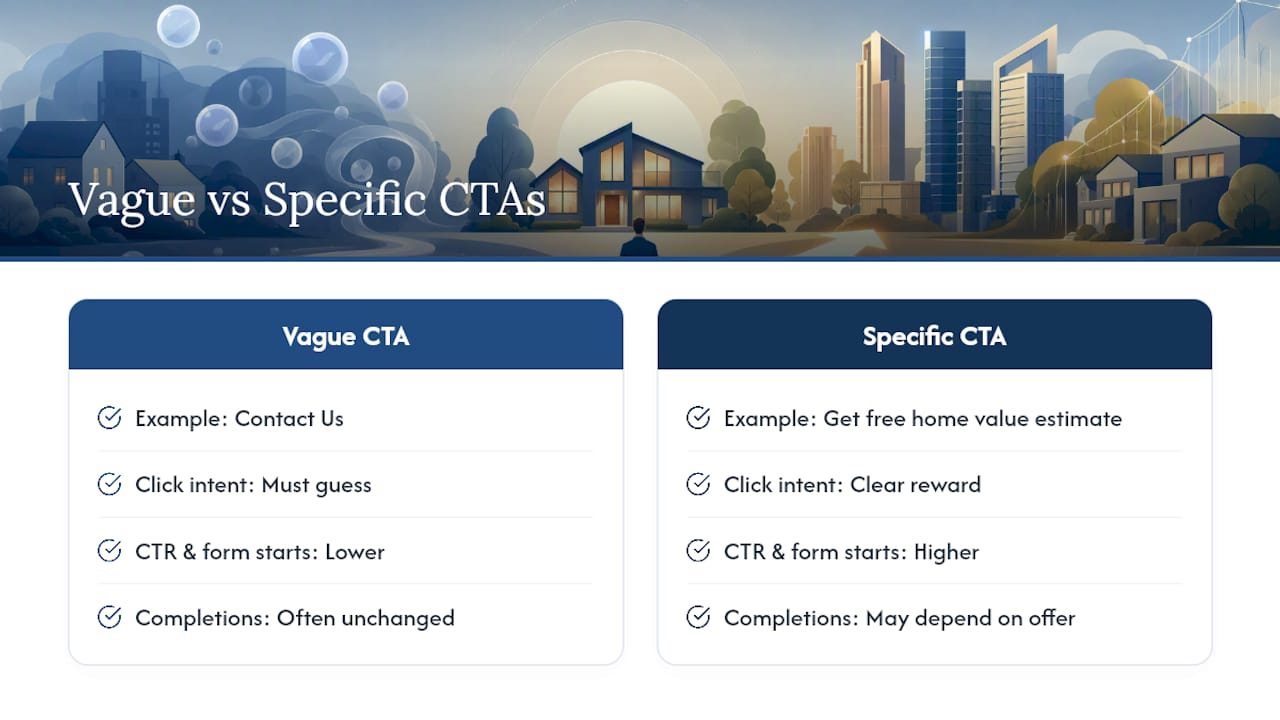
The KPIs that move first when you tighten a CTA are click-through rate and form starts, not completions. Completions lag because they depend on the offer itself, not just the invitation to act. If your CTR jumps but completions stay flat, the problem has shifted from the ask to the landing page.
Best Practices for Writing Real Estate CTAs That Convert
Good CTAs aren’t clever. They’re clear, specific, and matched to what the reader is actually ready to do. Before you publish anything, run it through this quick build order:
- Start with an action verb. “Get,” “See,” “Download,” “Book,” and “Text” outperform passive phrasing like “Click here” every time.
- Name the immediate benefit. The reader should know what they get in the next five seconds, not after they’ve filled out a form.
- Add one concrete detail. A neighborhood name, a price range, a time window, or a specific address makes the offer feel real instead of generic.
- Be honest about urgency. Tie any time pressure to something true, like an open house date or an offer deadline, never a fabricated countdown.
- Match the ask to the reward. Don’t ask for a phone number in exchange for a blog post. Save the phone number ask for something worth that much friction, like a private showing.
A practical CTA framework built around a strong verb, a named value, and a concrete detail tends to outperform generic phrasing across every channel tested, and short CTAs of three to seven words typically win on mobile screens where space is tight.
Before you hit publish, run this checklist:
- Does the CTA use one clear action verb?
- Is the benefit named in plain language, not implied?
- Is there exactly one primary CTA on this screen or email?
- Does the promise match what’s waiting on the other side of the click?
- Can you track this specific CTA separately from any others on the page?
Pro Tip: If you can’t answer “what does the reader get in the next 10 seconds” from the CTA alone, rewrite it. That’s the single fastest fix for most underperforming real estate marketing.
A Segmented CTA Phrase Library for Every Audience and Channel
Different prospects want different things, and the same CTA rarely works across buyers, sellers, renters, and investors. Building a small library by audience saves you from writing generic copy under pressure.
For buyers:
- “See new listings in [neighborhood] before they hit Zillow.”
- “Get pre-approval help from a lender we trust.”
- “Book a private tour of 3 homes this weekend.”
- “Download the first-time buyer’s closing cost breakdown.”
For sellers:
- “Get your free home value estimate in 60 seconds.”
- “See what similar homes on your street sold for.”
- “Grab the seller prep checklist before you list.”
- “Book a 15-minute pricing consultation, no obligation.”
For renters:
- “See available units in [neighborhood] updated daily.”
- “Schedule a same-week apartment tour.”
- “Get notified the moment a unit opens up.”
For investors:
- “Download the cap rate breakdown for this listing.”
- “See off-market deals before they’re public.”
- “Get the rental income projection for this property.”
Button and label copy needs to be even tighter on mobile. Swap long labels for short, benefit-first buttons: “Get My Estimate,” “Book My Tour,” “See the Numbers,” or “Text Me Listings.” Anything over five words on a mobile button gets truncated or ignored.
Channel context changes the ask, too. On postcards and direct mail, you need a bridge from offline to online, like a QR code, a personalized URL, or a “Text HOME to 55555” short code, because there’s no clickable link on paper. On social, keep the commitment small: “Save this post,” “Comment SOLD for details,” or “DM me for the address.” Email can carry a heavier ask because the reader already opted in, so “Book your free consultation” works fine there when it would feel aggressive in a cold ad.
Where to Place CTAs and How to Match Intensity to Readiness
Not every visitor is ready for the same ask. A first-time visitor to your website is not ready to “Book a Listing Consultation.” They might be ready to “See Recent Sales in Your Area.”
Match CTA strength to funnel stage:
- Soft CTA (cold traffic): “See what homes are selling for near you.” Low commitment, informational.
- Mid CTA (warm leads): “Get your free home value estimate.” Requires an email but promises a specific deliverable.
- Hard CTA (ready to act): “Book your listing consultation this week.” Asks for a phone call or a calendar slot.
Placement follows the same logic. Homepage and social ads should carry soft CTAs. Listing pages and valuation pages, where intent is already high, can carry mid or hard CTAs. Email nurture sequences should escalate gradually, moving a reader from soft to hard over several touches. Yard signs and direct mail need a single, prominent CTA because there’s no room for a secondary option.
The operational rule that fixes most cluttered pages: one primary CTA per screen. A valuation page asking visitors to both “Get your estimate” and “Schedule a call” and “Download our buyer guide” splits attention three ways and lowers completions on all three.

How to Test Your CTAs Without Guessing
Testing a CTA doesn’t require expensive software. It requires discipline about changing one thing at a time.
- Pick one variable. Test the CTA copy alone, routed to the identical landing page, so you know any difference in performance came from the words, not the offer.
- Track the full funnel, not just clicks. Operational testing guidance recommends tracking visits, CTA clicks, form starts, completions, and booked conversations, because CTR alone can mislead. A CTA that gets clicked a lot but converts poorly is often over-promising.
- Run it long enough to matter. Give each test at least 30 days or enough traffic to generate a meaningful sample before calling a winner, especially on lower-traffic pages like individual listings.
- Roll out the winner, then test again. Testing isn’t a one-time event. Running one test per month on a high-traffic page like your valuation page keeps improvements compounding.
Statistic Callout: A 5-to-1 value-to-conversion ratio in email nurture sequences is the benchmark top-performing agents use, meaning five pieces of genuinely useful content for every one direct ask. Post-Mail Privacy changes, CTR and direct replies matter more than open rate as a true engagement signal.
Common CTA Mistakes That Quietly Kill Conversions
Most underperforming CTAs share the same handful of problems, and all of them are fixable in minutes.
- Vague labels. “Submit” and “Contact Us” tell the reader nothing about what happens next. Replace them with the specific outcome: “Get my free estimate.”
- Too many choices. A page offering three or four equal CTAs splits attention. Pick one primary action and, if needed, one clearly secondary alternative.
- Promise mismatch. An ad that says “Free home valuation” should not land on a generic contact form. The CTA and the landing page need to promise the exact same thing.
- Fake urgency. “Only 2 spots left!” with no real event behind it erodes trust fast. Tie urgency to something true: an actual open house date, an actual offer deadline.
Scaling Compliant, Benefit-Driven CTAs With AgentWrite
Writing a fresh, benefit-driven CTA for every listing, email, and social post adds up fast when you’re juggling a full pipeline. Agentwrite generates listing descriptions, MLS remarks, social posts, emails, and CTA variants from a single set of property details, so you’re not rewriting the same information five different ways for five different channels.
The platform also flags potential Fair Housing wording concerns automatically, which matters when you’re producing CTA variants quickly and don’t have time to manually review every line for compliance risk. Combining AI-generated drafts with human review is the approach that preserves both personalization and compliance, and Agentwrite is built around exactly that workflow: fast generation, human final edit.
- Generates CTA variants for A/B testing without starting from scratch each time
- Flags Fair Housing language before it goes live
- Produces listing copy, MLS remarks, and social posts from one input
Pro Tip: Use Agentwrite to generate three CTA variants per listing at once, then pick your test pair based on which two feel most different in tone, not just wording.
If you want to see how this works on your own listings, Agentwrite lets you generate compliant CTA variants and full listing copy from a single property input.
What Actually Moves the Needle on Real Estate CTAs
Most advice on real estate CTAs stops at “use a strong verb,” which is true but incomplete. The research here points somewhere more useful: the biggest gains come from matching ask to readiness, not from finding a magically better verb. Agents obsess over whether “Get” beats “Discover” while leaving three competing CTAs on the same valuation page, which does far more damage than word choice ever could.
The conventional wisdom also overrates CTR as a success metric. A flashy CTA that generates clicks but no booked conversations isn’t working, it’s leaking. Track the full funnel or you’re optimizing for the wrong number.
If you take one thing from this, prioritize the preflight checklist over the phrase library. Great copy on a page with two competing CTAs still underperforms mediocre copy on a page with one clear ask.
Sources
- Real Estate CTA Examples for More Clicks
- Real estate marketing ideas (HousingWire)
- Digital marketing for real estate agents: the complete channel playbook for 2026
FAQ
What is the best call to action for real estate?
There’s no single best CTA, but the strongest pattern combines a specific verb, a named benefit, and a concrete detail, like “Get your free [neighborhood] home value estimate in 60 seconds.”
What is a call to action in real estate?
A call to action in real estate is the specific instruction that tells a prospect exactly what to do next, such as booking a showing, downloading a guide, or requesting a home valuation.
What is a good call to action example?
“Grab your seller prep checklist before you list” is a strong example because it names a concrete deliverable, uses an action verb, and implies timing without fake urgency.
How much does a realtor make off of a $300,000 house?
Commission rates vary by market and negotiation, so there’s no fixed national figure, but agents typically earn a percentage of the sale price split between listing and buyer’s agents, then further split with their brokerage.