

Get Sellers Talking Again With Five Expired Listing Emails for Agents
Get Sellers Talking Again With Five Expired Listing Emails for Agents

Send a short, empathetic first email offering a free, no-pressure marketing review, not a hard pitch. Follow it with a structured 4 to 5 touch sequence across email, call, and text over three weeks.
TL;DR:
- Personalization should focus on specific listing details like days on market, price reductions, and recent comparable sales to increase engagement.
- Starting outreach within 24 to 48 hours of expiration improves response rates, especially when using a structured five-touch sequence over three weeks.
- Compliance with CAN-SPAM and Fair Housing laws requires accurate sender information, honest subject lines, low-pressure CTAs, and avoiding language implying protected classes.
- Tailoring your tone between empathetic or data-driven based on how long the property was listed can significantly boost reply and conversion rates.
- Using automation tools that incorporate property data and flag risky language can save time and improve the quality of your personalized outreach.
Table of Contents
- Expired Listing Email Templates You Can Send Today
- What Subject Lines and Opening Lines Actually Get Opened?
- How Do You Personalize an Expired Property Email Without Overdoing It?
- What’s a Realistic Follow-Up Cadence for Expired Listings?
- How Do You Handle Common Expired Listing Objections?
- Legal Considerations and Compliance Guidance for Expired Listing Emails
- What Agents Get Wrong About Expired Listing Outreach
- Send Compliant Expired Listing Emails in Minutes, Not Hours
- Sources
- FAQ
Expired Listing Email Templates You Can Send Today
Five tones cover almost every seller mindset you’ll run into after a listing dies on the MLS. Pick based on how the seller likely feels, not how you feel about the deal.
1. The empathetic first contact
Keep this under 160 words. No pitch, no pressure, just acknowledgment and an easy way to reply.
Subject: Saw your listing on Maple Street didn’t sell
Hi [First Name],
I noticed your home at [Address] came off the market last week. That’s frustrating after putting it out there for [X] days. Sometimes it’s pricing, sometimes it’s marketing, sometimes it’s just bad timing.
I’d like to offer a quick, no-obligation look at what happened. No sales pitch, just an honest read on your local market and what I’d do differently.
Would a 10 minute call this week work, or would you rather I send over a short written breakdown first?
[Your Name]
2. The value-first marketing review
This one leads with a free CMA or marketing snapshot instead of a conversation ask, which lowers the reader’s guard.
Subject: A free look at what happened with [Address]
Hi [First Name],
I put together a quick marketing review for [Address] based on public listing data. It covers your pricing against recent comparable sales and a look at how the listing was presented online.
No strings attached. Reply and I’ll send it over today.
[Your Name]
3. The pricing-focused consult
Sellers who watched their home sit for months are usually wrestling with the pricing question even if they won’t say it outright. This template goes there directly but stays tactful.
Subject: Quick question about [Address]'s pricing
Hi [First Name],
Homes in [Neighborhood] have been selling in an average of [X] days recently, and yours was on the market for [Y]. That gap usually points to pricing, condition, or exposure, sometimes all three.
I’d like to walk you through the comparable sales I’m seeing and get your read on what you think happened. Fifteen minutes, your schedule.
[Your Name]
4. The re-launch plan
For sellers ready to try again, skip past to a concrete plan. This one works best as touch two or three, not the opener.
Subject: A 3-step plan to relist [Address]
Hi [First Name],
If you’re open to trying again, here’s what I’d change: reprice based on the last 60 days of comparable sales, refresh the listing photos and description, and launch with a targeted push to buyers who already viewed similar homes nearby.
I can walk you through the details whenever works. No pressure either way.
[Your Name]
5. The brief follow-up after silence
Short and low-friction. Give two easy outs instead of asking for a commitment.
Subject: Still thinking about [Address]?
Hi [First Name],
Just checking in. Would it help if I sent over a quick market update, or would you rather I just check back in a few weeks?
Either is fine, just let me know.
[Your Name]
These five tones map closely to the template mix MailMaestro recommends for expired-listing outreach: warm intro, value offer, empathetic approach, and analytical follow-up. What matters more than which template you start with is customizing the specifics for your market before you hit send.
What Subject Lines and Opening Lines Actually Get Opened?
The subject line and the first ten words of your preview text decide whether the rest of your email ever gets read. Group your subject lines by tone and rotate them based on how the seller likely feels about their failed listing.
Empathetic:
- “Saw your listing came off the market”
- “Sorry to see [Address] didn’t sell”
- “Thinking of you after your listing expired”
Analytical:
- “3 reasons homes don’t sell in [Neighborhood]”
- “A quick data check on [Address]”
- “How your listing compares to recent sales”
Urgent (use sparingly):
- “Before you decide what’s next for [Address]”
- “A window that’s closing for [Neighborhood] sellers”
Local-stat driven:
- “[Neighborhood] homes are selling in [X] days right now”
- “What buyers are paying in [Neighborhood] this month”
- “A shift in [Neighborhood] pricing you should see”
- “Comparable homes near you just closed”
Your preview text (the snippet visible before someone opens the email) should extend the subject line’s promise, not repeat it. If your subject line raises a question, your preview text should hint at the answer without giving it away entirely.
Run two subject lines against the same email body and same send time, then compare open rates after a batch of at least 20 to 30 sends. A lift of even 5 to 10 percentage points on open rate is worth locking in as your default.
Pro Tip: Test the analytical subject lines against homes that sat 90+ days, and the empathetic ones against homes that expired quickly. Sellers whose homes lingered respond better to data; sellers surprised by a fast expiration respond better to warmth.
How Do You Personalize an Expired Property Email Without Overdoing It?
Generic mail merges get ignored. Overly detailed emails feel invasive. The sweet spot references a handful of specific, publicly verifiable facts that prove you actually looked at the listing.
Eight data points are safe and effective to reference:
- The property address and neighborhood name
- Days on market (DOM) before expiration
- The original list price and any price changes
- One or two recent comparable sales nearby
- General showing feedback trends if publicly referenced (busy season, low showing volume)
- Notable listing photo or description issues (vague wording, missing photos)
- The listing agent’s brokerage, if relevant to a re-launch pitch
- Local market shifts (inventory, days-to-sell trend) since the listing expired
NAR’s 2024 Profile of Home Buyers and Sellers found that 81% of sellers contacted only one agent before choosing who to work with. That means the first agent to show up with something specific and useful usually wins the conversation, not the one who sends the most follow-ups.
Fair Housing compliance matters just as much as personalization. Avoid any language that references family status, religion, national origin, or characteristics of the buyer pool you’d market to (“perfect for a young family,” “great school district for your kids”). Stick to property facts and market data. Tools like AgentWrite flag risky phrasing automatically before an email goes out, which matters most when you’re personalizing dozens of emails a week and can’t manually audit every line.
Three snippets you can drop straight into any template:
- “Homes within a half mile of [Address] have sold in an average of [X] days over the past 60 days.”
- “Your listing was priced at [$X], about [Y]% above the median for comparable homes in [Neighborhood].”
- “I noticed the listing photos didn’t include the [feature], which buyers in this price range typically expect to see up front.”
What’s a Realistic Follow-Up Cadence for Expired Listings?
EstatePass and other practitioner resources point to a simple rule: contact expired listings within 24 to 48 hours of expiration. Sellers who haven’t heard from anyone yet are far more receptive than sellers who’ve already fielded five other agents’ letters.
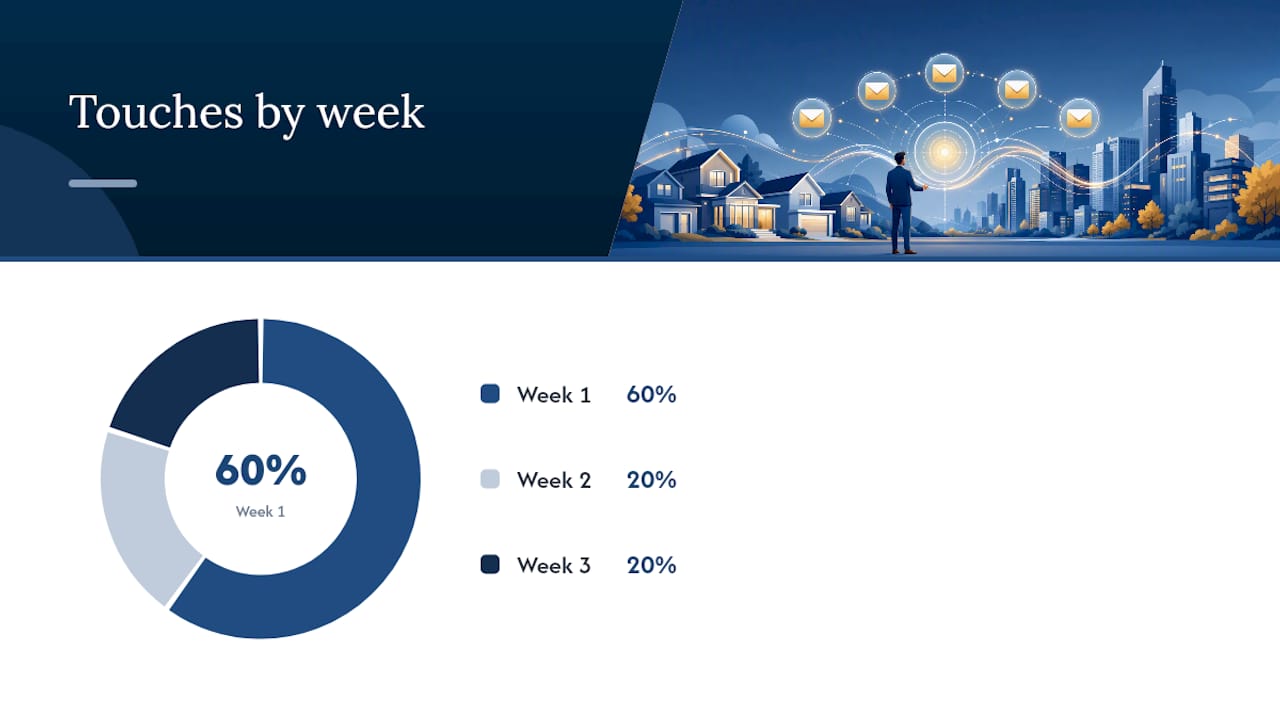
A five-touch sequence spread over three weeks balances persistence with restraint:
- Day 1, email: Empathetic first contact, no pitch, offer a free marketing review.
- Day 3, email: Short follow-up with one local market stat, no repeat pitch.
- Day 7, phone call or voicemail, followed by email: If you reach them, keep it conversational. If not, leave a short voicemail and send a follow-up email referencing the call attempt.
- Day 14, email: Share a market update or a brief success story from a similar relisted home nearby.
- Day 21, email: A final, low-pressure check-in offering an easy opt-out.
Add SMS starting around day 7 or day 14, but only if you already have a working relationship or the homeowner has replied at least once. SMS copy should be shorter than email, closer to “Hi [First Name], following up on the market update I sent, any questions?” than a full pitch. Never cold-text a homeowner you haven’t emailed or called first.
Track reply rate and conversion to listing appointment as your two core success metrics, not just opens. A sequence with strong opens but no replies usually means your CTA is too vague; a sequence with strong replies but few appointments usually means your ask isn’t concrete enough. Log which touch generated the reply so you know which message in the sequence is actually doing the work.
How Do You Handle Common Expired Listing Objections?
Sellers who’ve already been burned once tend to push back in predictable ways. Short, specific responses work better than long persuasive paragraphs.
- “You’re all going to tell me the same thing about price.” Acknowledge it directly, then offer something concrete: “Fair. Instead of telling you, let me show you three comparable homes that sold and what made the difference.”
- “I wasn’t happy with my last agent.” Ask what specifically went wrong before pitching anything: “That’s useful to know. What would you want handled differently this time?”
- “I’m just going to wait a while.” Respect it, but leave a door open: “Totally reasonable. Mind if I check back in a couple months with an updated market snapshot?”
- “How did you get my information?” Be transparent: “Your listing became public record when it hit the MLS, that’s how most agents reach out. Happy to remove you from any follow-up if you’d prefer.”
- “I already relisted with someone else.” Congratulate them and step back: “Good to hear, wishing you a smooth sale. I’ll leave it there unless things change.”
- “We’re not selling anymore.” Confirm and disengage: “Got it, thanks for letting me know. I’ll take you off my list.”
Cap outreach at two or three attempts across email and call within the first month unless the seller engages. Beyond that, continued contact starts working against you, both in terms of goodwill and compliance risk.
Legal Considerations and Compliance Guidance for Expired Listing Emails
Expired listing emails are commercial messages, which puts them squarely under the CAN-SPAM Act’s requirements. Every email needs your real physical business address, an accurate “from” line that identifies who’s sending it, and a subject line that doesn’t misrepresent the email’s content. “Sorry your listing expired” is fine; “Urgent: response required” when there’s no actual urgency crosses into deceptive territory.
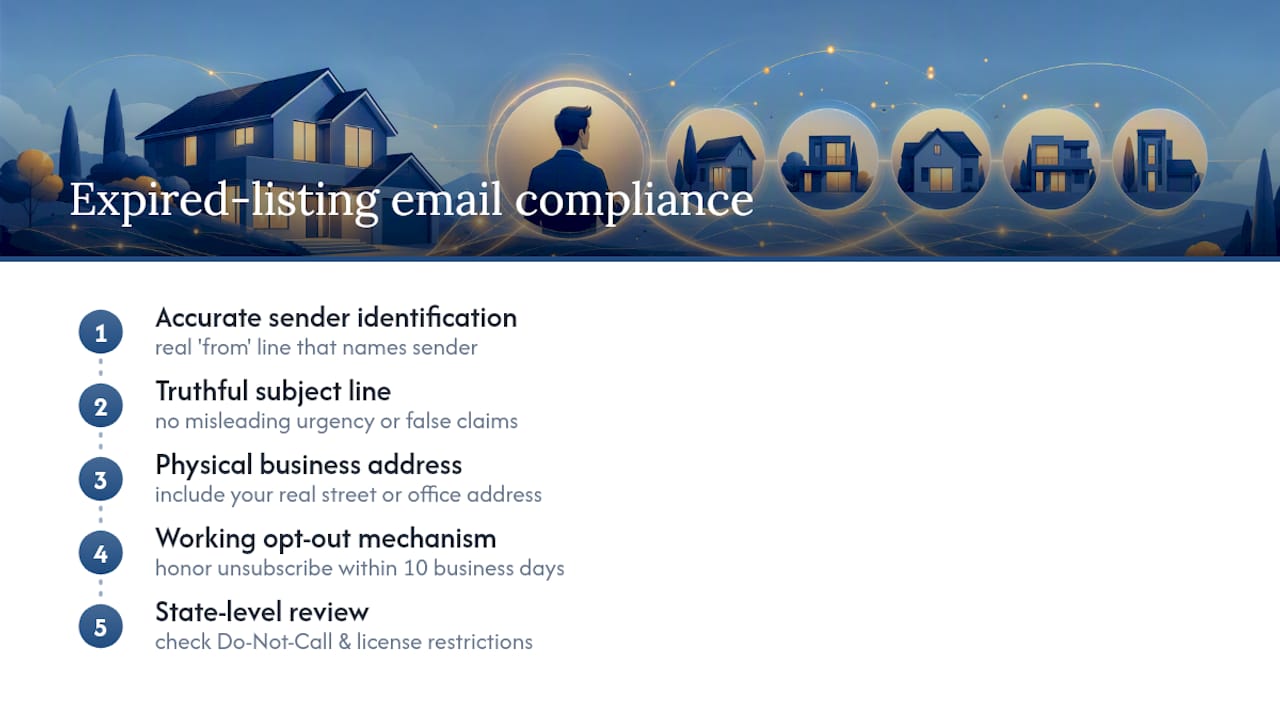
You also need a working, honored opt-out mechanism. If a homeowner replies “please stop emailing me” or clicks an unsubscribe link, you have 10 business days under CAN-SPAM to stop, and continuing to send after that window creates real legal exposure, not just an annoyed prospect.
State-level rules add another layer. Some states restrict telemarketing calls to expired-listing homeowners who are on the National Do Not Call Registry, so before you dial, check whether the homeowner’s number is registered and whether your state license board has additional restrictions on direct-mail or cold-call prospecting timelines after a listing expires.
Fair Housing compliance runs through every email, not just the personalization step. Avoid any language, even indirectly, that references protected classes when describing the property, the neighborhood, or the ideal buyer. Keep your CTAs low-pressure and your data claims accurate, since misleading claims about market conditions or comparable sales can create liability beyond just annoying a homeowner.
What Agents Get Wrong About Expired Listing Outreach
Most advice on expired listings treats every homeowner as equally motivated, which is the biggest strategic mistake I see agents make. A seller whose home expired after 12 days because of a scheduling conflict is in a completely different headspace than one whose home sat for 140 days and had three price cuts. Sending the same five-email sequence to both is why so many campaigns get mediocre reply rates instead of strong ones.
The agents who actually convert expired leads treat personalization and speed as inseparable, not as a trade-off. Automation isn’t the enemy of a personal-feeling email, sloppy automation is. A tool that pulls in DOM, comps, and listing history automatically frees up the ten minutes you’d otherwise spend digging through the MLS, and lets you spend that time on the one sentence that actually shows you looked closely.
Where I’d push back on conventional wisdom: don’t outsource your judgment on tone. Automation should draft the data-backed skeleton of the email. You still need to read it before it goes out and decide whether this particular seller needs warmth or numbers first.
— Tyler
Send Compliant Expired Listing Emails in Minutes, Not Hours
Writing five personalized touches for every expired listing on your list adds up fast, especially when you’re also flagging Fair Housing risks by hand and double-checking comps for accuracy. Agentwrite closes that gap: enter the property details once, and it generates listing-aware emails, subject lines, and full follow-up sequences in your own voice, while flagging language that could create Fair Housing exposure before you hit send.
Import your MLS data or paste in the property details, and Agentwrite drafts the empathetic first email, the marketing-review offer, and the follow-up touches in one pass, consistent in tone across every seller you’re reaching out to. That consistency matters when you’re running dozens of expired leads at once and can’t personalize every line manually. Start with a free trial at Agentwrite and generate your first five-email sequence for an actual expired listing on your list today.
Sources
- 5 Convenient Expired Listing Email Templates & Examples | MailMaestro
- Free Expired Listing Scripts 2026 | EstatePass
FAQ
What Should You Say to an Expired Listing?
Acknowledge that the listing didn’t sell without blame, offer something concrete and free like a marketing review or updated CMA, and ask a low-pressure question that invites a reply instead of pushing for a commitment.
What Does It Mean When a Listing Says Expired?
It means the listing agreement between the seller and their agent ran out before the home sold, and the property is no longer actively marketed on the MLS, though the seller may relist with the same agent, a new agent, or not at all.
Can Realtors Call Expired Listings?
Yes, real estate agents can call expired-listing homeowners, but they must honor the National Do Not Call Registry and any applicable state telemarketing restrictions before dialing.
Are Expired Listings Good Leads?
Expired listings are generally strong leads because the homeowner has already shown clear intent to sell and simply needs a better pricing, marketing, or presentation strategy; contacting them within 24 to 48 hours of expiration, as recommended by practitioner guides, improves your odds before other agents reach out.