

Avoid Fair Housing Risk: MLS Safe Floor Plan Descriptions for Agents
Avoid Fair Housing Risk: MLS Safe Floor Plan Descriptions for Agents

A floor plan description is the written narrative in your listing copy that explains how a home’s rooms connect and flow, not a technical drawing but the story you tell about the layout. The single best practice: write a buyer-focused walkthrough that highlights usable space and facts photos can’t capture. Keep the MLS version between 150 and 250 words, then expand for portals and brochures.
TL;DR:
- Detailed facts such as renovation years, appliance brands, and mechanical ages improve credibility and should be verified against documentation before listing.
- The ideal MLS description is between 150 and 250 words, focusing on clear layout facts and features, with longer versions reserved for websites and brochures.
- Descriptions must avoid buyer-profile language and instead highlight physical features like layout, storage, and updates to prevent fair housing violations.
- Use a structured format starting with a hook, followed by a walkthrough, feature highlights, and a low-friction call to action to streamline drafting.
- Writing the MLS version first helps eliminate filler and makes expanding for other platforms more efficient and consistent.
Table of Contents
- What Facts Do You Need Before Writing a Floor Plan Description?
- What’s the Right Order for Writing a Listing Description?
- How Do You Avoid Fair Housing Issues in Layout Descriptions?
- How Long Should a Floor Plan Description Be?
- Templates You Can Adapt for Any Property Type
- Final QA Checklist Before You Publish
- What Agents Get Wrong About Floor Plan Descriptions
- Draft Faster With AgentWrite’s Compliance-Aware Copy
- Sources
- FAQ
What Facts Do You Need Before Writing a Floor Plan Description?
Good copy starts with a checklist, not a blank page. Before you write a word, gather the layout details and supporting facts that make your description both persuasive and defensible if a buyer or broker questions it later.
Start with the core layout facts: bed and bath counts, how the main level flows, and any special rooms worth calling out. Note room relationships specifically. “Open kitchen to living room” tells a buyer something a bedroom count never will, and it’s the kind of detail that converts browsers into showing requests.
Then move to the details a photo simply can’t convey:
- Renovation years and scope (kitchen remodel 2023, roof replaced 2021)
- Appliance and fixture brands, when they add credibility (quartz counters, a specific cabinetry line)
- The practical utility of odd or small spaces, like a loft nook that works as a home office
- Storage solutions, parking counts, and access points buyers ask about on every showing
- Notable mechanicals, especially anything recently updated or under warranty
Before you publish, verify four things: the source of your square footage figure, permit or renovation dates against actual documentation, HOA or fee numbers against the management company’s current statement, and parking counts against the deed or listing sheet. A wrong number here isn’t just embarrassing. It’s the kind of error that gets flagged in a buyer’s agent’s due diligence and makes your entire listing look less trustworthy.
What’s the Right Order for Writing a Listing Description?
Every strong listing description follows roughly the same sequence, and once you internalize it, drafting gets faster every time.
- Hook. One or two sentences naming the property type, the standout feature, and a location cue. Card previews on portals cut off after the first line, so front-load the best detail instead of building up to it.
- Walkthrough. Move the reader through the home the way a buyer would experience it in person: entry, great room, kitchen, primary suite, secondary bedrooms, then outdoor space. This mirrors how virtual tours sequence a home and helps out-of-town buyers actually picture the flow.
- Feature block. Group major updates first, then operational or utility details (HVAC age, water heater, storage), then outdoor and parking facts.
- CTA. A neutral, low-friction line. “Schedule your private tour today” works everywhere; anything cuter risks sounding gimmicky in an MLS field that strips formatting.
Pro Tip: Draft the walkthrough section first, then write the hook last. It’s easier to pull the single best line from a full room-by-room draft than to invent a catchy opener before you know what the home actually offers.
How Do You Avoid Fair Housing Issues in Layout Descriptions?
The riskiest habit in listing copy is describing who a home is “ideal” for. Phrases like “perfect for a young family” or “great for retirees” describe a buyer’s characteristics rather than the property, and that’s exactly what Fair Housing guidance warns against. The fix is simple: describe the feature, not the person. A single-level layout is a feature. “Perfect for empty nesters” is a buyer profile, and buyer profiles are where agents get into trouble.
Here’s the swap in practice:
- Instead of “ideal for a growing family,” write “four bedrooms with a flexible bonus room.”
- Instead of “perfect for retirees,” write “single-level layout with no interior stairs.”
- Instead of “great starter home for young couples,” write “efficient two-bedroom layout with low-maintenance finishes.”
- Instead of “walkable neighborhood great for families with kids,” write “sidewalks connect to the park two blocks north.”
Short, verifiable bullets anchored to years, brands, and dimensions build more trust than a string of adjectives anyway, so this rewrite habit improves your copy on two fronts at once. Before publishing, run a quick pass specifically for banned-words and strip any adjective describing a type of buyer rather than a physical attribute of the home.
How Long Should a Floor Plan Description Be?
Write the MLS version first, then adapt. MLS fields typically cap or truncate public remarks, and buyers scan rather than read, so 150 to 250 words is the working standard. Personal websites and printed brochures give you more room to breathe.
| Platform type | Target length | Formatting notes |
|---|---|---|
| MLS public remarks | 150–250 words | Many boards truncate or strip HTML; avoid special characters |
| Portal listing pages | 200–350 words | Card previews cut off after roughly the first sentence |
| Agent website / brochure | 350–500 words | Room for full room-by-room detail and lifestyle language |
Skip ALL CAPS entirely. It reads as shouting on screen and some MLS systems flag it during compliance review. Keep every factual claim verifiable, and make sure your description matches the hero photo and the actual floor plan buyers see, since a mismatch between what you wrote and what they see undermines the whole listing.
Templates You Can Adapt for Any Property Type
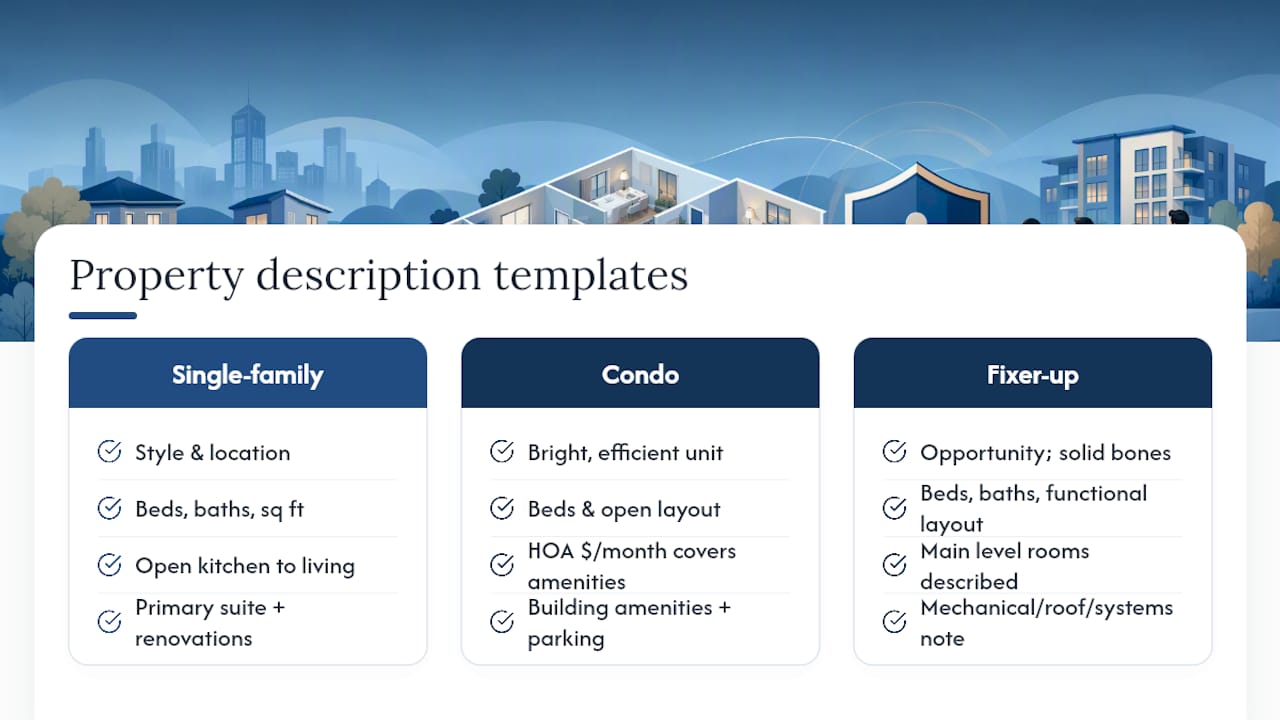
Templates save time, but only if you actually swap in verified specifics before hitting publish. Each of these follows the hook, walkthrough, feature, CTA shape and lands inside the MLS-safe range.
Single-family home: “This [style] home on [street/area] offers [#] bedrooms and [#] baths across [approx. sq ft] of living space. The open kitchen flows into a [dining/living] area with [notable feature]. The primary suite includes [feature], and [renovation year] updates include [scope]. Outside, enjoy [yard/patio feature] and a [#]-car garage. Minutes from [location cue]. Schedule your tour today.”
Condo: “Bright and efficient, this [#]-bedroom condo at [building/area] features an open layout connecting the kitchen and living space. [HOA amount]/month covers [amenities]. Building amenities include [feature], and this unit includes [parking detail]. Close to [location cue]. Contact us to view this home.”
Fixer-upper: “Opportunity awaits at this [style] home offering [#] bedrooms and [#] baths with solid bones and a functional layout. The main level includes [rooms], with [feature] ready for your vision. [Mechanical/roof/systems note if relevant]. Priced to reflect the work ahead. Reach out to schedule a walkthrough.”
Two edits make any template property-specific: swap every bracketed placeholder for a verified number or fact, then confirm the description matches what’s actually in the photos and floor plan before it goes live.
Final QA Checklist Before You Publish
Run this sequence every time, even on listings you’ve written a hundred times before.
- Verify every number, date, and brand name against source documents: permits, invoices, inspection reports, and the HOA statement.
- Confirm the description aligns with your photos and the listing’s floor plan. Nothing erodes buyer trust faster than copy that describes a room the photos don’t show.
- Run a Fair Housing wording check and strip any leftover buyer-profile language.
- Check platform character limits and confirm the CTA and contact fields actually work on mobile.
Pro Tip: Keep a saved copy of your MLS version before you expand it for portals. When something changes (a price drop, a repair, a fee update) you’ll need to edit both, and starting from the shorter version keeps the expanded copy consistent.
What Agents Get Wrong About Floor Plan Descriptions
The most common mistake isn’t bad grammar. It’s vague adjectives standing in for facts. “Spacious,” “charming,” and “must-see” tell a buyer nothing they can verify, while “kitchen renovated 2023 with quartz counters” tells them something they’ll remember at the showing.
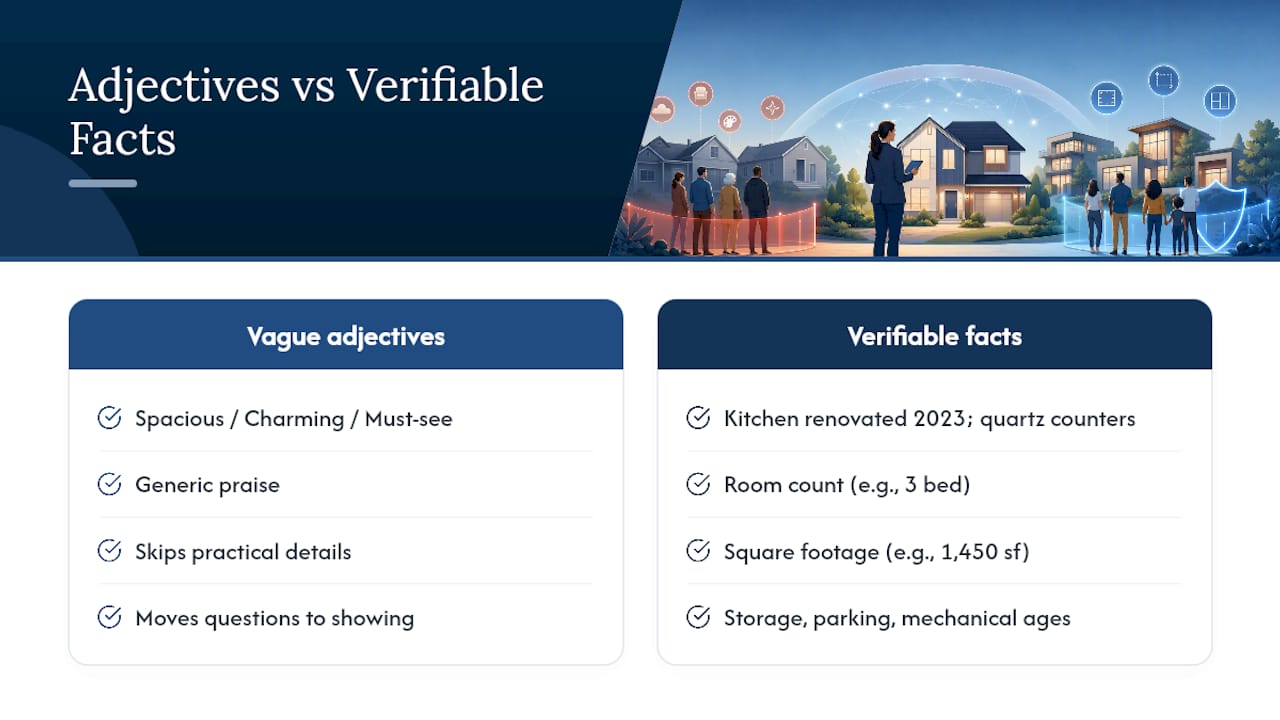
The second mistake is skipping practical details because they seem boring. Storage utility, parking access, and mechanical ages aren’t glamorous, but they answer the questions buyers actually ask an agent, and leaving them out just moves that conversation to the showing instead of the listing.
My recommendation: write the MLS version first, every time, even when you plan to expand for a portal or brochure. Forcing yourself into that 150 to 250 word constraint early strips out filler before it has a chance to creep in, and expanding a tight draft is always easier than cutting down a bloated one.
— Tyler
Draft Faster With AgentWrite’s Compliance-Aware Copy
Writing a clean, buyer-focused walkthrough for every new listing takes real time, especially when you’re juggling MLS remarks, a portal blurb, and a social caption for the same property. The platform generates all three from a single property input, avoiding the need to retype the same details multiple times.
It also provides a feature to flag potential Fair Housing wording before publishing, helping to catch buyer-profile language. For agents managing volume, that combination of speed and a built-in compliance check matters more than any single template. Start a trial at AgentWrite and generate your next MLS description in minutes instead of an hour.
Sources
This article draws on listing-structure and compliance guidance from Opendoor, conversion-focused writing advice from Zillow and Redfin, and practical example frameworks from HousingWire and Listingai. For further reading on incorporating property features into listing copy, see Prop Report’s articles.
- How to write a listing description — Opendoor
- Listing descriptions that sell — Zillow
- Virtual home tours — Redfin
FAQ
How Long Should a Floor Plan Description Be for MLS?
Aim for 150 to 250 words in MLS public remarks, since most boards truncate longer text and buyers scan rather than read in full.
Can I Describe a Home as Perfect for a Certain Buyer?
No. Describe physical features instead, like “single-level layout” or “four bedrooms,” and let buyers determine fit on their own rather than naming a buyer type.
What Details Should I Include That Photos Can’t Show?
Renovation years and scope, appliance or fixture brands, mechanical ages, storage utility, and parking access all belong in the text because a camera can’t capture them.
Should I Write the MLS Version or the Website Version First?
Write the MLS version first. The 150 to 250 word constraint forces you to cut filler, and it’s easier to expand a tight draft for a website or brochure than to trim a long one down.
Can AgentWrite Help Me Write Compliant Floor Plan Descriptions?
Yes. AgentWrite generates MLS remarks and portal copy from one property input and flags potential Fair Housing wording before you publish.