

Copy Paste FSBO Email Scripts for Agents: Get Replies in 3–5 Touches
Copy Paste FSBO Email Scripts for Agents: Get Replies in 3–5 Touches

The best-performing approach is a short, respectful email that leads with one useful piece of value, like a market snapshot or a comparable sale, followed by a 3 to 5 touch sequence spaced over two weeks. Below you’ll find copy-ready scripts for that initial email and every follow-up, subject lines built for opens, personalization rules that don’t eat your afternoon, and objection replies for the seller who pushes back.
TL;DR:
- Personalized, permission-based outreach with a useful first touch such as a market snapshot significantly increases response rates compared to generic pitches.
- A consistent follow-up sequence spaced over two weeks, delivering distinct value at each step, outperforms single or repetitive messages in converting FSBO leads.
- Simple, specific subject lines referencing local data, small curiosities, or low-pressure offers yield higher open rates among FSBO sellers.
- Automation tools like AI-assisted platforms can streamline personalized messaging and scale outreach efforts across multiple leads efficiently.
- Emphasizing specificity in emails, such as mentioning actual addresses or recent comps, combined with modest personalization, improves seller engagement.
Table of Contents
- The Best FSBO Email Script for Initial Outreach and Follow-Ups
- Which Subject Lines Actually Get FSBO Emails Opened?
- How Much Should You Personalize Each FSBO Email?
- What’s the Right Follow-Up Cadence for FSBO Sellers?
- How Do You Respond to Common FSBO Objections by Email?
- What Compliance Details Belong in Every FSBO Email?
- Scaling FSBO Outreach With an AI-Assisted Workflow
- What I’ve Learned Watching FSBO Scripts Actually Work
- Try AgentWrite for Faster, Compliant FSBO Outreach
- Where This Guide’s Best Practices Come From
- Sources
- FAQ
The Best FSBO Email Script for Initial Outreach and Follow-Ups
Cold outreach to a FSBO seller fails for one of two reasons: it sounds like a form letter, or it asks for the listing before it’s earned anything. HousingWire’s research into agent scripts backs a simpler structure: identify yourself, ask permission, then offer something useful instead of pitching your services first. The seven templates below follow that shape, with a distinct value item at each touch so you’re never sending the same email twice.
1. Initial outreach (Day 0) Subject line: “Quick question about [street name]” Purpose: Open the door with permission, not a pitch. Personalization tokens: {seller_first_name}, {street_name}, {neighborhood}
Hi {seller_first_name}, I noticed your home on {street_name} is listed for sale. I work with buyers and sellers in {neighborhood} and pulled together a quick look at what similar homes nearby have sold for recently. Would it be helpful if I sent that over, no strings attached?
2. Follow-up 1: market snapshot (Day 2) Subject line: “Here’s what {neighborhood} homes are actually selling for” Purpose: Deliver on the promise from touch one, building trust before asking for anything. Tokens: {seller_first_name}, {comp_address}, {comp_price}, {days_on_market}
{seller_first_name}, as promised, here’s a quick snapshot: {comp_address} sold for {comp_price} after {days_on_market} days on market. Happy to walk through how your home compares if that’s useful.
3. Follow-up 2: net sheet offer (Day 4) Subject line: “What you’d actually walk away with” Purpose: Address the pricing/negotiation blind spot most FSBO sellers underestimate. Tokens: {seller_first_name}, {estimated_price}
A lot of FSBO sellers price based on what they want, not what buyers will actually offer after inspection negotiations and closing costs. If it helps, I can put together a simple net sheet showing what a sale at {estimated_price} would look like after typical costs. No obligation either way.
4. Follow-up 3: buyer interest / showing logistics (Day 7) Subject line: “One thing buyers keep asking about” Purpose: Surface a practical pain point (showings, buyer qualification) that agents solve well. Tokens: {seller_first_name}, {street_name}
{seller_first_name}, one pattern I see with FSBO listings on streets like yours: buyers hesitate to schedule showings without knowing they’re pre-qualified first. If you’re fielding a lot of unqualified lookers at {street_name}, I have a quick screening approach that might save you some weekends.
5. Follow-up 4: market update / soft consult ask (Day 14) Subject line: “Update on {neighborhood} plus a quick offer” Purpose: Close the sequence with a low-pressure invitation to talk, not a listing pitch. Tokens: {seller_first_name}, {neighborhood}, {days_on_market}
Wanted to pass along one more update: inventory in {neighborhood} has shifted since we last talked. If you’re still weighing your options after {days_on_market} days on the market, I’m happy to grab 15 minutes, by phone or in person, whichever’s easier.
6. Break-glass script (urgency or price resistance) Subject line: “If timing matters, this might help” Purpose: For sellers who’ve signaled they need to move fast or have already dropped their price once. Tokens: {seller_first_name}, {price_drop_amount} (if known)
{seller_first_name}, I noticed the listing price adjusted recently. That usually means either the market’s telling you something or timing has gotten tighter. Either way, I have a short checklist that’s helped other owners in similar spots get a sale moving without dropping price again. Want me to send it over?
The ListingLeads FSBO script pack recommends treating every one of these touches as a chance to educate rather than sell, and that discipline is what keeps sellers reading instead of unsubscribing.
Which Subject Lines Actually Get FSBO Emails Opened?
FSBO sellers get pitched constantly, so subject lines that scream “I want your listing” get deleted on sight. The lines that survive borrow from four formulas: hyperlocal specificity, a data hook, a low-pressure offer, or a small curiosity gap that doesn’t oversell.
Neighborhood/data formula:
- “What homes on {street} sold for last month”
- “{neighborhood} market update, 2 minutes”
- “3 comps near {street_name} you might not have seen”
- “Quick data point on {neighborhood} pricing”
Low-pressure offer formula:
- “A free net sheet for {street_name}, no strings”
- “Want a CMA on your place? No cost either way”
- “Sending you a market snapshot, feel free to ignore”
- “One resource that might save you a few showings”
Curiosity formula:
- “Quick question about {street_name}”
- “Noticed something about your listing”
- “One thing FSBO sellers often miss”
- “A pattern I’m seeing on your street”
Follow-up/urgency formula:
- “Following up on the {neighborhood} comps”
- “Still helpful? Update on your area”
- “If timing matters, this might help”
- “One more thing before you keep going solo”
Preview text should extend the subject line’s promise rather than repeat it. If the subject line says “Quick data point on {neighborhood} pricing,” the preview text can read “Two homes within half a mile just closed, here’s what they went for.” That second layer of specificity is often what tips a skim into an open.
How Much Should You Personalize Each FSBO Email?
Personalization moves reply rates, but it doesn’t need to eat your whole afternoon. Three tiers cover almost every situation.
- Minimal tier: seller first name and street name only. Use this for a first-touch email to a long list where you haven’t researched each property individually.
- Standard tier: name, street/neighborhood, one nearby comp or recent sale, and days on market. This is the baseline for follow-ups 1 through 3 and should take under two minutes per email once you have comp data pulled.
- High-touch tier: everything in standard, plus a specific observation about the listing itself (photos, pricing gap, showing availability). Reserve this for sellers who’ve shown any sign of engagement, an open, a reply, a price drop.
Arivana’s research on FSBO conversion points out that agents can safely speed up personalization by focusing on a handful of high-impact fields, seller name, street or neighborhood, and one comparable sale, and letting automation or mail-merge tokens handle the rest. You don’t need ten personalized data points. You need the right three.
Before and after, same script:
Before: “Hi, I saw your listing and wanted to reach out about the market.”
After: “Hi Maria, I noticed 214 Birchwood is listed. A similar 3-bed on Elmhurst closed last month at $412,000 after 19 days, thought that might be useful context.”
Pro Tip: Run every personalized draft through a quick Fair Housing scan before sending, phrases like “great for families” or “perfect starter home” can imply steering, even when unintentional.
What’s the Right Follow-Up Cadence for FSBO Sellers?
A 3 to 5 touch sequence where each message adds a distinct, non-redundant value item consistently beats sending the same pitch on repeat. Here’s the cadence that maps to the scripts above:
- Day 0, initial email. Lead with permission and a small value offer (market snapshot or CMA). Goal: get a reply or an open, not a listing appointment.
- Day 2, quick follow-up. Deliver the data you promised. Keep it under four sentences. If you have the seller’s phone number, a short text or voicemail on this day often outperforms a second email alone.
- Day 4, value email. Introduce the net sheet or a pricing insight. This is where FSBO sellers most often start reconsidering their number.
- Day 7, market update. Reframe around buyer behavior or showing logistics, something they’re likely dealing with firsthand by now.
- Day 14, consult ask. Soft invitation to talk by phone or in person. If there’s been zero engagement across four touches, this is also your natural point to pause the sequence rather than keep pushing.
Switch from email to a phone call as soon as a seller replies with a question, that’s a buying signal worth acting on immediately rather than answering by email. Two quick A/B tests worth running: compare a data-driven subject line (“3 comps near your street”) against a curiosity-driven one (“One thing FSBO sellers often miss”), and compare a soft CTA (“happy to send more info”) against a direct one (“want to grab 15 minutes this week?”). Track opens and reply rates separately since they measure different things.
How Do You Respond to Common FSBO Objections by Email?
Objection-handling emails need to feel like a continuation of a helpful conversation, not a rebuttal. Keep each reply to one paragraph and end with a question, not a close.
- “I don’t want to pay commission.” Acknowledge the concern directly, then reframe around net proceeds: “That’s fair, and it’s exactly why the net sheet matters more than the sticker price. Want me to show you the actual numbers side by side?”
- “I can handle showings myself.” “Totally doable, a lot of owners do. The part that trips people up is qualifying buyers before the showing, not the showing itself. Happy to share how I screen for that if it’d help.”
- “We’re not ready to use an agent yet.” “No pressure at all, keep the updates coming either way. If your plans change, I’ll already have the comps ready.”
- “How is this different from Zillow’s estimate?” Zillow itself notes that FSBO sellers often need outside help on pricing and buyer logistics, which is a useful, non-defensive way to explain why a live CMA beats an automated estimate.
Once a seller asks a direct question or requests more detail, that’s your cue to move the conversation to a call. Email is for building trust in small doses. It’s a poor tool for negotiating.
What Compliance Details Belong in Every FSBO Email?
A few non-negotiable items keep your outreach professional and reduce friction with sellers who are already wary of agents.
- Include your brokerage name and license information in your email signature, not buried in the body copy.
- Add a one-line opt-out (“Let me know if you’d rather not receive these updates”) near the bottom. It’s a small courtesy that tends to improve reply rates rather than hurt them.
- Follow your state and local advertising rules for real estate email, requirements vary by jurisdiction, so this isn’t a substitute for checking your own state’s regulations or your broker’s compliance guidelines.
Scaling FSBO Outreach With an AI-Assisted Workflow
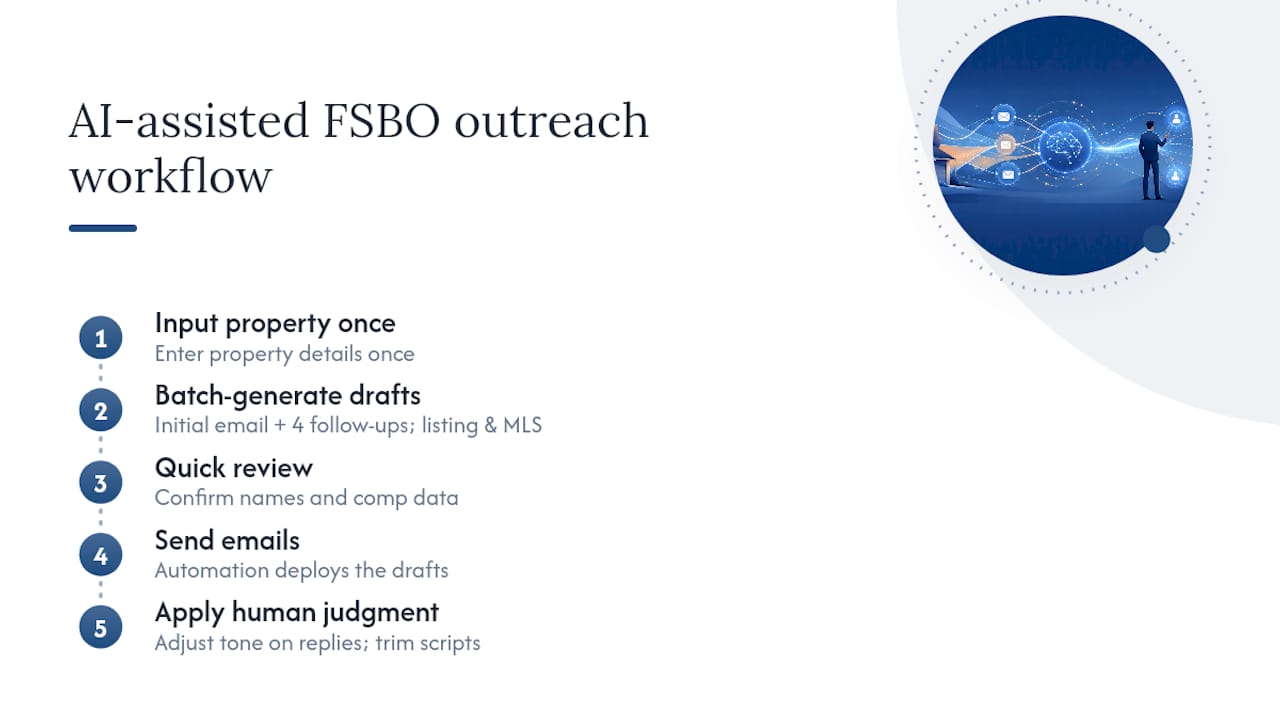
Writing seven personalized variations of one script, times fifty FSBO leads, is where most agents quietly give up on the sequence. AgentWrite handles that gap: enter a property’s details once, and it generates the listing description, MLS remarks, and matching emails in your own voice, while flagging Fair Housing wording concerns before you hit send.
A practical workflow looks like this: input the property once, batch-generate the initial email plus four follow-ups, do a quick pass to confirm names and comp data are correct, then send. Automation handles the repetitive drafting. You still make the judgment calls, when a seller’s reply needs a human tone shift, or when a script needs trimming for a specific personality. Treat AI-generated drafts as a fast first pass, not a final send, especially on the break-glass or objection-handling emails where tone matters most.
What I’ve Learned Watching FSBO Scripts Actually Work
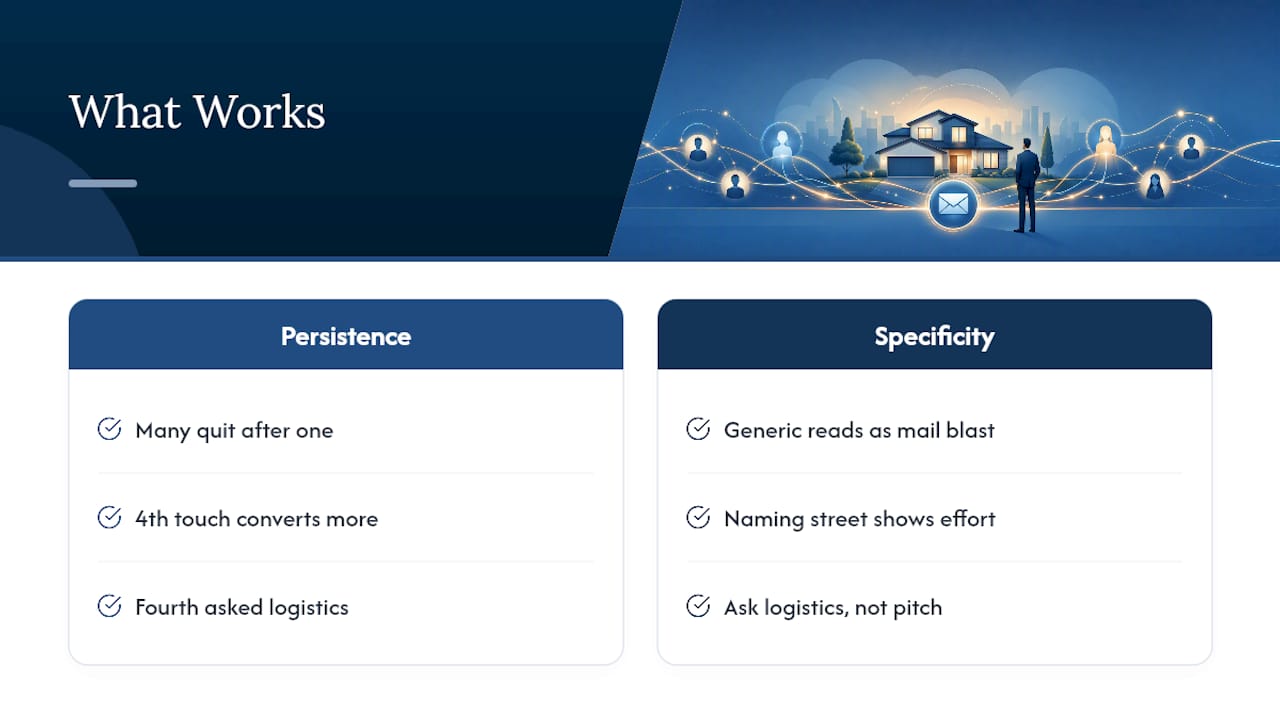
Two things hold up across every agent conversation I’ve had on this topic. First, persistence beats cleverness. The fourth touch converts more often than the first, mostly because most agents quit after one email. Second, specificity beats generic outreach every time. An email that names the actual street and cites a real comp reads as effort. A generic “I noticed you’re selling” reads as a mail blast.
One agent I heard about had a FSBO seller ignore three emails entirely, then reply within the hour to the fourth, which simply asked about showing logistics rather than pitching a listing appointment. The seller’s exact line back was that nobody else had asked about that part. Sometimes the win isn’t the perfect pitch. It’s asking the question nobody else bothered to ask.
— Tyler
Try AgentWrite for Faster, Compliant FSBO Outreach
This is an alternative to writing every FSBO variation from scratch: enter a property’s details once, and it drafts the listing copy, emails, and social posts in your voice, while flagging Fair Housing wording issues before you send anything.
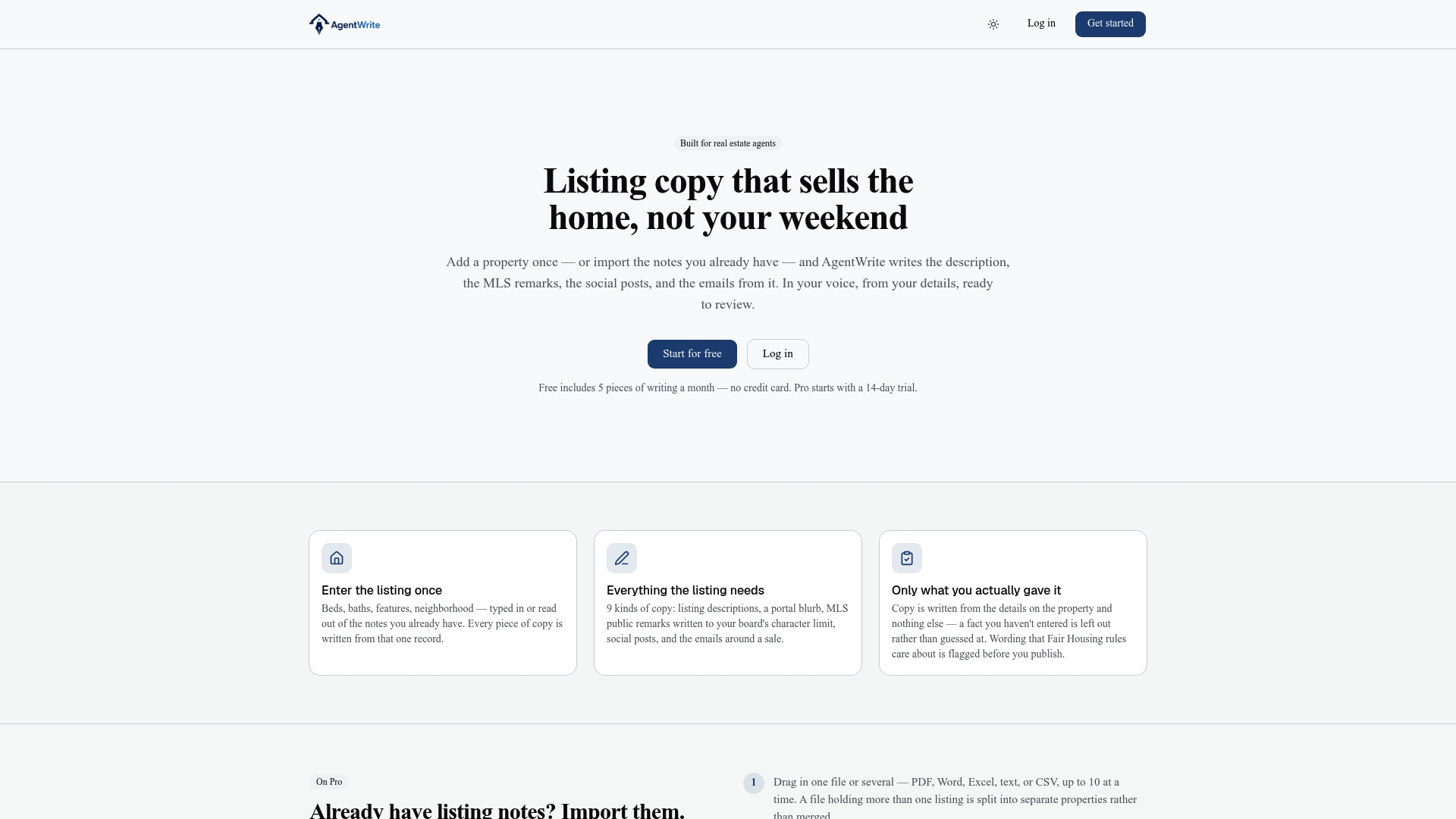
Instead of retyping the same comp data into seven different templates, you import a property once and generate the initial outreach plus a full follow-up sequence in a fraction of the time. The AgentWrite platform is built specifically for agents managing listing copy and outreach at volume, not as a generic writing tool retrofitted for real estate. If you’re running FSBO campaigns across dozens of leads at once, that time savings compounds fast. Check out the AgentWrite landing page to see current plans and start generating your own script variations.
Where This Guide’s Best Practices Come From
The scripts and cadence above draw on a handful of sources worth reading directly if you want to go deeper. ListingLeads’ FSBO script pack offers dozens more phone, text, and voicemail variations beyond email. HousingWire’s appointment-booking scripts break down why short, permission-based openers outperform pitches. Zillow’s marketing guidance explains the pricing and logistics gaps FSBO sellers commonly face. Publicate’s email templates reinforce the trust-first, multi-touch structure used throughout this guide. And Arivana’s piece on AI-assisted FSBO conversion covers how automation fits into a compliant outreach workflow. Agents building out their own local market guides may also find value comparing notes with working brokerages like Kenneth Hogan’s Berkeley team on how they frame seller-facing offers.
Sources
- 3 FSBO scripts that actually book appointments (+ tips) (HousingWire)
- How to market your home for sale (Zillow)
- FSBO Email Templates (Publicate)
- Convert FSBO Leads Into Listings With AI (Arivana)
FAQ
How Do You Convince a FSBO Seller to List With You?
Lead with a specific, low-pressure value offer, like a market snapshot or CMA, rather than a pitch for your services, and follow up 3 to 5 times with distinct value at each touch instead of repeating the same message.
What Are Some Catchy Phrases for Real Estate Agents to Use in FSBO Emails?
Phrases that reference specific, verifiable details work better than generic slogans, try “here’s what similar homes on your street sold for” or “no strings attached” rather than broad claims about expertise or results.
What Are Some Catchy Email Subject Lines for Real Estate FSBO Outreach?
Strong options include “Quick question about [street name],” “A free net sheet for your street, no strings,” and “One thing FSBO sellers often miss,” each built around specificity or a small curiosity gap rather than a sales claim.
What’s a Good Script for a Real Estate Voicemail Follow-Up to a FSBO Email?
Keep it brief: state your name, reference the specific email you sent (mention the comp or net sheet you offered), and ask a single low-pressure question, such as whether they’d like the full comparison sent again.
Can AI Tools Like AgentWrite Help Draft FSBO Email Sequences?
Yes. AgentWrite generates listing-related emails and other agent copy from a single property input, flags potential Fair Housing wording issues, and lets agents batch a full outreach sequence instead of writing each email manually.