

Agents: 3 MLS Ready Luxury Listing Descriptions That Sell Lifestyle
Agents: 3 MLS Ready Luxury Listing Descriptions That Sell Lifestyle
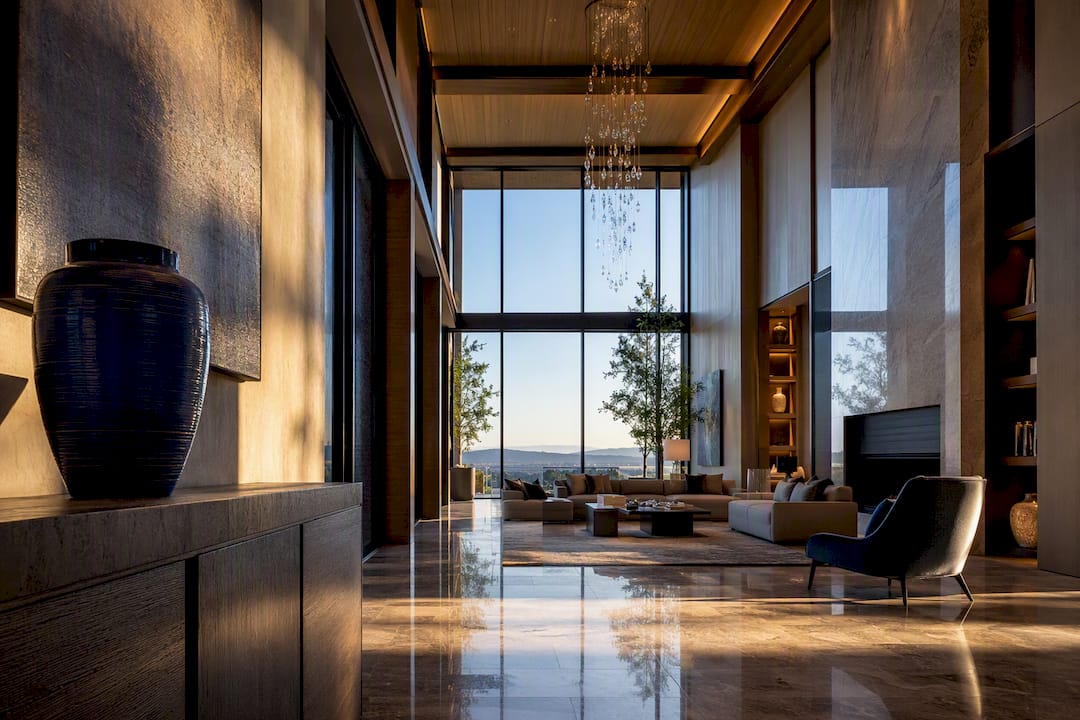
The best luxury listing descriptions replace superlatives with provenance, precise details, and controlled access. Swap “stunning” for the architect’s name, swap “spacious” for the actual ceiling height, and swap “must-see” for “shown by private appointment.” That single edit does more for credibility than any adjective ever will. This article emphasizes the importance of including Fair Housing checks in every listing draft generated, because the same listing that signals exclusivity can easily cross into exclusionary language if you’re not careful.
TL;DR:
- Precise details and verifiable facts, such as architect names, ceiling heights, and specific features, outperform superlatives in establishing credibility.
- Highlighting provenance, privacy, and scarcity with factual language, like private elevator access or limited units, effectively signals exclusivity without crossing fair housing boundaries.
- Leading with a strong, specific headline and one clear opening sentence focusing on a unique feature captures buyer attention immediately.
- Descriptions should follow a natural walkthrough: from exterior and entry to main spaces, primary suite, then outdoor areas, aligning with how buyers experience the property.
- Avoid vague claims and superlatives, replacing them with dimensions, names, or exact counts, and ensure language remains compliant with fair housing standards.
Table of Contents
- What Makes Luxury Listing Descriptions Actually Work
- Headline and Opening Sentence: A Formula for Instant Exclusivity
- Narrative Body Structure: What to Include and in What Order
- Sensory Language and Word Choice for Luxury Copy
- Signaling Provenance, Privacy, and Scarcity the Right Way
- Templates You Can Adapt in Minutes
- Sequencing Photos So the Copy Reads Like a Walkthrough
- Fair Housing Pitfalls and How to Rewrite Around Them
- Publishing Checklist Before You Hit Go Live
- Who You’re Actually Writing For: The Luxury Buyer’s Mindset
- Making Unique Amenities Carry the Listing
- Storytelling That Sells the Life, Not Just the Listing
- SEO Considerations for Luxury Property Copy
- Writing for Waterfront, Penthouse, and Estate Properties Differently
- How I Edit Luxury Listings
- An Option for Agents Who Want Compliant Copy Without the Rewrite Cycle
- Sources
- FAQ
What Makes Luxury Listing Descriptions Actually Work
A luxury buyer has seen a hundred listings that call the kitchen “chef’s dream” and the view “breathtaking.” None of it registers anymore. What breaks through is specificity: naming the architect, stating the ceiling is 22 feet rather than “soaring,” noting the wine room holds 800 bottles rather than “impressive.” Luxury Presence’s research on property description structure backs this up directly. Precise, verifiable facts read as trustworthy in a way that adjectives never can, especially to buyers who are used to being sold to.
There’s a second layer beyond precision: exclusivity signaling. Scarcity, privacy, and pedigree do real persuasive work when they’re stated plainly instead of implied through hype. A listing that says “one of six units with private elevator access” is doing more than a listing that says “exclusive.” One is a fact you can check. The other is a word every listing uses.
None of this replaces good structure. Headline, opening line, narrative body, photo sequence, call to action. Get that skeleton right and the sensory language has somewhere to land.
Headline and Opening Sentence: A Formula for Instant Exclusivity
Your headline has one job: make a scrolling buyer stop. McKissock’s guidance on listing descriptions points to short headlines and a single strong opening sentence as the two highest-leverage lines in the entire listing, because they’re often the only lines a buyer reads before deciding whether to click further.
Choosing what to lead with: pick the one feature a competing agent couldn’t copy. Not “gourmet kitchen.” Everyone has a gourmet kitchen. Pick the architect, the view, the lot size, or the provenance. If three things compete for the lead spot, the rarest one wins.
Length targets: keep the headline to 5 to 10 words. Keep the opening sentence to one sentence. That’s not a guideline you can stretch. A run-on opening line reads as desperate.
Templates that work across property types:
- “[Architect name]-designed estate on [street/neighborhood], offered for the first time in [number] years.”
- “Penthouse residence with private elevator access and unobstructed [city/water] views.”
- “Waterfront compound with 200 feet of private shoreline and a boat house built for a 40-foot yacht.”
Weak-to-strong headline edits:
- “Gorgeous luxury home with amazing views” becomes “Hillside estate with 180-degree ocean views from every principal room.”
- “Must-see estate, won’t last” becomes “1920s Mediterranean revival, fully restored, offered by the original family.”
- “Beautiful custom home” becomes “Custom-built by [builder name], one of four homes on a private cul-de-sac.”
Narrative Body Structure: What to Include and in What Order
A luxury description isn’t a list of amenities stapled together. It follows a sequence that mirrors how a buyer actually experiences a property, moving from credibility to feeling to logistics.
- Provenance. Who designed it, who built it, when, and why that matters. This is your credibility anchor.
- Spaces. The rooms that define the home, described in the order a visitor would walk through them.
- Materials. Named finishes and fixtures, not generic praise. “Calacatta marble” beats “high-end marble.”
- Lifestyle. What living here actually feels like day to day, not what it looks like in a photo.
- Private features. Pools, guest houses, wine cellars, home theaters. The things that make this property different from the one down the street.
- Practical facts. Square footage, lot size, taxes, HOA if applicable.
- Call to action. How to see it and who to contact.
The five-piece structure Luxury Presence outlines, running headline through call to action at under 250 words, holds up across property types because it forces you to cut filler before you run out of room for facts.
Pro Tip: Write your MLS remark first at 150 words, using only verifiable facts. Then expand it to a 350-word property page by adding the lifestyle and storytelling sections. Writing short to long is easier than cutting a long draft down.
Trade every superlative for a number, a name, or a dimension. “Enormous primary suite” becomes “650-square-foot primary suite with a private terrace.” The buyer trusts the second version because they can measure it against reality.
Sensory Language and Word Choice for Luxury Copy
Sensory phrases outperform superlatives because they put the buyer inside the room instead of telling the buyer how to feel about the room. “Flooded with natural light” does more work than “bright.” “Calacatta marble counters” does more work than “gorgeous counters.” One is an image. The other is an opinion you’re asking the reader to trust for no reason.
Rismedia’s roundup of descriptive language for luxury homes collects phrases like “postcard-perfect views” and “soaring ceilings” precisely because they carry a mental image rather than a generic value judgment.
High-impact nouns and verbs worth building sentences around:
- Cascading, framed, anchored, curated, commissioned
- Motor court, breezeway, loggia, mudroom, conservatory
- Reclaimed, hand-troweled, book-matched, quarter-sawn
Adjectives that still earn their place, used sparingly:
- Sun-drenched, secluded, storied, unobstructed, discreet
Language to retire immediately: “luxurious,” “stunning,” “amazing,” “must-see,” “won’t last,” “dream home.” Every one of these appears in thousands of other listings, which means it signals nothing.
Word count matters, too. Industry guidance consistently points to descriptions under 250 words as the sweet spot for listing platforms, since buyer attention drops fast once a description outruns a quick scroll.
Signaling Provenance, Privacy, and Scarcity the Right Way
Naming the architect, designer, or builder is one of the fastest ways to justify a premium price in a single sentence. A McKissock-backed principle worth internalizing: a provenance-led opening does more persuasive work than three sentences of adjectives, because it hands the buyer a fact they can research and verify on their own.
Name the credential when you have one. “Designed by [architect]” or “one of only twelve homes built by [builder]” beats “custom-built” every time. If there’s no notable name attached, skip the provenance line rather than inventing significance that isn’t there.
Privacy and access language works the same way, as long as it stays factual:
- “Shown by private appointment only” signals controlled access without excluding anyone.
- “Gated, single-lane private drive” states a real feature.
- “One of six residences in the building” states real scarcity.
Avoid vague scarcity claims like “won’t last” or “rare opportunity” unless you can back them with a fact. If the property really is one of four homes on a private lane, say that. If it’s simply on the market, don’t manufacture urgency that isn’t real.
Templates You Can Adapt in Minutes
Annotated templates work best when you treat the bracketed fields as the only thing you’re changing. The structure underneath should stay intact.
Estate template: “[Architect]-designed estate set on [acreage] private acres, offered for the first time in [years]. The foyer opens to a great room with [ceiling height]-foot ceilings and views across [feature]. The chef’s kitchen includes [named appliance brand] appliances and a [dimension] island in [material]. Outside, a [pool dimension] pool anchors a motor court framed by [landscaping detail]. Shown by private appointment.”
Penthouse template: “Full-floor penthouse residence with private elevator access and [number]-degree views of [skyline/water]. Interiors by [designer name if applicable] feature [flooring material] floors and floor-to-ceiling glass throughout. The primary suite spans [square footage] with a [feature]. Building amenities include [named amenity]. One of [number] residences on this floor plan.”
Waterfront template: “Waterfront estate with [linear footage] of private shoreline and a private dock rated for a [boat size] vessel. The great room frames unobstructed water views through [window detail]. A separate guest house adds [square footage] of living space. Offered at [price context if relevant] with [acreage] of grounds.”
Weak-to-strong rewrite one: “Beautiful home with tons of upgrades” becomes “Fully renovated in 2024, with a new [named brand] kitchen suite and restored original hardwood floors throughout.”
Weak-to-strong rewrite two: “Won’t last in this market” becomes “First time offered since 1987, held by the original owning family.”
Even a modest fixer-upper description benefits from the same discipline: naming the original architectural details worth preserving does more than calling the place a “diamond in the rough.” For MLS character limits, trim the lifestyle sentence first and keep provenance and dimensions. Those are the facts buyers search for and agents get asked about on the first showing call.
Sequencing Photos So the Copy Reads Like a Walkthrough
Photos and copy should mirror the same walkthrough, front door to primary suite to outdoor living, because that’s the order a buyer’s brain expects a home tour to follow. Luxury Presence’s guidance on photo and copy alignment recommends exactly this sequence: exterior and entry first, main living spaces next, primary suite, then outdoor entertaining last.
- Open with the exterior or a defining architectural shot, then move inside in the order a visitor would walk.
- Reference photos in copy only when it adds context (“the great room pictured above opens to a covered loggia”), never as filler.
- On single-property websites, expand the story in captions since there’s no character limit.
- On portals that truncate descriptions, front-load the provenance and headline facts in the first two sentences before any truncation cuts them off.
Fair Housing Pitfalls and How to Rewrite Around Them
Exclusivity language and exclusionary language sit closer together than most agents realize, and the line between them is intent, not vocabulary. Advertising should describe the property. It should never describe or imply the ideal buyer.
The Fair Housing Institute’s advertising words and phrases list catalogs the categories that create risk, and the fixes are usually simple rewrites rather than wholesale rewrites:
- “Perfect for a young family” becomes “Four bedrooms, ideal for a home office or guest suite.”
- “Walking distance to the synagogue” becomes just describing the neighborhood’s walkability, without naming religious institutions as a selling point.
- “Exclusive, private community” is fine. “Exclusive community, ideal for discerning buyers” edges toward implying who belongs there.
- “No wheelchair access” or any phrasing referencing ability status should be dropped entirely; describe physical features (stairs, elevator) factually instead.
Pro Tip: If a sentence answers the question “who should live here” instead of “what does this property offer,” rewrite it. That single filter catches most Fair Housing issues before they happen.
Keep the tone aspirational by describing the property’s features and setting, never the buyer’s identity, income bracket, or lifestyle category. “Ideal for entertaining” describes a floor plan. “Ideal for executives” describes a person, and that’s the line you don’t want to cross.
Publishing Checklist Before You Hit Go Live
Run this before every luxury listing goes public:
- MLS remark stays under 150 words; the single-property page can run to 350 words where character limits don’t apply.
- Headline sits at 5 to 10 words; opening sentence is one sentence, no run-ons.
- Every superlative has been replaced with a number, name, or dimension, or removed.
- Call to action uses phrasing like “shown by private appointment” or “contact [agent] for a private tour” rather than a generic “call today.”
- Proofread specifically for accuracy: architect names, appliance brand spellings, square footage, and confirm you have permission to name any designer or builder credited.
Portals that truncate descriptions reward listings that front-load the strongest facts, so anything cut for length should be lifestyle detail, never the provenance line or the headline claim.
Who You’re Actually Writing For: The Luxury Buyer’s Mindset
Luxury buyers aren’t shopping for shelter. They are shopping for validation that the price is justified and the property matches a life they already picture for themselves. That changes what convinces them. A first-time buyer responds to “move-in ready” and “great schools.” A luxury buyer responds to provenance, craftsmanship, and privacy, because they’ve already ruled out anything that doesn’t clear a baseline of quality.
Many luxury buyers are repeat purchasers who’ve owned several homes and read dozens of listings before yours. They can spot generic copy in one sentence, and they discount it accordingly. That’s why precision does more persuasive work here than in a starter-home listing. A buyer comparing three eight-figure properties isn’t swayed by “gorgeous.” They’re swayed by knowing one property has a wine room built for 800 bottles and the other doesn’t.
Time matters differently, too. Luxury buyers often move faster once genuinely interested, because they’re not waiting on financing approvals the way many first-time buyers are. Your copy needs to convert interest into a scheduled showing quickly, which is exactly why the call to action deserves as much care as the headline.
Making Unique Amenities Carry the Listing
Every luxury property has one or two features that don’t exist in comparable homes. Find those first, before writing anything else, because they’re what separates your listing from every other listing in the price bracket.
A home theater is common in this segment. A home theater with a named acoustic engineer’s design credit is not. A wine cellar is common. A wine cellar with a specific bottle capacity and climate control system is a fact a buyer can weigh against their own collection. The difference isn’t the amenity. It’s whether you described it as a category or as a specific, verifiable thing.
Group amenities by what they let a buyer do, not just what they are. A private dock isn’t just a dock. It’s the ability to keep a 40-foot boat steps from the back door without a marina slip. A home gym isn’t just a gym. It’s not needing a membership or a commute to train. Framing amenities around the resulting lifestyle, backed by the specific fact, does more work than listing features in a row.
Storytelling That Sells the Life, Not Just the Listing
Facts justify the price. Story justifies the desire. A luxury description needs both, in that order, because a buyer who isn’t emotionally engaged won’t get far enough to care about the square footage.
The story doesn’t need to be long. One or two sentences describing a specific, sensory moment, morning coffee on a terrace facing the water, guests arriving through a motor court lit at dusk, does more than a paragraph of generic lifestyle language. Specificity works in storytelling exactly the way it works in fact statements: a named, particular detail is more convincing than a general one.

Avoid inventing details you can’t back up. If the seller has never actually hosted dinner parties on that terrace, don’t claim they have. Ground the story in something true about the space itself: the orientation catches the sunset, the layout naturally separates public and private zones, the pool sits far enough from the house for real privacy. Truthful, specific staging beats fabricated narrative every time, and it keeps you well clear of any misrepresentation risk.
SEO Considerations for Luxury Property Copy
Luxury listing descriptions still need to perform in search, even though the buyer’s decision ultimately gets made through relationship and showing, not a Google query. Location-specific terms matter: neighborhood name, architectural style, and property type should appear naturally in the first two sentences, since that’s the portion search engines and portal previews tend to surface.
Avoid keyword stuffing entirely. A listing packed with repeated neighborhood names or property types reads as spam to both algorithms and human readers, and luxury buyers notice awkward phrasing faster than most. Write the sentence for the person reading it, and let the natural inclusion of location and property type do the SEO work.
Single-property websites benefit from slightly longer, more descriptive copy than MLS remarks, since they aren’t fighting a character limit and can support a fuller narrative that search engines can index. That’s also where you can safely repeat key terms like the architect’s name or the neighborhood across a few different sections without it feeling repetitive to a reader scrolling the page.
Writing for Waterfront, Penthouse, and Estate Properties Differently
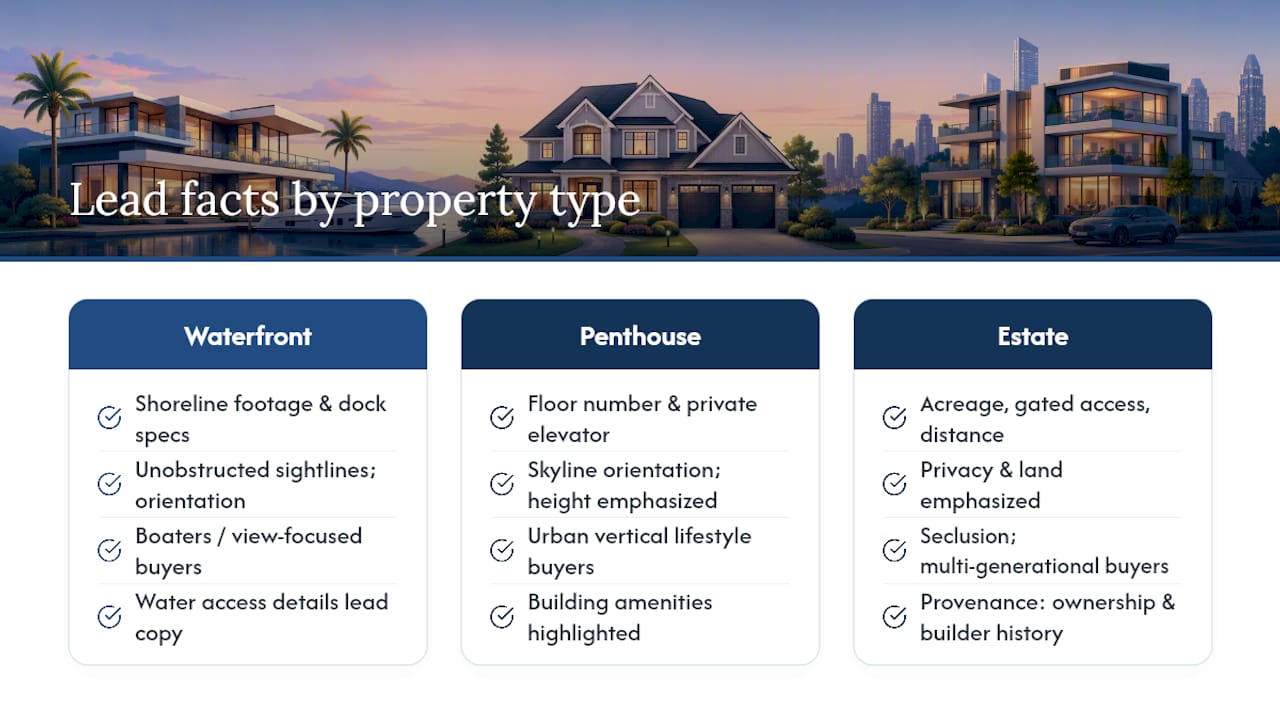
A waterfront property, a penthouse, and a sprawling estate are selling three different fantasies, and the copy should reflect that rather than defaulting to one template for all three.
Waterfront listings should lead with the water itself: linear footage of shoreline, dock specifications, and unobstructed sightlines. Buyers here are often boaters or people prioritizing a specific view, so orientation (west-facing for sunsets, protected cove for calm water) matters more than it does in other luxury categories.
Penthouse listings should lead with height and access: floor number, private elevator, skyline orientation. The lifestyle pitch here is urban and vertical: proximity to the city below without the compromises of ground-level noise or foot traffic. Building amenities deserve their own line, since a penthouse buyer is also buying into the building’s services.
Estate properties should lead with land and privacy: acreage, gated access, distance from neighboring properties. The story is seclusion and permanence, often multi-generational, which is why provenance (how long the family has owned it, who built it) carries more weight here than in a penthouse listing where the building’s history matters more than any one owner’s.
Each property type earns the same underlying discipline, precision over adjectives, but the specific fact you lead with should match the fantasy that property type is actually selling.
How I Edit Luxury Listings
Most drafts I see lean on the same five adjectives and bury the one fact that would actually sell the home. My first edit is always the same: find the most specific, most verifiable detail in the listing and move it to the first sentence. The process can be sped up by generating a first draft from the agent’s own inputs and flagging Fair Housing language before it reaches a buyer’s screen, which catches mistakes editors used to have to hunt for by hand.
— Tyler
An Option for Agents Who Want Compliant Copy Without the Rewrite Cycle
If you’re writing five or six listings a week, the bottleneck usually isn’t creativity. It’s the time spent rewriting the same property details into MLS remarks, social captions, and a property page without repeating yourself or risking a Fair Housing slip. Some platforms are built for exactly that gap: enter a property’s details once, and they generate listing descriptions, MLS remarks, social posts, and emails in an agent’s voice, while flagging language that could raise compliance concerns before publication.
Certain platforms are designed specifically for agents and teams, not general copywriting, and understand differences between types of listings, such as penthouse versus waterfront. If you’re spending more time editing your own listing copy than showing homes, try Agentwrite and generate your next luxury listing draft in the time it takes to pour a coffee.
Sources
- How to Write Real Estate Listing Descriptions - McKissock
- An Easy, 5-Step Guide to Writing Property Descriptions - Luxury Presence
- Fair Housing advertising words/phrases list (PDF) - Fair Housing Institute
- 15 Descriptive Words to Use When Selling a Luxury Home - Rismedia
FAQ
What is the 3-3-3 rule in real estate?
It’s a listing-preparation guideline: get professional photos within 3 days of listing, publish across at least 3 major platforms, and secure showings or interest within the first 3 weeks. It’s a workflow standard, not a copywriting formula.
How do you describe a luxurious house?
Lead with provenance (architect, builder, year), use precise sensory details instead of superlatives, and name materials and dimensions rather than calling things “beautiful” or “stunning.” A phrase like “flooded with natural light” outperforms “bright” for the same reason a specific number outperforms a vague claim.
What do I put in a property description?
Structure it as headline, one-sentence opening, a narrative body covering provenance, spaces, materials, lifestyle, and private features, then practical facts and a call to action, all typically under 250 words for the MLS remark.
What are trigger words in real estate?
Trigger words are phrases that describe or imply an ideal buyer rather than the property itself, which risks violating Fair Housing standards. Phrases like “perfect for a young family” or wording referencing religion, ability, or family status need rewriting to describe the property’s actual features instead.