

3 Compliant MLS Ready Mobile Home Templates for Agents
3 Compliant MLS Ready Mobile Home Templates for Agents
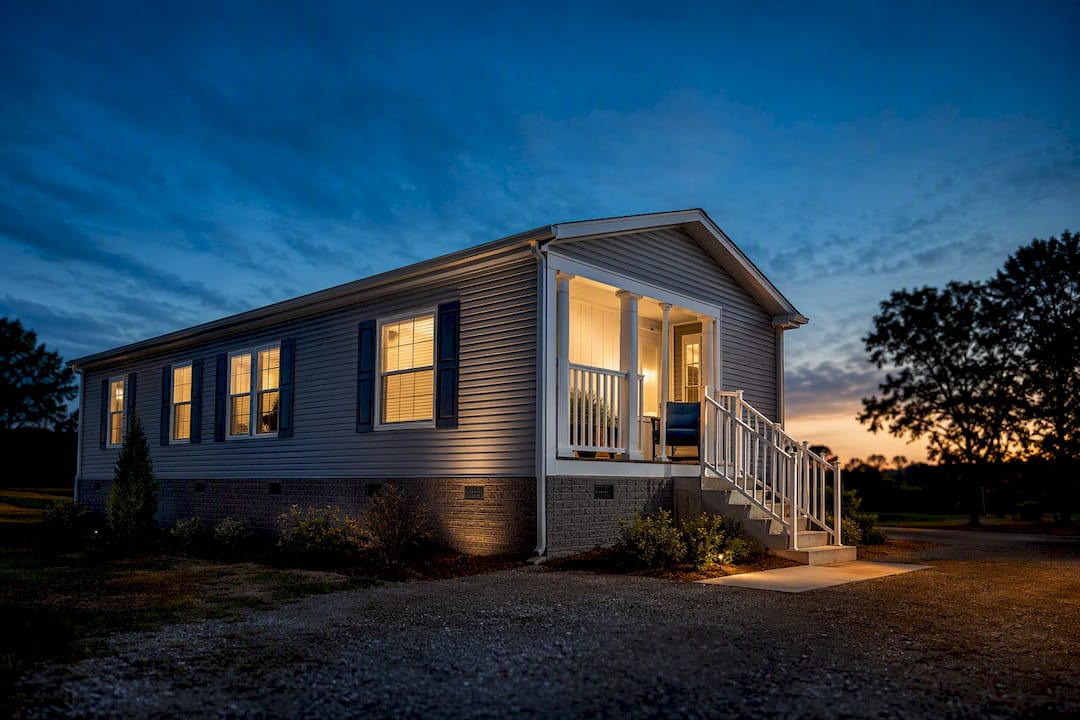
Every compliant mobile home description leads with the home type and ownership status, states price and any lot rent up front, lists exact specs (year, size, beds/baths, HUD label or title status), and never includes wording that signals a preference for who should live there. You, the licensed agent, own that compliance regardless of who or what drafted the copy.
TL;DR:
- Clear specifications on home type, titling, and location must be front-loaded to qualify buyers and avoid unqualified showings.
- Listing descriptions should separate sale price, lot rent, and updates in dedicated lines to improve transparency and conversion rates.
- Avoid language implying preferences or discrimination, replacing phrases like “perfect for retirees” with factual property features to comply with Fair Housing rules.
- Using templates and automated tools speeds compliance and reduces errors, but final review for fair housing adherence is essential before publishing.
- State and local regulations may add requirements, so verifying titling, disclosures, and advertisement rules with relevant authorities is mandatory.
Table of Contents
- What belongs in every mobile home description?
- What Fair Housing rules apply to mobile home ads?
- How do you write mobile home descriptions that convert?
- What are ready-to-use mobile home listing templates?
- Why systematized compliance saves agents real time
- A faster way to draft compliant listings
- Where to verify these compliance rules
- Sources
- FAQ
What belongs in every mobile home description?
A buyer or renter scanning a manufactured-home listing wants three things fast: what it is, what it costs, and whether they qualify. Build your description in that order and you cut showing requests from unqualified leads before they ever call.
Start with type and titling. Say plainly whether the home is HUD-code manufactured, a pre-1976 mobile home, or a modular unit, and whether the sale includes land or is home-only inside a leased-lot community. A line like “2019 HUD-code manufactured home, titled personal property, situated on a leased lot” tells a buyer exactly what they’re financing before they read another word. State-specific rules on titling and disclosure vary enough that manufactured-housing listing guidance recommends confirming your state’s exact requirements before you publish.
From there, hit the specs in this order:
- Year built, HUD label or serial number (or note “available upon request” if you’re not attaching a photo of it).
- Square footage, bedroom and bathroom count, and foundation or installation status.
- Recent updates: roof, HVAC, flooring, skirting, plumbing.
- Ownership structure: home-only, home-and-land, or leasehold.
Then get to money, and separate every line item. Buyers comparing manufactured housing get burned by ads that quote a price and bury a $450 monthly lot rent in the fine print. List asking price, monthly lot rent if applicable, estimated utilities, and any owner-financing or rent-to-own terms as their own bullets, not a paragraph. Listings that lead with clear specs and explicit money terms consistently outperform vague ones, because they answer the qualifying question before a buyer wastes a Saturday driving out to look.
Close the checklist with:
- Park or community rules (age restrictions on the community, pet policy, application/approval process, and typical approval timeline).
- Condition notes and whether inspection reports or maintenance records are available.
- A specific call to action: “Schedule a showing,” “Applications reviewed within 48 hours,” or similar, with a direct contact method.
What Fair Housing rules apply to mobile home ads?
The Fair Housing Act makes it unlawful to publish any advertisement or statement for a sale or rental that indicates a preference, limitation, or discrimination based on race, color, religion, sex, familial status, national origin, or disability. That covers your MLS remarks, your portal blurb, your Facebook post, and anything a tool generates on your behalf. There’s no exception for a single-wide on a quarter acre.
24 CFR § 100.75 spells out what counts as discriminatory: language, photos, illustrations, and even placement choices that signal who belongs and who doesn’t. A few phrases show up in mobile home listings more than they should:
- “Perfect for a retired couple” or “ideal for empty nesters” (familial status)
- “Walking distance to churches” used as a selling point tied to a specific faith community (religion)
- “Great for a single professional” (familial status, sometimes national origin by proxy)
- “No wheelchair access” phrased as a warning rather than a factual accessibility note
Swap those for neutral, factual language: instead of “perfect for retirees,” describe the home as “one-level living, no interior stairs.” Instead of “ideal for a small family,” just state the bedroom count and let the buyer decide who fits. Responsible advertising guidance puts it simply: describe the property, not the person you picture living in it.
Digital platforms add a wrinkle. Audience-targeting tools on ad platforms can replicate discriminatory delivery even without discriminatory intent, so review your targeting settings the same way you review your copy.
Pro Tip: Read every automated or templated draft out loud before publishing. If a sentence answers “who should live here” instead of “what is this home,” rewrite it.
Using AI or a template doesn’t transfer liability. You’re the publisher of record, and fair housing advocates are explicit that automation expands your exposure if you skip the review step, not shrinks it.
Before you hit publish, run this quick pass: does the copy describe the property only? Are all specs and money terms accurate? Would this wording survive a fair housing complaint if a regulator read it cold? If yes to all three, you’re clear.
How do you write mobile home descriptions that convert?
Your MLS remarks and your portal blurb serve different jobs. MLS remarks are for agents and serious buyers already comparing specs, so keep them tight, factual, and front-loaded, usually 150 to 250 words. Portal blurbs on consumer sites can run longer and lean into lifestyle detail, since that’s where a buyer decides whether to click at all.
Structure the MLS remark like this: type and titling, then price and lot rent, then specs, then condition and updates, then park notes, then a call to action. No adjectives doing the heavy lifting, just facts in order.
For portal copy, you can afford a little warmth without drifting into risky territory. Short phrase patterns that work:
- Flooring: “New luxury vinyl plank throughout the main living areas.”
- Foundation: “Set on a permanent foundation, county-inspected in 2024.”
- HVAC: “Central AC and furnace replaced in 2023.”
- Updates: “Kitchen refreshed with new countertops and cabinet hardware.”
When describing community amenities, stick to what exists, not who enjoys it: “Community pool, clubhouse, and on-site management” works. “Family-friendly community with a playground” edges toward familial-status framing; “playground and green space on-site” says the same thing without the label.
Photos carry more weight in manufactured housing than in traditional listings, because buyers are often mentally correcting for outdated assumptions about the category. Lead with exterior curb appeal, then kitchen, then living space, then bedrooms, then any recent upgrade like a new roof or skirting. Photo sequencing guidance built for listing conversion applies just as well here: the first three images decide whether someone keeps scrolling.
- Use a template for structure and field order.
- Always customize price, lot rent, specs, and any condition detail, since generic templates flatten exactly the details that make a listing convert.
What are ready-to-use mobile home listing templates?
Three starting points cover most of what you’ll list. Copy, then replace every bracketed field before publishing.
Template A: HUD-code manufactured home on owned land
“[Year] HUD-code manufactured home on [lot size] owned land. [Bed]BR/[Bath]BA, [sq ft] sq ft, set on a [foundation type] foundation. Recent updates: [list]. Priced at $[price]. Serial/HUD label available upon request. Schedule a showing: [contact method].”
Attach photos of the HUD label and any foundation/installation certification if your state requires it for financing.

Template B: home-only sale in a land-lease community
“[Year] manufactured home, home-only sale, located in [community name], a land-lease community. $[price] plus estimated monthly lot rent of $[amount]. [Bed]BR/[Bath]BA, [sq ft] sq ft. Park approval required; application typically processed in [timeframe]. Recent updates: [list]. Contact [method] to apply.”
Note buyer responsibilities clearly: who applies for park approval, and whether financing options are limited by home-only status.
Template C: rental listing
“[Year] manufactured home for rent in [community/location]. $[monthly rent] plus $[lot rent] lot rent, or $[rent] all-inclusive. [Bed]BR/[Bath]BA. Available [date]. Application requires [documents]. Contact [method] to schedule a viewing.”
- Fill every bracket with real, verified numbers before publishing.
- Never leave a placeholder price or date live on an MLS feed.
Why systematized compliance saves agents real time
Most agents don’t lose time writing the first draft. They lose it rewriting a description after a broker flags risky wording, or fielding calls from buyers whose questions the listing should have answered. A repeatable workflow fixes both: gather the property packet, generate a draft, review it against a Fair Housing checklist, attach supporting documents, then publish.
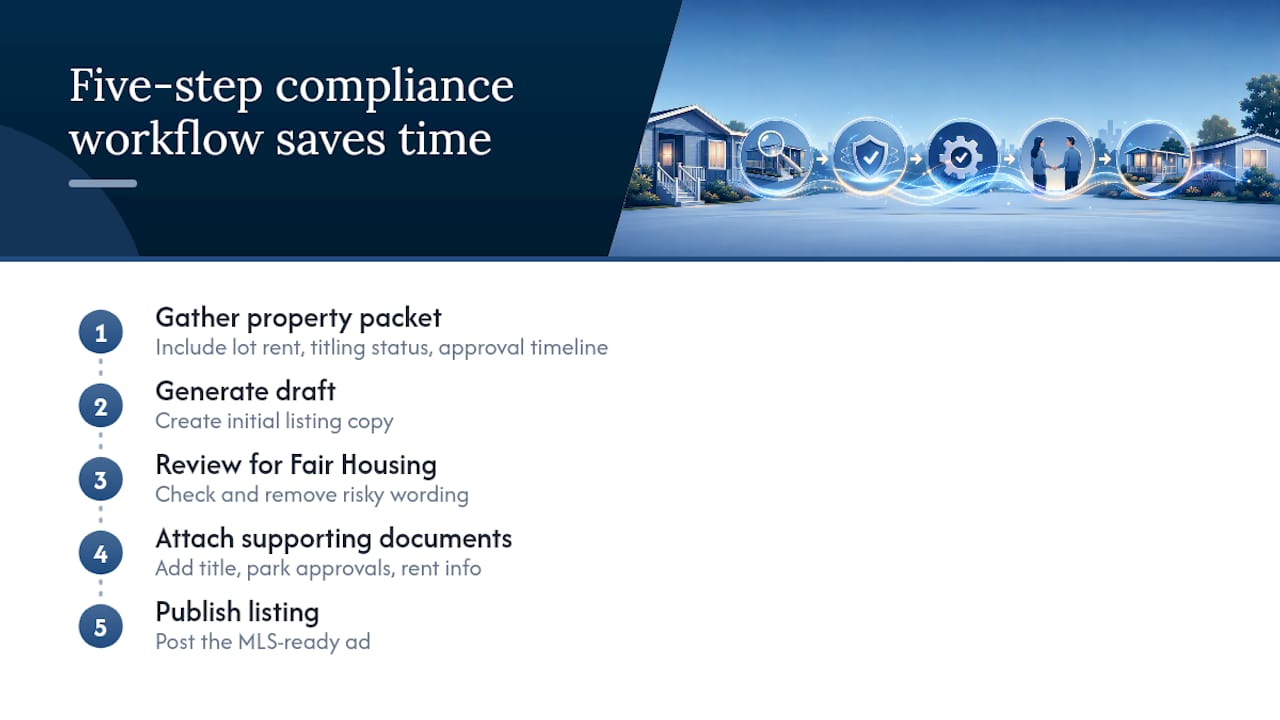
Templates don’t just speed up copy. They reduce the number of listings that sit unsold because a buyer couldn’t find the lot rent, the titling status, or the park’s approval timeline anywhere in the ad…
— Tyler
A faster way to draft compliant listings
You’ve seen how much a compliant mobile home listing has to cover: titling, price breakdowns, park rules, disclosures, and wording that stays neutral under Fair Housing scrutiny. Getting all of that right, every time, on every listing, is where most agents lose the most drafting time. This type of software is built to close that gap. Enter a property’s details once, and it generates MLS remarks, portal blurbs, social posts, and buyer emails while flagging wording that could raise a Fair Housing concern before you publish.
Instead of retyping the same specs into five different formats, you review one set of drafts and send them out. If you list manufactured or mobile homes regularly, that review step matters more than most software features, since it catches the exact kind of phrasing this article warns against. Start a draft on your next listing at AgentWrite and see how it handles your next mobile home description.
Where to verify these compliance rules
The guidance above draws on federal fair housing law and industry-specific listing practices, but state and local rules add another layer agents need to check directly.
- Fair Housing Act, U.S. Code Title 42, Chapter 45 for the statutory advertising prohibition.
- 24 CFR § 100.75 for specific examples of discriminatory advertisements.
- State-by-state manufactured housing listing rules for titling and disclosure requirements that vary by jurisdiction.
- Responsible advertising guidance from the National Fair Housing Alliance for practical do/don’t wording examples.
Confirm titling requirements and disclosure rules with your state’s real estate commission before you publish, since manufactured-housing regulations differ enough state to state that no single template covers every jurisdiction.
Sources
- U.S. Code, Title 42, Chapter 45 (Fair Housing) — U.S. House of Representatives
- 24 CFR § 100.75 - Discriminatory advertisements, statements and notices. — Legal Information Institute (LII)
- Guidance on application of the Fair Housing Act to advertising through digital platforms — FHEO / EqualHousing
- Mobile Home Marketing: Complete Guide for Mobile Home Investors | MobileHomeBiz
FAQ
What must a compliant mobile home description include?
It must state home type and titling status, price and any lot rent, exact specs like year and square footage, and condition details, all without language that signals a preference for who should live there.
Can I use AI or templates to write mobile home listings?
Yes, but you remain fully responsible for reviewing the output for Fair Housing compliance before publishing, since automation doesn’t transfer that liability to the tool.
What phrases should I avoid in mobile home ads?
Avoid anything describing an ideal buyer or renter, like “perfect for retirees” or “great for a small family,” and replace it with factual property descriptions such as bedroom count or one-level layout.
Should lot rent appear separately from the sale price?
Yes. Listing price and monthly lot rent as separate line items lets buyers accurately compare total housing cost, and ads that separate these terms clearly tend to convert better than those that bundle or omit them.
Does Agentwrite check listings for Fair Housing wording?
This type of software can flag potentially risky Fair Housing language while generating MLS remarks and portal blurbs, though the agent still needs to complete a final compliance review before publishing.