

How to Write Neighborhood Descriptions That Sell and Hold Up
How to Write Neighborhood Descriptions That Sell and Hold Up

A strong neighborhood description names the buyer type first, then anchors that claim to one verifiable place and one lifestyle detail. Skip the throat-clearing about “vibrant communities” and get specific: which school, which transit stop, which market fact a buyer or an underwriter could check in five minutes.
Here’s the model: [Buyer type] + [verifiable anchor] + [lifestyle or market detail].
A one-line version looks like this: “First-time buyers priced out of downtown are landing here for the 12-minute Blue Line commute and homes still listing under $650,000.” That single sentence does more work than three paragraphs of scenery description, because leading with buyer type and a verifiable reason improves both clarity and conversion.
You can compress or expand that same pattern depending on the format:
- MLS headline: “Riverside Heights: Blue Line access, top-rated Jefferson Elementary, homes from $580K.”
- Short appraisal sentence: “The subject neighborhood is bounded by Route 9, Miller Creek, and Ash Street, an established residential area with stable to increasing values over the past 24 months.”
- Social caption: “Coffee at Grover’s, a 12-minute train ride downtown, and a school rated 8/10. Riverside Heights in one sentence.”
Every version above passes the same test: could a stranger verify it? If yes, keep it. If it’s “charming” or “up-and-coming” with nothing behind it, cut it.
Key Takeaways
A defensible neighborhood description names a buyer type, anchors that claim to a verifiable place, and adds one honest market or lifestyle detail, and it holds up whether you’re writing an MLS remark or an appraisal paragraph.
| Point | Details |
|---|---|
| Lead with buyer type | Open with who the neighborhood serves before any scenery description, then add one verifiable fact. |
| Anchor every claim | Name real schools, transit lines, or businesses so buyers and reviewers can verify the claim directly. |
| Cut Fair Housing risk | Replace phrases like “family-oriented” or “quiet adult community” with fact-based alternatives that carry no protected-class framing. |
| Match tone to format | Use lifestyle imagery for MLS and social copy, and market-supportable facts only for appraisal paragraphs. |
| Draft fast, verify locally | Agentwrite generates first-draft listing copy and flags Fair Housing language in one pass, but street-level facts still need human confirmation. |
Table of Contents
- Neighborhood Description Examples Start With a Framework, Not Adjectives
- Fair Housing-Safe Language: What to Cut and What to Say Instead
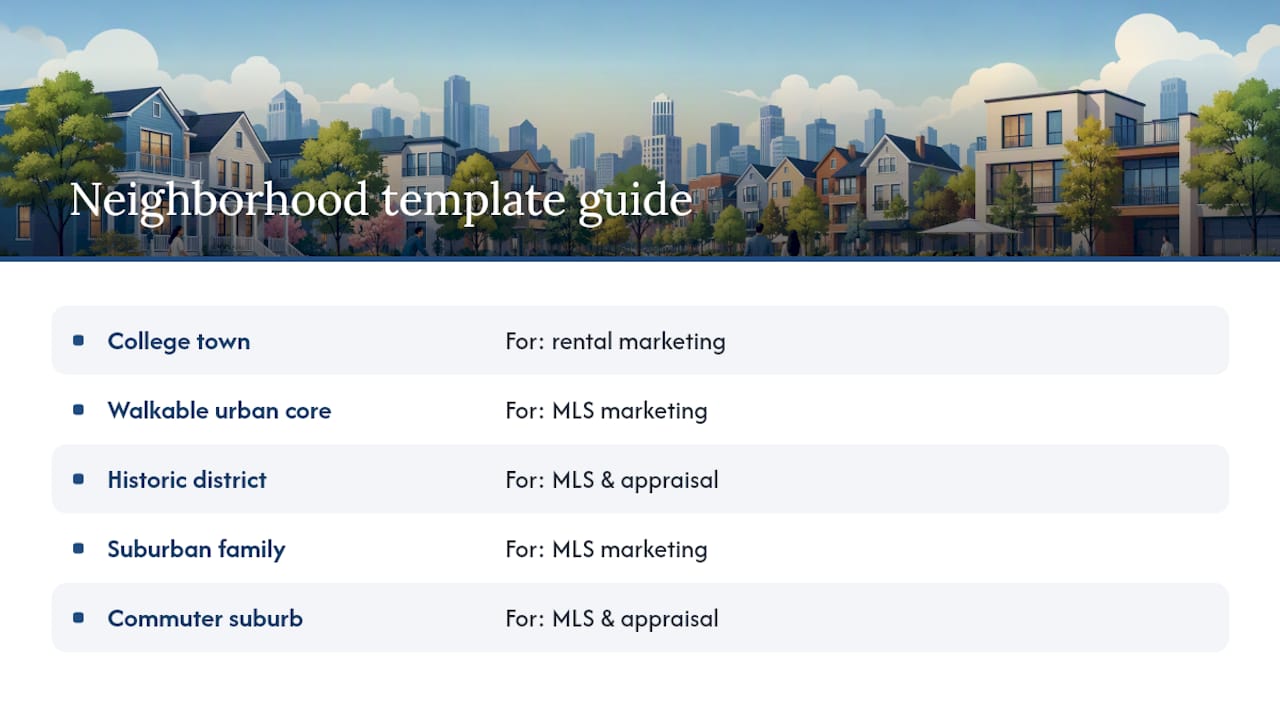
- Twelve Neighborhood Description Templates You Can Adapt Today
- Meeting 1004 Requirements Without Writing Like a Robot
- A Five-Step Workflow for Drafting Any Neighborhood Description
- What Agentwrite Automates, and What Still Needs Your Eyes
- Where to Verify Facts and Check Compliance
- The Real Skill Isn’t Writing. It’s Restraint.
- Get Your First Draft Written in Minutes, Not Hours
- Sources
- FAQ
Neighborhood Description Examples Start With a Framework, Not Adjectives
The gap between a listing that gets clicks and one that gets skimmed almost always comes down to structure, not vocabulary. Agents reach for words like “desirable” or “sought-after” when what the description actually needs is a fact a buyer can look up. The strongest neighborhood description examples share three traits: they open with who the place is for, they anchor every claim to something real, and they layer in market context without turning into a spreadsheet.
It tells the reader in the first clause whether to keep reading, and it gives an appraiser a defensible starting point for describing market demand rather than aesthetics.
Anchor every claim to a place someone could Google. “Close to shopping” means nothing. “A five-minute walk to the Saturday farmers market on Elm Street” means something, because a reader can verify it in one search. This is the core of the framework Metes uses across its 12 curated neighborhood examples: anchor in real, named places, then build lifestyle detail around that anchor. A named high school, a specific transit line, a specific park. Vague superlatives (“stunning,” “unbeatable,” “prime”) carry zero information density and, in an appraisal context, actively hurt your credibility because they can’t be tied to comparable-sales evidence.
Layer in market context without burying the lead. Buyers and appraisers both want to know: is this neighborhood appreciating, flat, or softening? Is inventory tight or loose? You don’t need paragraphs of data. One clause does it: “where median days-on-market has dropped from 45 to 22 over the past year” or “an area that’s seen three new multifamily permits filed since last spring.” Market context separates a listing description from an appraisal-grade paragraph, and appraisers in particular need this framed as observation, not sales pitch.
Know when to switch from lifestyle to fact. A rental listing or MLS remark can lean into lifestyle imagery: morning runs along the river trail, the smell of the bakery two doors down. An appraisal report cannot. The moment you’re writing for a 1004 form, imagery becomes a liability, and every sentence needs to map to a market-supportable claim. Keep a mental switch: marketing copy sells a feeling, appraisal copy documents a fact.
Here’s the sequence that keeps both goals intact:
- Identify the buyer type or use case. Who is this description for, and what decision are they making?
- Pick one verifiable anchor. A school name, a transit stop, a named business district, a park.
- Add one lifestyle or market detail. A commute time, a price trend, a walkability note.
- Check the sentence for anything unverifiable. If a stranger couldn’t confirm it, rewrite it.
- Match the tone to the format. Lifestyle language for MLS and social, factual language for appraisal.
Pro Tip: Keep a running list of your market’s “named anchors” (the specific parks, schools, coffee shops, and transit stops locals actually reference) so you’re not reaching for generic filler under deadline pressure.
This is also where the case for real estate agents documenting their own local knowledge pays off long-term. A neighborhood description you can defend with a name and a fact holds up whether you’re writing for a buyer, a portal algorithm, or an appraisal reviewer.

Fair Housing-Safe Language: What to Cut and What to Say Instead
Certain phrases that sound harmless in a listing description are legal liabilities under the Fair Housing Act, because they signal a preference for or against a protected class rather than describing the property or neighborhood itself. HUD’s Fair Housing Act overview lays out the protected classes, and the practical rule for agents is simple: describe the place, never the people you imagine living there.
Here’s where agents most often trip:
- “Family-oriented” or “great for families” implies a preference tied to familial status, a protected class. Say “close to three parks and a playground” instead. The fact does the work without the framing.
- “Quiet adult community” can suggest age discrimination unless the property is a legally qualified 55+ community under the Housing for Older Persons Act. If it isn’t, drop the phrase entirely.
- “Walking distance to churches” or naming a specific house of worship implies religious targeting. Say “several places of worship within a mile” if location context matters, or omit it.
- “Safe neighborhood” invites a discrimination claim because “safe” is often used as a proxy for racial or ethnic composition. Cite actual crime-rate data with a source, or skip the claim.
- “No Section 8” or any language referencing housing voucher status runs afoul of source-of-income protections in many states and cities, on top of federal risk.
The fix isn’t to strip out all personality. It’s to replace the risky phrase with a specific, buyer-focused fact that does the same persuasive job legally. “Popular with buyers seeking top-rated elementary schools” communicates the same appeal as “family-oriented” without the legal exposure, because it’s about the school, not about who should live near it.
Run every draft through this five-point check before publishing:
- Verify school boundaries directly with the district (boundaries shift yearly and don’t always match popular assumption).
- Confirm transit schedules and reliability, not just proximity. A stop that’s “five minutes away” is meaningless if the line runs every 40 minutes.
- Confirm major employers and their actual commute distance, not a straight-line guess.
- Check for recent development activity: permits, rezoning notices, road construction that could affect value or livability.
- Screen for adverse factors: flood zones, easements, or nearby industrial use that a buyer would want disclosed.
Redacted example: “This quiet, family-friendly neighborhood is perfect for young families near great schools.” Corrected version: “This block sits within the Jefferson Elementary zone (rated 8/10 on GreatSchools) and has seen steady demand from buyers with school-age children over the past three years.”
Same appeal, zero protected-class targeting, and every claim in the corrected version is checkable.
Twelve Neighborhood Description Templates You Can Adapt Today
Below are twelve ready-to-edit templates covering the market contexts agents and appraisers run into most often. Each follows the same structure: buyer type, verifiable anchor, lifestyle or market detail, then a verification note flagging what to confirm locally before you publish. Swap in your own street names, school names, and transit lines.
1. College town “Grad students and young professionals gravitate here for the 15-minute walk to campus and the cluster of coffee shops along University Avenue. Rental demand stays strong from August through May, with vacancy tightening every fall semester.” Verify: current semester enrollment trends and off-campus housing rules. Better for: rental marketing.
2. Walkable urban core “Buyers who want to ditch the car find it here: a 92 Walk Score, three grocery stores within eight blocks, and the Green Line stop two minutes from the corner. Condo inventory has stayed under 30 active listings for most of the past year.” Verify: current Walk Score and active listing count. Better for: MLS marketing.
3. Historic district “Preservation-minded buyers are drawn to the 1920s bungalow lots protected under the local historic overlay, with renovation guidelines enforced by the district review board. Homes here trade less frequently than the broader market, often sitting with the same owner for 15 years or more.” Verify: overlay restrictions and renovation permit requirements with the local preservation office. Better for: both, with the ownership-tenure detail useful in appraisal market analysis.
4. Suburban family neighborhood “Buyers relocating for the Lincoln Middle School zone make up the bulk of activity here, drawn to the cul-de-sac layout and the community pool two blocks from most lots. Median list price has held between $475,000 and $510,000 for the past six months.” Verify: current school zone map and HOA pool access rules. Better for: MLS marketing.
5. Commuter suburb “This area draws buyers commuting into the city for work, with the Metro-North platform an eight-minute drive and a 42-minute ride to Grand Central at peak hours. New construction has added roughly 60 units to the local inventory since last year.” Verify: current train schedule and peak-hour ride time. Better for: MLS marketing, with the inventory figure usable in an appraisal supply/demand note.
6. 55+ active adult community “This legally age-restricted community under the Housing for Older Persons Act draws retirees relocating for the maintenance-free clubhouse lifestyle and the on-site fitness center. Resale activity has been steady, with most homes selling within 45 days.” Verify: HOPA-qualified status directly with the HOA before using age-restriction language. Better for: MLS marketing.
7. Waterfront “Buyers seeking direct water access choose this stretch for the private dock rights and the unobstructed sunset view over the bay, though flood insurance is required for most lots in the FEMA-designated zone.” Verify: current FEMA flood zone designation and dock permit status. Better for: appraisal paragraph, given the adverse-factor disclosure.
8. Mountain or outdoor-recreation area “Buyers relocating for year-round trail access find this neighborhood a five-minute drive from the national forest trailhead, with ski shuttle service running seasonally from December through March. Short-term rental activity has increased local turnover in recent years.” Verify: current shuttle schedule and any local short-term-rental permit caps. Better for: MLS marketing.
9. Mixed-use redevelopment area “Investors and early adopters are watching this corridor closely, where a formerly industrial stretch has added two mixed-use developments and a rezoning approval for additional multifamily density in the past 18 months.” Verify: zoning board minutes and pending permit applications with the municipal planning office. Better for: appraisal paragraph, since redevelopment activity is a direct value-influencing factor.
10. Rental-heavy area Landlords report consistent turnover in spring and late summer." Verify: current renter-occupied percentage from the most recent census tract data. Better for: appraisal paragraph, since owner/renter mix is a standard neighborhood-analysis data point.
11. Short MLS headline plus two-line body Headline: “Maple Grove: A-rated schools, 10-minute downtown commute, homes from $410K.” Body: “Buyers priced out of the city core are choosing Maple Grove for the school ratings and the quick commute via Route 30. Inventory has stayed under two months’ supply since spring.” Verify: current months-of-supply figure. Better for: MLS marketing.
12. Appraisal-style paragraph (boundary plus market influences) “The subject neighborhood is bounded by Route 9 to the north, Miller Creek to the east, Ash Street to the south, and the rail corridor to the west. Market conditions have shown stable to slightly increasing values over the trailing 24 months, supported by consistent demand and a marketing time averaging 30 to 45 days. No adverse conditions were noted within the defined boundaries at the time of inspection.” Verify: boundary description against the most recent plat map and confirm marketing-time data against MLS comps. Better for: appraisal report exclusively.
Rental-listing best practice backs up why the headline-plus-anchor format in template 11 performs well: placing location early and highlighting one or two standout features filters unqualified leads before they even click through.
Meeting 1004 Requirements Without Writing Like a Robot
Fannie Mae’s appraisal guidance and the 1004 form don’t ask for creative writing. They ask you to answer a specific set of questions, and the paragraph reads well precisely because every sentence is doing reporting work, not marketing work. A vague appraisal paragraph fails review not because it’s poorly written, but because it doesn’t answer what the reviewer needs to know.
Here are the questions your neighborhood section has to answer, and the language pattern that satisfies each one:
- Location type: “The subject is located in a suburban residential neighborhood approximately six miles from the central business district.” State it plainly, no adjectives needed.
- Growth rate: “The neighborhood is fully developed with limited vacant land available for new construction.” Or, for an active area: “New construction has added an estimated 40 units over the past 18 months.”
- Value trends: “Property values have trended upward over the past 12 to 24 months, supported by declining days-on-market and rising median sale prices.” This needs comparable-sales evidence in the workfile, not just the sentence.
- Demand and supply: “Demand currently exceeds supply, evidenced by an average marketing time of 30 days and inventory below two months’ supply.”
- Marketing time: State the actual average, drawn from your MLS data, not an estimate.
- Predominant land uses: “Land use is approximately 90% single-family residential, with the remaining 10% comprising neighborhood-serving retail along the main corridor.”
- Boundaries: Name the actual streets, waterways, or rail lines. Never describe boundaries as “the surrounding area.”
Documenting adverse factors means citing something market-supportable, not just noting a nuisance. A busy road only counts as adverse if you can show it affects marketing time or sale price relative to comparable properties set back from traffic. If you can’t tie it to comp evidence, note it factually and let the valuation section carry the analysis. Fannie Mae’s Selling Guide treats this distinction as central to a defensible report.
Here’s the template-12 paragraph again, this time annotated: “The subject neighborhood is bounded by Route 9 to the north, Miller Creek to the east, Ash Street to the south, and the rail corridor to the west” answers boundaries. “Market conditions have shown stable to slightly increasing values over the trailing 24 months” answers value trends. “A marketing time averaging 30 to 45 days” answers demand and supply. Every clause maps to a checklist item, which is exactly why it holds up under review.
A Five-Step Workflow for Drafting Any Neighborhood Description
You don’t need a new process for every listing. The same five steps work whether you’re writing an MLS remark or an appraisal paragraph.
- Gather your sources. Pull recent MLS comps, confirm school zones directly with the district, check current transit timetables, and scan municipal planning notices for permits or rezoning activity nearby.
- Choose the buyer profile and primary anchor. Decide who this description serves and pick the single most verifiable fact that supports their decision.
- Draft the headline and short body. Use the buyer-type-plus-anchor-plus-detail pattern from earlier, and match the tone (lifestyle vs. factual) to the format.
- Verify facts and scan for flagged language. Cross-check every claim, and run the draft against HUD’s Fair Housing guidance for any phrase that implies a preference tied to a protected class.
- Localize and publish. Add the one or two hyperlocal details (the specific coffee shop, the specific trail) that make the description unmistakably about this block, not a template.
A sample prompt you can paste into a drafting tool: “Write a two-sentence neighborhood description for [neighborhood name]. Buyer type: [first-time buyers / retirees / investors]. Anchor: [school name / transit line / park]. Include one market detail: [price trend / inventory level / days on market]. Avoid Fair Housing flagged language.”
Pro Tip: Save your five best verified anchors per neighborhood (school, transit stop, park, main street, one employer) in a running doc. Most of your drafting time disappears once that reference list exists, and you’ll stop reaching for filler adjectives under deadline pressure.
If you work across referral networks, checking how other professionals frame local buyer experience, through resources like an agent referral network or a REALTOR directory, can sharpen your sense of what buyers in a given market actually ask about first.
What Agentwrite Automates, and What Still Needs Your Eyes
Agentwrite exists for the drafting bottleneck described above: entering the same property and neighborhood facts over and over across a listing description, MLS remarks, a social post, and a follow-up email. The platform takes one input and generates all of it in a selected writing voice, flagging language that could raise Fair Housing concerns before you publish.
What it automates:
- Single-entry input that generates listing copy, MLS remarks, and outreach emails together.
- Fair Housing wording flags built into the draft, not a separate compliance pass.
- Selectable voices so output matches how you actually write.
- Fact-check prompts that remind you to confirm details before publishing.
What it doesn’t replace: the appraisal-grade market analysis in the earlier section, or the street-level verification (school zones, transit reliability, adverse factors) that only a professional with local knowledge can confirm. Use Agentwrite for the first draft. Localize and verify before it goes live.
Where to Verify Facts and Check Compliance
- HUD’s Fair Housing Act overview for protected-class guidance
- Fannie Mae’s Selling Guide for appraisal neighborhood analysis
- GreatSchools for school ratings and boundary checks
- Local MLS and municipal planning pages for development notices
The Real Skill Isn’t Writing. It’s Restraint.
Most advice on neighborhood copy pushes toward more description: more color, more adjectives, more “paint the picture” energy. That’s backward. The agents and appraisers who write the most useful neighborhood descriptions are the ones who cut the most, not the ones who add the most.
The conventional wisdom treats a neighborhood description as a marketing opportunity first and a factual document second. Flip that. Every strong example in this guide works because it resists the urge to sell before it establishes a fact. The lifestyle detail comes last, not first, and it earns its place only because the anchor and buyer type already did the real work.
If you take one thing from this guide, prioritize the anchor. Not the adjective, not the tone, the anchor. A school name, a transit line, a boundary street. Get that right and Fair Housing risk drops on its own, because specific facts rarely sound like protected-class targeting. Vague language is where the risk hides.
— Tyler
Get Your First Draft Written in Minutes, Not Hours
Every template in this guide still takes time to draft from scratch, especially when you’re rewriting the same property details across a listing, MLS remarks, and a follow-up email. Agentwrite cuts that repetition: enter your property and neighborhood facts once, and it generates the listing description, MLS remarks, and email copy together, in your own voice, with Fair Housing wording flagged automatically rather than caught after publishing.
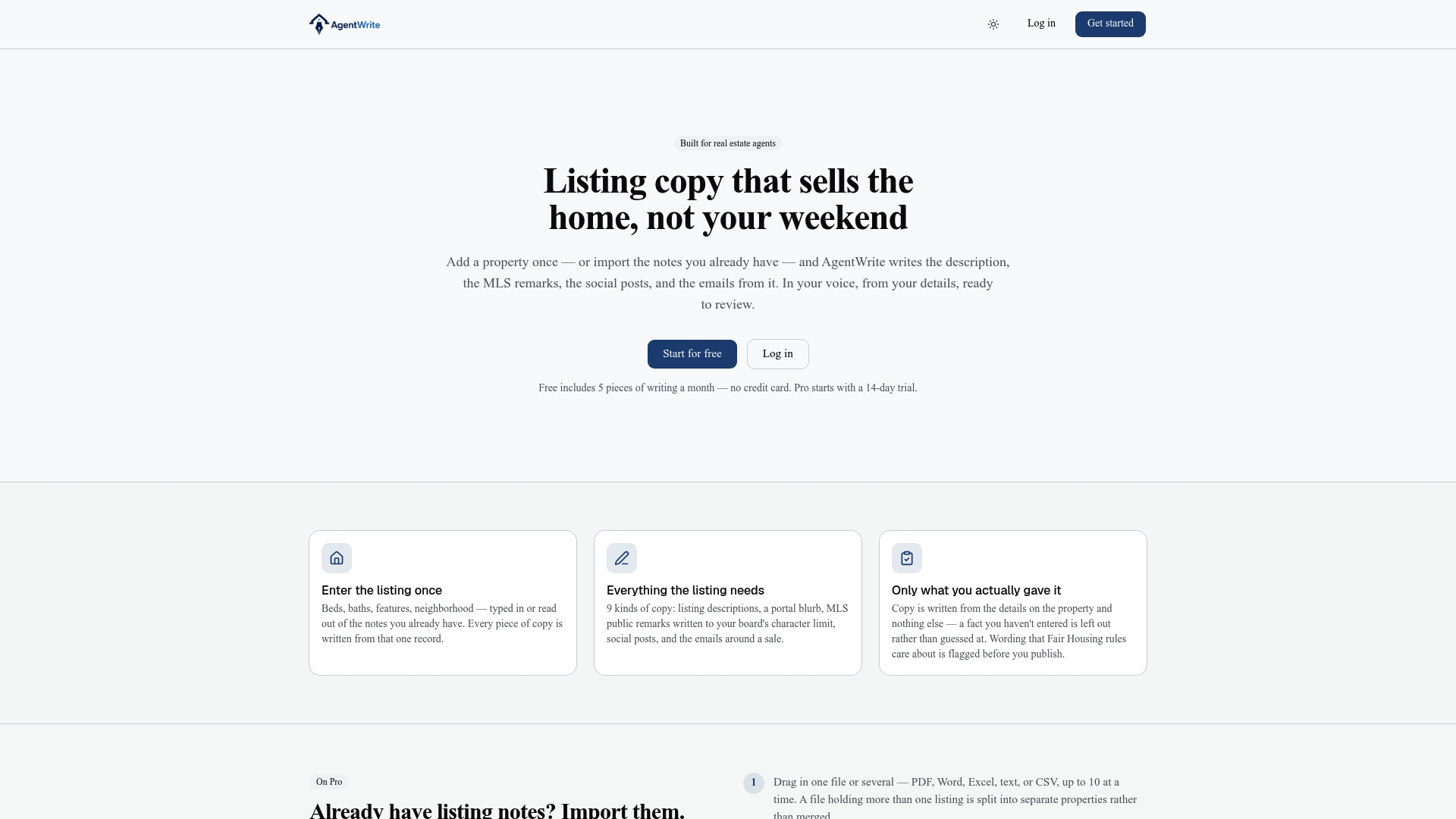
That matters most for agents juggling multiple active listings, where rewriting the same neighborhood facts five different ways eats time you’d rather spend with clients. Agentwrite’s free tier gives you a limited number of monthly drafts to test the workflow, and the Pro plan adds unlimited writing plus file import for agents who want every listing covered without starting from a blank page. Try a draft on your next listing at Agentwrite and see how much of the framework above it handles for you automatically.
Sources
- Fair Housing Act overview
- How to write neighborhood pages that actually rank
- How to write attractive rental listing descriptions (with examples)
FAQ
How do you describe your neighborhood in a listing?
Lead with the buyer type it serves, anchor that claim to a real place like a school or transit stop, and add one honest market or lifestyle detail, such as a commute time or a current price range.
How do you describe a good neighborhood without generic language?
Skip words like “desirable” or “up-and-coming” and instead name something verifiable: a school rating, a walk time to a named business district, or a recent price trend backed by MLS data.
What words can I use to describe a neighborhood?
Favor concrete, checkable terms: walkable, transit-adjacent, owner-occupied, established, low-turnover, rezoned, or a specific price range, rather than vague adjectives like “charming” or “prime.”
Can you give me an example of a neighborhood description?
“First-time buyers priced out of downtown are landing here for the 12-minute Blue Line commute and homes still listing under $650,000.” It names the buyer, anchors to a transit line, and closes with a checkable price point.
What should agents avoid when writing about a neighborhood?
Avoid phrases tied to protected classes, like “family-oriented” or “quiet adult community” unless the property is a legally qualified 55+ community, since HUD’s Fair Housing guidance treats this kind of framing as discriminatory targeting.