

What Goes in a Pre-Listing Packet (Plus Copy-Ready Templates)
What Goes in a Pre-Listing Packet (Plus Copy-Ready Templates)

A pre-listing packet is a printed or digital presentation an agent sends a seller before the listing appointment to prove they’re the right person for the job. Six items separate a packet that wins listings from one that gets skimmed: your agent bio, a marketing plan, a market snapshot, testimonials, seller homework, and clear contact information with a call to action. Build or update those six pieces this week, then read on for the details, timing, and templates that make each one land.
- Agent bio with a headshot and one or two credentials, not a résumé
- Marketing plan naming the specific channels and deliverables you’ll use
- Market snapshot that teases value without giving away the full CMA
- Testimonials from three to five recent, relevant transactions
- Seller homework so they arrive at the appointment prepared
- Contact info and a direct next step at the end, not buried mid-packet
Key Takeaways
A pre-listing packet wins listings when it pairs a clear market snapshot and marketing plan with proof (testimonials, credentials) and a specific next step for the seller.
| Point | Details |
|---|---|
| Lead with six core items | Agent bio, marketing plan, market snapshot, testimonials, seller homework, and contact info with a call to action. |
| Time delivery deliberately | Send by email after the intake call, a few days before the appointment, with a two-message reminder cadence. |
| Save the full CMA for later | Show a short neighborhood snapshot in the packet and reserve the complete valuation for the in-person meeting. |
| Personalize without rebuilding | Swap the address, one neighborhood detail, and the closest comparable case study instead of starting from scratch. |
| Speed compliant copy with AgentWrite | Generate cover letters, MLS remarks, and seller pitch text from one input, with built-in Fair Housing phrasing checks. |
Table of Contents
- What to Include in a Pre-Listing Packet
- Copy-Ready Pre-Listing Packet Templates
- When Should You Send a Pre-Listing Packet?
- Personalizing Your Packet Without Extra Work
- Designing a Packet That Looks Premium on a Budget
- Can AI Speed Up Your Pre-Listing Packet Copy?
- Printable Pre-Listing Checklist
- How Much Market Data Should You Actually Show?
- What Legal Disclosures Belong in a Pre-Listing Packet?
- What Questions Do Sellers Actually Ask Before Listing?
- Why Pre-Listing Packets Actually Help Sellers
- Customizing Packets for Different Property Types
- A Packet That Won a Listing on Page One
- Generate Packet Copy Faster With AgentWrite
- Templates and Guides Worth Bookmarking
- Sources
- FAQ
What to Include in a Pre-Listing Packet
Every packet works or fails on the same seven pieces. Get these right and the rest is formatting.
- Agent bio. Keep it to 150 to 200 words. Lead with years in the local market, one or two credentials (broker license, CRS, local board leadership), and a portrait, not a studio glamour shot. A study cited by McKissock Learning found people are significantly more likely to engage with photos that include faces, which is exactly why a bio page without your picture underperforms one with it.
- Market snapshot. Show high-level trends: median days on market, list-to-sale ratio, a one-line note on inventory. Save the full comparative market analysis for the in-person meeting. A short neighborhood snapshot of three to five comparables teases your pricing expertise without doing the appointment’s job for you.
- Marketing plan. Name actual channels: MLS syndication, targeted social ads, professional photography, a video walkthrough, an open house schedule. Vague promises (“I’ll market it everywhere”) read as filler.
- Testimonials and case studies. Three to five recent, relevant quotes beat a wall of twenty. Pair one with a recent sale story that mirrors the seller’s situation (similar price point, similar neighborhood).
- Selling timeline. Walk through the process in five or six steps, from listing prep to closing, so sellers know what to expect and when.
- Seller documents and homework. List what to gather: disclosures, HOA paperwork, mortgage payoff info, receipts for major improvements.
- Media. High-resolution photos, a floor plan, and a link to a virtual tour if the property (or a comparable listing) has one.
A strong pre-listing packet works like a beefed-up résumé; it’s not just information, but proof you’ve already done the homework most agents skip.
Copy-Ready Pre-Listing Packet Templates
Steal these structures and adjust the details to your market.
Cover page checklist: your headshot, brokerage logo, the seller’s property address, and a three-line welcome note.
Cover letter template: “Thank you for the opportunity to discuss selling your home at [address]. Inside, you’ll find my marketing approach, recent results in [neighborhood], and a short list of things to have ready for our meeting. P.S. Please review the homework checklist on page 6 before we talk.”
Marketing plan outline with sample bullets:
- Online: MLS syndication to Zillow, Realtor.com, and Redfin; targeted Facebook and Instagram ad set; professional listing video
- Offline: yard sign with QR code, open house within the first two weekends, printed flyers for neighborhood drop-off
CMA excerpt (neighborhood snapshot only): Three comparable homes within a half-mile closed between [range]." Save the full valuation for the live appointment.
Delivery formats: PDF attachment, a linked online packet (Highnote, Canva, or a branded landing page), or a printed leave-behind for sellers who prefer paper.
Pro Tip: Keep one master template with placeholder brackets for address, neighborhood, and comp figures. Swapping four data points takes five minutes; building from scratch every time doesn’t.
When Should You Send a Pre-Listing Packet?
Timing determines whether the packet gets read or ignored.
- Send after the initial intake call, once you know the address and have a few days before the appointment. Sending in advance gives sellers time to actually review the material instead of skimming it in your driveway.
- Use a two-message cadence. Subject line one: “Your Pre-Listing Guide for [Address].” Subject line two, sent a day or two before the appointment: “Quick Reminder Before We Meet Thursday.”
- Check engagement data before you walk in. Platforms like Highnote track opens and clicks, so you’ll know if the seller watched your video or skipped the marketing plan, giving you real conversation material at the table.
Personalizing Your Packet Without Extra Work
You don’t need a custom packet from scratch for every seller. A handful of targeted swaps does the job.
- Pull public records and recent comparable sales for the specific address before you write anything
- Note one neighborhood selling point (a new school rating, a transit line, a park renovation) and drop it into the cover letter
- Swap the case study on page 4 for one closest in price and location to the seller’s home
- Add a seller homework checklist: disclosures, HOA documents, current loan balance, receipts for major improvements
Small, specific asks work better than one big request. Micro-conversions, like asking sellers to gather three documents before the appointment, build a sense of commitment that a single “please prepare everything” line never does. A cover letter that names the street, the school district, or a recent comp down the block reads as personal attention, not a mail merge.
Designing a Packet That Looks Premium on a Budget
Good design costs almost nothing if you follow a few rules.
- Stick to two fonts: one for headings, one for body text
- Use white space generously; a cramped page reads as amateur regardless of content quality
- Caption every photo with a one-line detail (renovated in 2023, south-facing backyard)
- Link virtual tours instead of embedding heavy video files that slow down email delivery
- Keep your logo, colors, and fonts identical across every page for brand consistency
Printed and bound copies still matter for sellers who want something to hold, but a clean PDF works for most and costs nothing to produce.
Pro Tip: Export your packet as a PDF with a one-page executive summary as the first sheet. Some sellers only ever read page one, and if that page carries your bio, your marketing plan headline, and your phone number, you’ve still made the sale case.
Can AI Speed Up Your Pre-Listing Packet Copy?
Automated writing tools work well for anything formulaic: MLS remarks, cover letter drafts, and email follow-ups where the structure repeats but the details change. Save manual writing for the parts that need a personal touch, like a specific story about why you love a neighborhood.
A platform like AgentWrite can generate listing descriptions, cover letter snippets, and seller pitch text from property details you enter once, then export that copy directly into your packet template. The bigger issue with AI-generated real estate copy isn’t quality. It’s compliance: language that unintentionally signals a preference based on a protected class. Run a quick Fair Housing phrasing check on any AI draft before it goes to a seller, and keep an edit checklist so you catch biased descriptors on the same pass every time.
Printable Pre-Listing Checklist
Paste this into your packet or send it as a standalone email attachment before the appointment.
| Item | Who Handles It |
|---|---|
| Disclosures, HOA documents, mortgage payoff statement | Seller |
| Improvement receipts and permits | Seller |
| Spare keys or garage remote for showings | Seller |
| Professional photos ordered | Agent |
| CMA and market snapshot finalized | Agent |
| Marketing assets (flyers, social posts, video) queued | Agent |
| Packet reviewed for Fair Housing compliance before sending | Agent |
Run through this list once before you hit send. A packet with a missing CMA or an unfinished marketing plan undercuts the professionalism the rest of the document is trying to establish.
How Much Market Data Should You Actually Show?
Sellers want proof you understand their market, not a spreadsheet dump. Stick to three or four high-level figures: median days on market, current inventory levels, list-to-sale ratio, and a one-line trend note (buyer’s market, seller’s market, or balanced). That’s enough to demonstrate expertise without doing the pricing conversation’s job before you’re in the room.
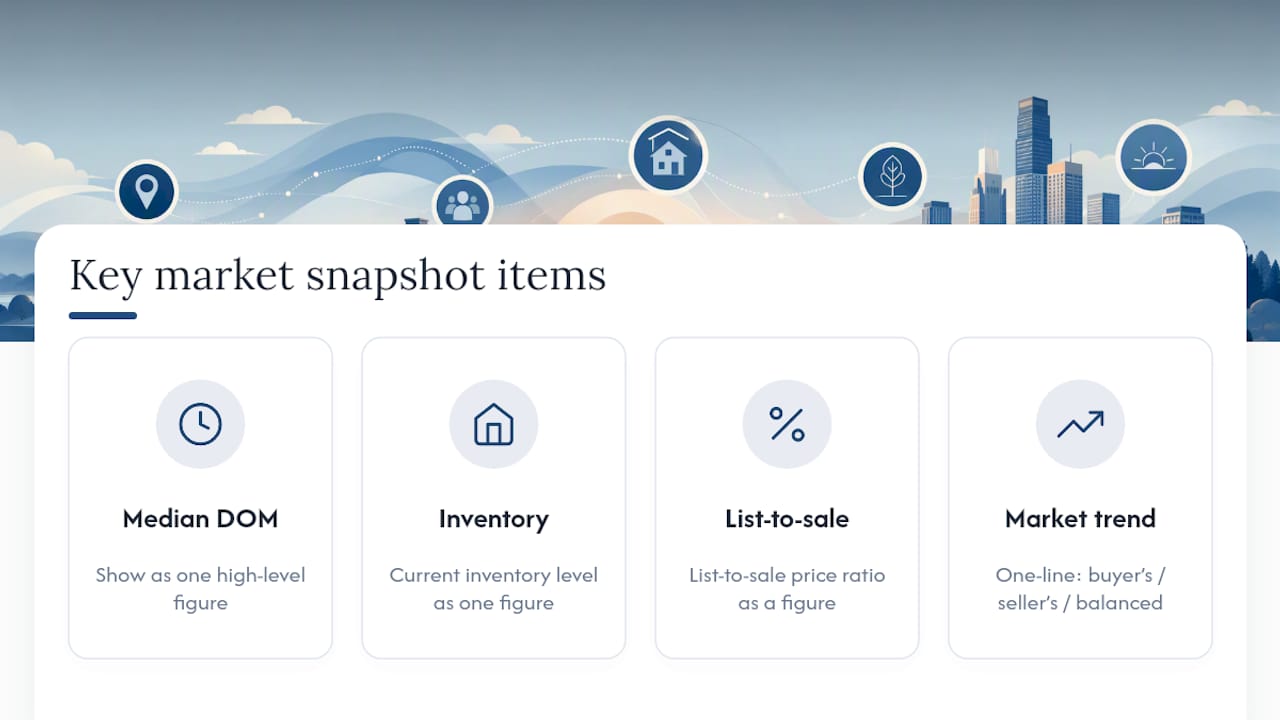
Timing the full comparative market analysis matters as much as the numbers themselves. A complete CMA belongs in the live appointment, not the packet, for a simple reason: once a seller sees a suggested price on paper, the conversation shifts from “let’s discuss strategy” to “why is this number what it is” before you’ve had a chance to walk them through your reasoning. The neighborhood snapshot approach sidesteps that problem. Three to five comparable sales, summarized in two or three sentences, prove you’ve done the research while leaving the actual valuation conversation for face-to-face.
Update your snapshot figures monthly if your market moves quickly, quarterly if it’s stable. Stale numbers (a “hot market” reference during a slowdown) undercut your credibility faster than no data at all. If you work multiple neighborhoods, keep a simple spreadsheet with current stats for each so building a snapshot for a new listing takes minutes, not a fresh pull every time.
What Legal Disclosures Belong in a Pre-Listing Packet?
Requirements vary by state and by property type, so treat this section as a starting framework, not a substitute for your broker’s compliance checklist or an attorney’s review. Most packets include a blank or sample seller’s property disclosure form so the seller can start thinking through answers before the appointment, along with a summary of any state-specific disclosure obligations (lead paint for homes built before 1978, flood zone status, known material defects).
A filled-out listing agreement, with every field complete except price, is a smart inclusion. It shows the seller exactly what they’re agreeing to and removes a layer of surprise from the actual signing. Pair it with your brokerage’s standard vendor list (title company, inspector referrals, contractor recommendations) so the seller sees you’ve already lined up the resources they’ll need.
Never present packet disclosures as a substitute for legal advice, and never let a seller assume a sample or blank form is legally binding until it’s actually completed and signed under your broker’s guidance. If your state requires a specific mandatory disclosure form (megan’s law notifications, homeowner association resale certificates, or similar), name it explicitly rather than folding it into a generic “disclosures” bullet. Sellers appreciate specificity here more than almost anywhere else in the packet, because this is the section where getting it wrong has real consequences.
What Questions Do Sellers Actually Ask Before Listing?
The same handful of questions come up in nearly every listing appointment, so answer them in the packet before the seller has to ask.
“How did you arrive at this price?” Point to your market snapshot and note that the full valuation comes in the live walkthrough, once you’ve seen the property’s condition and updates firsthand.
“What if my home doesn’t sell?” Address contract length and cancellation terms directly in your marketing plan or FAQ page rather than leaving it for a tense conversation later.
“How much does it cost to sell?” Sellers want to understand commission structure and typical closing costs before they commit to a conversation, not after.
“How long will this take?” Your selling timeline section should already answer this, but restate the average days-on-market figure from your snapshot here too.
“What do I need to do before you list it?” This is exactly what your seller homework checklist solves. Sellers who see a clear list feel more in control, not more burdened.
Addressing these questions inside the packet, rather than waiting for the seller to raise them cold, changes the tone of the appointment. You walk in having already answered their biggest worries, which frees up the meeting for strategy instead of damage control. Resources like Ryan Case’s seller FAQ show how direct, plain-language answers to exactly these questions build trust before a seller ever meets an agent in person.
Why Pre-Listing Packets Actually Help Sellers
A packet isn’t just a sales tool for you. It sets expectations that protect the seller from surprises later in the process. Sellers who receive a clear timeline upfront are less likely to panic when a home sits on the market for the average number of days rather than selling in 48 hours, because you’ve already told them what average looks like in their neighborhood.

The homework checklist does double duty: it prepares the seller for the appointment, and it prepares them for the disclosures and paperwork that come later in escrow. A seller who’s already located their mortgage payoff statement and HOA documents moves faster once an offer arrives.
There’s also a trust dividend. Delivering a packet in advance signals professionalism and, according to agents who track their own conversion rates, frequently increases the odds that a seller signs with the agent who sent one over an agent who showed up empty-handed. For sellers weighing multiple agents, a packet is often the first real evidence of how organized that agent will be once the property is actually listed.
Customizing Packets for Different Property Types
A condo seller and a rural acreage seller need different information, even though the packet’s skeleton stays the same.
For condos and townhomes, add a section on HOA fees, rules, and any pending special assessments, since these questions come up immediately with attached housing. For luxury listings, lean harder on your marketing plan (professional staging, drone photography, targeted print placements) and trim the homework list, since these sellers often have documents already organized through a property manager or attorney. For investment properties, include a rent roll or income summary alongside your market snapshot, since the buyer pool and pricing logic differ from owner-occupied comparables.
For first-time sellers, expand the selling timeline section with more detail and add a short glossary of terms (escrow, contingency, earnest money) since the process itself is unfamiliar. For rural or acreage properties, swap the standard neighborhood comps for regional comparables and add a note on well, septic, or land-use considerations if relevant to your market.
The seven core components stay fixed. What changes is emphasis: more marketing detail for high-end listings, more education for first-time sellers, more disclosure specificity for properties with unique legal considerations.
A Packet That Won a Listing on Page One
The best pre-listing packets aren’t the longest ones. A seller once told an agent colleague she’d decided within the first two pages, purely because the market snapshot answered a question three other agents hadn’t even addressed. Keep your executive summary sharp and lead with your strongest proof point.
Pro Tip: Build a five-minute review habit: read your own packet as if you’re the seller, and cut anything that doesn’t answer a question they’d actually ask.
— Tyler
Generate Packet Copy Faster With AgentWrite
Building a pre-listing packet from scratch every time eats into hours you could spend prospecting or prepping for the appointment itself. AgentWrite cuts that time down by generating listing descriptions, MLS remarks, cover letter snippets, and email templates from property details you enter once, in your own voice, instead of rewriting the same boilerplate for every new address.
The compliance layer is what separates it from a generic writing tool: every draft gets checked for Fair Housing phrasing concerns before it lands in your packet, so you’re not manually re-reading every line for language that could put a listing at risk. You can generate seller-facing pitch text, social posts, and portal blurbs from the same input, then export directly into your packet template. If you’re rebuilding your pre-listing materials for the year ahead, start a trial at AgentWrite and see how much faster your next packet comes together.
Templates and Guides Worth Bookmarking
- Pre-Listing Packet CAMP 4:4:3 Tool Kit — Keller Williams (PDF) for a filled-out listing agreement and checklist format
- Pre-Listing Package + Free Checklist & Templates — Highnote for editable templates with engagement tracking
- The Essential Pre-Listing Home Seller’s Guide Template — ShowingTime for a downloadable seller guide format
Sources
- Include in a Powerful Pre-Listing Package - McKissock Learning
- Pre-Listing Packet CAMP 4:4:3 Tool Kit — Keller Williams (PDF)
- Pre-Listing Package + FREE CHECKLIST & Templates — Highnote
FAQ
What Does Pre-Listing Mean in Real Estate?
Pre-listing refers to the period before a property officially goes on the market, when an agent gathers information, prepares marketing materials, and meets with the seller to secure the listing agreement.
Is a Pre-Listing Inspection a Good Idea?
A pre-listing inspection can surface repair issues before buyers find them, which often speeds up negotiations and reduces the odds of a deal falling apart after an offer is accepted. It’s an optional add-on to your packet, not a required component.
How Much Is a Pre-Listing Appraisal?
Costs vary significantly by location, property size, and the appraiser hired, so check with a licensed appraiser in your market for a current quote rather than relying on a single national figure.
How Much Commission Does a Realtor Make on a $300,000 Home?
Commission rates are negotiable and vary by market, brokerage, and the specific agreement between agent and seller, so there’s no fixed national rate to quote. Your packet’s marketing plan section is the right place to explain your specific fee structure and what it covers.
Can AI Help Write My Pre-Listing Packet Copy?
Yes. Tools like AgentWrite can draft cover letter snippets, MLS remarks, and seller pitch text from property details, with a Fair Housing phrasing check built into the workflow before you send anything to a seller.