

Agents: Property Feature Bullets That Sell, Paste Ready & Compliant
Agents: Property Feature Bullets That Sell, Paste Ready & Compliant

Use 4 to 6 benefit-first bullets, anchored to verifiable facts, ordered so the strongest selling point leads. Bullet 1 states the primary reason a buyer should care, bullets 2 and 3 back it up with proof and lifestyle context, and the rest add quality reassurance before closing with a low-friction detail. For MLS remarks, keep total copy between 150 and 250 words and never sacrifice a real number for a vague adjective.
TL;DR:
- Highlighting verifiable details like renovation years, appliance brands, or measurements increases credibility and draws buyer attention more effectively than vague adjectives.
- The first bullet should focus on the property’s strongest unique selling point to capture interest immediately, especially given mobile viewers often see only the initial two or three bullets.
- Each bullet should serve a specific purpose, such as proving the main benefit, illustrating lifestyle use, or providing reassurance through recent updates or warranties.
- Using a five-bullet framework ensures the listing builds a persuasive, logical argument, with each line offering a different, impactful piece of information.
- Including only verifiable data and adhering to formatting rules creates scannable, trustworthy copy that engages buyers quickly and reduces listing update time.
Table of Contents
- What Makes Property Feature Bullets Worth the Effort
- The Five-Bullet Sequence That Does the Persuading for You
- Copy-Ready Templates for the Three Listings You Write Most
- Formatting Rules That Keep Bullets Scannable
- Getting the Length Right Across MLS and Portals
- Compliance and Photo Alignment Before You Publish
- Your 90-Second Pre-Publish QA Pass
- What Hundreds of Listings Taught Us About Writing Bullets
- Write Bullets in Minutes, Not Meetings
- Primary Sources and Quick References
- Sources
- FAQ
What Makes Property Feature Bullets Worth the Effort
Buyers see your bullets before they read a single sentence of prose. They sit right under the price and hero photo, which makes them the first block of text a scrolling buyer actually processes, and on most listing portals that placement gets more eye contact than anything else on the page except the photos themselves.
Mobile changes the math further. Only the first two to three bullets typically display without expansion, so whatever you put first is often the only thing a phone-scrolling buyer ever sees before swiping to the next listing. If your best feature is buried in bullet 5, most mobile users never find it.
This is why vague adjectives lose to hard facts almost every time. “Beautifully updated kitchen” tells a buyer nothing they can verify. “Kitchen renovated in 2024 with quartz counters” gives them something to picture and something to check against the photos. Real estate copy built on verifiable details like brands, years, and measurements reads as more credible, and credibility is what gets a buyer to book a showing instead of scrolling past.
A few things separate a bullet that earns a click from one that gets skimmed and forgotten:
- It leads with a benefit, not a feature name alone (not “granite counters,” but what the counters mean for daily use).
- It includes at least one hard number, brand, or date where possible.
- It avoids stacking three adjectives in a row with nothing to back them up.
- It fits in one line on a phone screen without wrapping awkwardly three or four times.
Get those four right and the rest of the listing does less work convincing anyone of anything.
The Five-Bullet Sequence That Does the Persuading for You
Bullets don’t work as a random list of nice things. They work as a small argument, and each one has a job. Following a bullet framework built around lead-in, benefit, and proof, here’s the role each position should play:
- Primary USP. Answer “why this property, specifically” in one line. This is the single strongest, most differentiating benefit the home offers, and it should never be generic.
- Proof or metric. Back up bullet 1 with a year, brand, dimension, or credential. If bullet 1 claims a “renovated chef’s kitchen,” bullet 2 might name the appliance brand or the square footage of the island.
- Lifestyle or use case. Translate a feature into how someone actually lives with it, whether that’s a fenced yard for a dog owner or a finished basement that functions as a home office.
- Quality or reassurance. This is where systems, materials, and recent replacements go, things that lower a buyer’s perceived risk (new roof, updated HVAC, recent inspection).
- Risk reversal or closing detail. Parking, storage, a transferable warranty, or a low-pressure next step. This bullet often closes the loop on a practical concern a buyer hasn’t voiced yet.
A quick example of the sequence in action:
- Chef-caliber kitchen anchors the main level with a 9-foot waterfall island.
- Fully renovated in 2024 with Bosch appliances and quartz counters throughout.
- Open layout connects kitchen to dining and yard, ideal for entertaining or remote work with a view.
- New roof and HVAC (2023) back the sale with a 10-year manufacturer warranty.
- Two-car garage plus driveway parking for guests or a second vehicle.
Notice how each line does something different. None of them repeat the same job twice, and by bullet 5 the buyer has a full picture without a single wasted word.
Copy-Ready Templates for the Three Listings You Write Most
Most agents cycle through the same three property types over and over. Having a template for each saves time and keeps the sequencing framework intact even when you’re writing fast.
Renovated single-family home. Lead with the biggest visible upgrade, back it with the year and brand, then move to layout, systems, and parking.
- Fully renovated in [year] with [brand] kitchen appliances and [material] counters.
- Primary suite features a spa-style bath with [measurement] walk-in shower.
- Open-concept main level flows to a fenced backyard, perfect for entertaining.
- New roof and windows ([year]) reduce buyer maintenance risk for years.
- Attached two-car garage with additional driveway parking.
Condo with amenities. Lead with the amenity that competitors in the building don’t have, then stack lifestyle and low-maintenance appeal.
- Building offers a rooftop deck with skyline views, rare for this price point.
- Unit includes in-unit washer/dryer and [measurement] of private balcony space.
- HOA covers water, trash, and exterior maintenance, keeping monthly costs predictable.
- Secure garage parking included, a premium in this neighborhood.
- Steps from [landmark or transit line], cutting commute time significantly.
Investment or fixer-upper. Lead with the number that matters most to an investor: cap rate potential, lot size, or zoning flexibility.
- Zoned for [use], opening multiple redevelopment or rental strategies.
- [Measurement] lot with alley access, ideal for an ADU or expanded parking.
- Roof and foundation inspected [year], no major deferred maintenance found.
- Priced below comparable renovated units in the same zip code.
- Long-term tenant in place, generating immediate cash flow at closing.
| Scenario | Bullet 1 focus | Bullets 4 to 6 focus |
|---|---|---|
| Renovated single-family | Biggest visible upgrade | Systems, warranty, parking |
| Condo with amenities | Rare building amenity | HOA coverage, location, parking |
| Investment or fixer | Zoning or lot potential | Inspection status, price position, tenancy |
Keep every bracketed placeholder filled with a real number or name before publishing. MLS systems strip most special characters, so skip emojis, asterisks, and ALL CAPS anywhere in the bullet text.
Formatting Rules That Keep Bullets Scannable
Pick one grammatical form, either short phrases or full sentences, and use it for every bullet in the listing. Mixing “Renovated kitchen with new appliances” with “The kitchen was renovated and features new appliances” forces a buyer’s brain to reset with each line, which slows reading and looks unpolished.
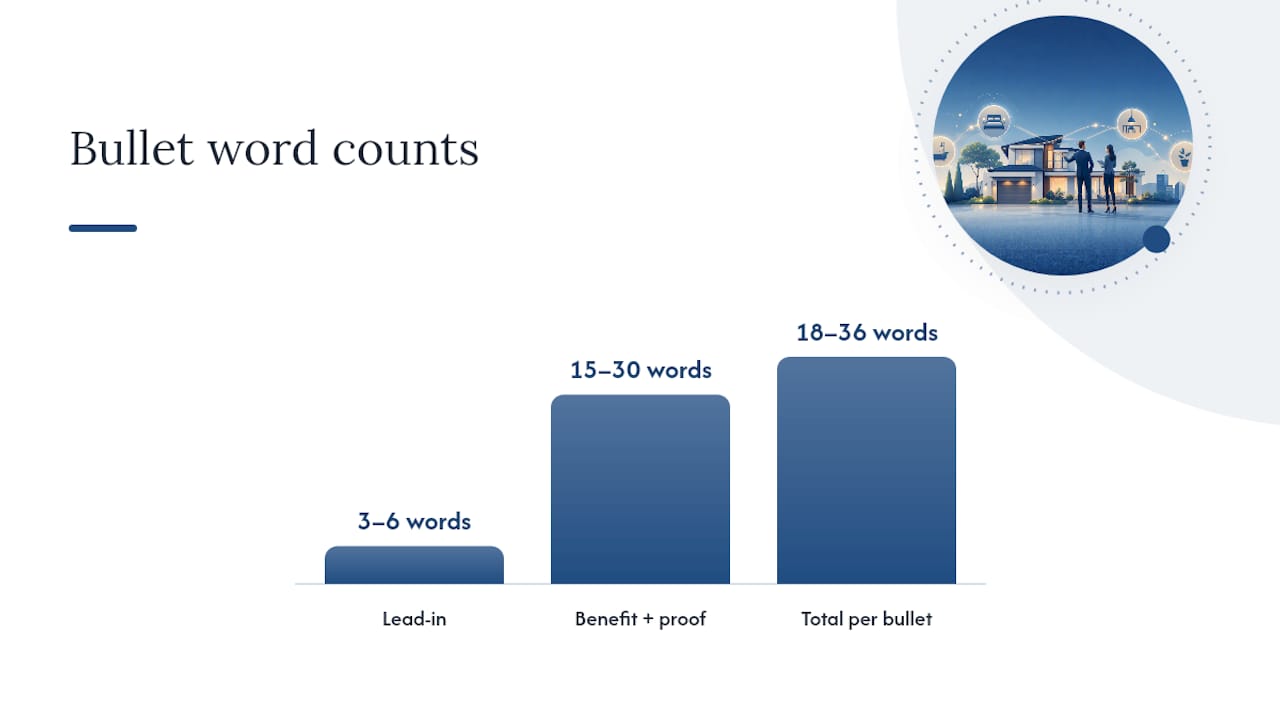
A consistent structure across a bulleted list preserves scanability, and that consistency starts with a short lead-in of three to six words that acts as a visual anchor, followed by 15 to 30 words of benefit and proof.
- Start each bullet with a bolded or capitalized lead-in phrase.
- Follow immediately with the concrete benefit, not a restated feature name.
- Close with a proof point: a year, brand, dimension, or credential.
- Cut “stunning,” “amazing,” and “must-see” unless a specific fact follows in the same breath.
Pro Tip: Read your five bullets out loud back to back. If two of them could describe almost any listing in the area, rewrite one with a real number pulled from the inspection report or appraisal.
Getting the Length Right Across MLS and Portals
MLS remarks have the tightest constraints of any platform you’ll write for. Aim for 150 to 250 total words, with your feature bullets making up four to six of those lines, and strip out special characters and emojis since most MLS systems reject or mangle them on submission.
Zillow, Redfin, and similar portals give you more room. Use that extra space to expand on lifestyle context you couldn’t fit in the MLS remarks, not to introduce claims that contradict what you wrote there.
Before cross-posting the same listing across platforms, run this quick check:
- Confirm square footage matches on every platform, including the MLS sheet.
- Confirm dates (renovation years, roof age) are identical everywhere they appear.
- Confirm brand names are spelled the same way in every version of the copy.
- Confirm no platform’s bullets contradict another platform’s description.
Compliance and Photo Alignment Before You Publish
Every listing needs a quick Fair Housing pass. The Department of Justice’s Fair Housing Act guidance prohibits language that signals preference based on protected classes, so swap “great for families” with “four bedrooms” and “walkable, safe neighborhood” with “sidewalks and streetlights throughout.”
Buyers cross-reference your bullets against your photos within seconds. If bullet 1 claims a renovated kitchen and the hero photo shows dated cabinets, that mismatch costs you trust before the buyer reads bullet 2.
That’s why the lead photo should visually support whatever bullet 1 claims. If bullet 1 highlights a renovated kitchen, the first photo needs to be that kitchen, not the front yard.
Pro Tip: AgentWrite flags risky Fair Housing phrasing automatically as it generates bullets, so common missteps get caught before the listing goes live instead of after a complaint.

Your 90-Second Pre-Publish QA Pass
Run through this before every listing goes live:
- Check that each bullet includes at least one verifiable data point (year, brand, or measurement) where possible.
- Confirm the top photo matches the claim in bullet 1, and that every date and brand name matches your supporting documents.
- Scan every bullet for Fair Housing red flags, then confirm your MLS remarks fall within the platform’s character limit.
What Hundreds of Listings Taught Us About Writing Bullets
Starting from a five-bullet template instead of a blank page cuts drafting time dramatically, mostly because the sequencing decisions are already made. The most common mistake we see is agents reaching for adjectives when a single date or brand name would do more persuading. Templates get you moving fast; a 90-second QA pass is what keeps that speed from turning into sloppy, unverifiable copy.
— Tyler
Write Bullets in Minutes, Not Meetings
Agentwrite gets you a full set of MLS-safe bullets, portal blurbs, and social captions from one round of property details, instead of retyping the same facts into three different templates. You enter the address, the year the roof was replaced, the appliance brand, the square footage, once, and Agentwrite writes matching copy for MLS remarks, portal descriptions, and a social post in your own voice, flagging any Fair Housing phrasing risk along the way.
That single-input workflow is the real time saver: instead of manually rewriting five bullets into a longer Zillow description and then again into a social caption, you get all three from one entry. Start a free draft on the Agentwrite listing copy platform and see your next listing’s bullets generated before your coffee gets cold.
Primary Sources and Quick References
- Fair Housing Act guidance | U.S. Department of Justice
- How to write a listing description | Opendoor
- How to use bullet points | Merriam-Webster
- Amazonfba
- Structuring feature bullets | Shortlist Properties
Sources
FAQ
What is the 3-3-3 rule in real estate?
It’s a shorthand some agents use for pacing a sale: roughly the first 3 days for initial buyer interest, 3 weeks for serious offer activity, and 3 months as a benchmark for how long a well-priced, well-marketed listing should take to close. It’s not an official standard, and results vary widely by market.
What makes a house sell fast?
Accurate pricing and strong photos matter most, but the copy underneath them, especially the first two or three feature bullets a buyer sees, drives whether someone clicks in for a closer look or scrolls past. Listings with verifiable facts instead of vague adjectives tend to build buyer trust faster.
What are the three types of property?
Real estate is generally classified into residential, commercial, and industrial property, with land sometimes treated as a fourth category depending on the source.
What are the 7 characteristics of real estate?
Common lists include immobility, indestructibility, uniqueness, scarcity, improvements, permanence of investment, and location, though the exact wording varies by textbook and isn’t governed by one universal standard.
How many bullets should a listing have?
Aim for 4 to 6 bullets, each anchored to a verifiable fact, with the strongest selling point in bullet 1 since mobile users often see only the first two or three without expanding the listing.
Can AgentWrite help write Fair Housing compliant bullets?
Yes. Agentwrite flags potentially risky Fair Housing phrasing as it generates MLS remarks and portal copy, and keeps every bullet anchored to the property facts you enter rather than generic filler language.