

10 Minute Compliance First Real Estate Brand Guidelines for Brokers
10 Minute Compliance First Real Estate Brand Guidelines for Brokers

Real estate brand guidelines work when they force two things at once: a voice buyers recognize across every listing, and wording that never triggers a Fair Housing complaint. The fastest fix is a one-page rulebook covering vocabulary, forbidden phrases, and channel formats, paired with a tool like Agentwrite that flags risky language before it publishes. Everything below builds that rulebook, section by section.
TL;DR:
- Fair Housing compliance is critical, requiring careful avoidance of proxy language related to protected classes and thorough review of ad targeting settings.
- Establish clear, concise voice pillars like credible, vivid, and concise, supported by an approved vocabulary list and a forbidden-word table linked to Fair Housing rules.
- Use standardized, fact-based headlines and openers tailored to property types, and create three versions of listings for MLS, website, and social media.
- Implement a repeatable workflow with automated flagging tools and designated compliance reviewers to ensure listings are both consistent and lawful before publishing.
- Utilize AI platforms like Agentwrite to generate compliant listing copy from property details, reducing editing time while maintaining adherence to Fair Housing standards.
Table of Contents
- What Belongs in Your Real Estate Brand Guidelines?
- What Fair Housing Rules Actually Affect Listing Copy?
- Headlines, Openers, and Ready-to-Paste Listing Templates
- How Should Listing Copy Change Across Channels?
- What’s the Workflow for Publishing Compliant Listing Copy?
- Why Consistent, Compliant Copy Comes Down to Process
- How Do Logo Rules Protect Brand Recognition?
- What Color Codes Belong in Your Brand Palette?
- What Typography Rules Keep Materials Consistent?
- What Makes Real Estate Photography On-Brand?
- What Should a Brand Positioning Statement Say?
- How Do Brand Rules Change Across Print, Digital, and Merchandise?
- Compliance Rules Matter More Than Style Preferences
- Try Agentwrite for Consistent, Compliant Listing Copy
- Sources
- FAQ
What Belongs in Your Real Estate Brand Guidelines?
A usable set of real estate brand guidelines is short enough to read in ten minutes and specific enough that two different agents on your team produce nearly identical copy from the same listing sheet. Most brokerages skip this and end up with five writing styles across one office, which confuses buyers and slows down everyone’s editing process.
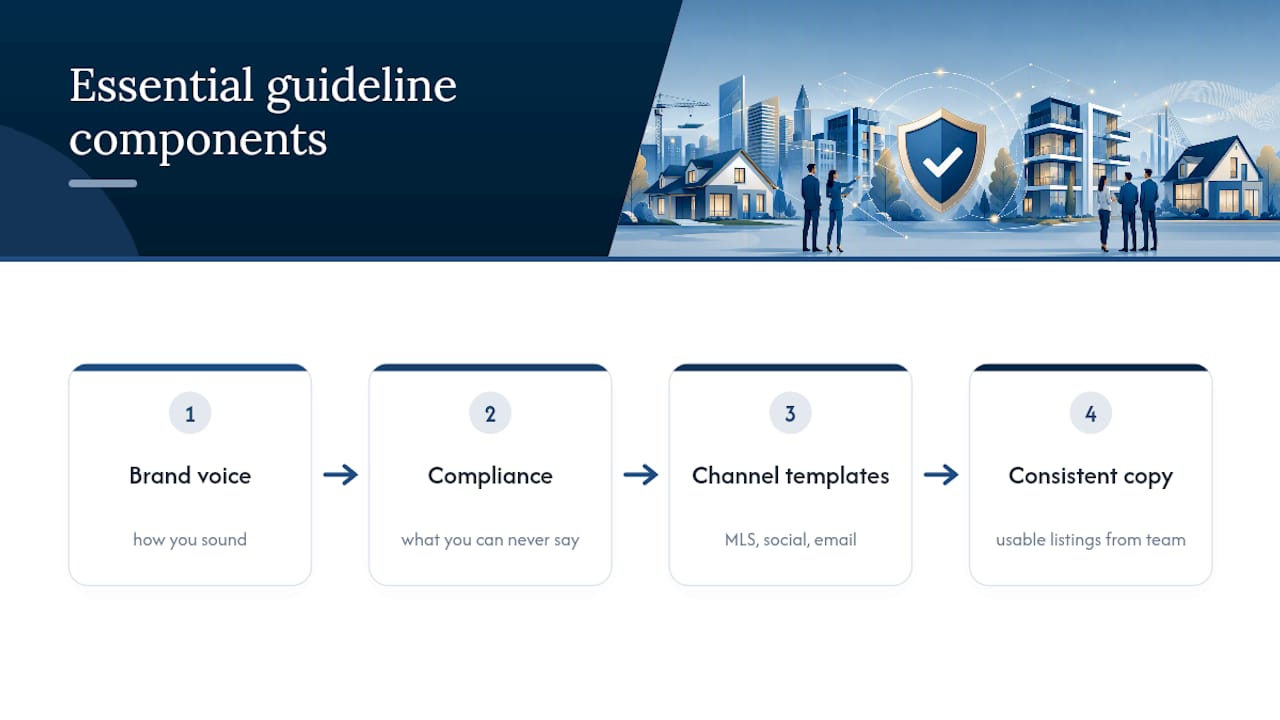
The core document needs a brand voice framework (how you sound), a compliance layer (what you can never say), and channel templates (how copy changes shape across MLS, social, and email). Skip any one of those three and the guidelines fall apart in practice: a beautiful voice guide with no Fair Housing rules is a liability, and a compliance checklist with no voice rules produces bland, forgettable listings.
Three voice pillars that actually hold up
Pick three adjectives that describe how your brokerage sounds, not what it sells. “Credible, vivid, concise” works well because each pillar gives you a testable rule:
- Credible means every claim is verifiable. Skip “stunning views” and write “unobstructed lake views from the primary suite.”
- Vivid means you describe a sensory or lived-in detail instead of a generic adjective. “Morning light floods the kitchen through east-facing windows” beats “bright and airy.”
- Concise means no sentence carries two ideas. Split it, or cut the weaker half.
Build a short approved-vocabulary list (move-in ready, updated, renovated, walkable) and a forbidden-words table tied directly to Fair Housing guidance, covering terms that reference family status, religion, national origin, or disability, even indirectly (“perfect for a young couple,” “walking distance to the church,” “no wheelchairs”).
Match tone to property type: luxury listings lean into craftsmanship and materials, starter homes lean into affordability and low-maintenance features, and historic properties lean into provenance and preserved detail. Realtor.com’s guidance on writing listing descriptions that convert makes the same point: specific, verifiable details outperform generic praise every time.
Before: “This gorgeous home won’t last long! Great for a growing family in a wonderful neighborhood.” After: “This 4-bedroom colonial sits on a quarter-acre lot with a fenced backyard and a 2023 roof replacement.”
Pro Tip: Keep your forbidden-words table next to your approved-vocabulary list in the same document. Editors catch more violations when the “don’t say this” and “say this instead” columns sit side by side.
What Fair Housing Rules Actually Affect Listing Copy?
The Fair Housing Act bars advertising that references race, color, religion, sex, national origin, familial status, or disability, and that ban extends to coded language, not just explicit terms. Phrases like “no kids,” “ideal for empty nesters,” or “close to [religious institution]” all function as proxy language for protected classes, even when the agent never intended discrimination.
Digital advertising raises the stakes further. Ad platforms let you target audiences by age, gender, or neighborhood, and those targeting features can produce a discriminatory outcome even when your ad copy is clean. Federal guidance instructs advertisers to identify housing ads to the platforms running them and to avoid targeting features that could produce a disparate impact, which means checking your audience settings is now as important as checking your copy.
Federal guidance also recommends auditing custom audience lists and ad delivery data rather than assuming a platform’s default settings are compliant.
Build a two-minute editor’s checklist before anything publishes:
- Scan for protected-class references and their common proxies (family-oriented, walkable to synagogue, bachelor pad).
- Confirm any human models in photos or graphics don’t suggest the property excludes certain groups.
- Check ad-targeting settings for age, gender, or ZIP code exclusions that could narrow the audience unlawfully.
- Confirm the equal housing opportunity statement and required publisher notices appear where your state mandates them, a standard covered in Virginia’s Fair Housing advertising guidance.
When a listing touches an unfamiliar situation, such as a property marketed to a religious community or an age-restricted development, escalate to your broker or legal counsel before publishing. The cost of a five-minute delay is nothing compared to a fair housing complaint.
Headlines, Openers, and Ready-to-Paste Listing Templates
Your first sentence functions as the headline, and it should name a specific, verifiable benefit instead of a greeting. “Welcome home” tells the reader nothing; “Sunset views from every west-facing room” tells them exactly what they’re getting, an approach industry guidance on high-converting listing descriptions backs consistently.
Six headline formulas mapped to property type:
- Luxury: “Custom Millwork and a Chef’s Kitchen Anchor This [Neighborhood] Estate”
- Starter home: “Move-In Ready 3-Bedroom With a Fully Fenced Yard”
- Historic: “Restored 1920s Craftsman With Original Hardwood Throughout”
- Condo/urban: “Corner Unit With Skyline Views and In-Unit Laundry”
- Investment property: “Turnkey Duplex With Two Long-Term Tenants in Place”
- Fixer-upper: “Solid Bones on a Quarter-Acre Lot, Ready for Your Vision”
Opening-line template: “[Property type] with [top differentiator], set in [neighborhood detail].” Fill in the blanks with facts, not adjectives: square footage, a recent renovation, a specific view, or a walkability detail.
Write three versions of every listing, a strategy Zillow’s listing-description guide also recommends:
- MLS snapshot (around 60 words): lead differentiator, bed/bath count, one standout feature, call to action.
- Full listing (200 to 250 words): headline, opening hook, three to four feature paragraphs, neighborhood context, closing CTA.
- Social caption (one to two lines): a single vivid detail plus a direct CTA (“Tour Saturday at 1 PM. Link in bio.”).
Replace vague adjectives with facts throughout: “spacious” becomes “1,850 square feet,” “updated” becomes “kitchen renovated 2024,” and “great location” becomes “0.4 miles from the elementary school.”
How Should Listing Copy Change Across Channels?
Each channel imposes its own format limits, and copy that ignores them either gets cut off or reads wrong. MLS fields often cap remarks between 500 and 1,000 characters depending on your local board, so lead with the single strongest differentiator first, since that’s what survives if the field truncates.
Social and ad copy carry separate rules. Keep captions short, use hashtags sparingly (three to five relevant ones beats fifteen generic ones), and never use targeting settings that narrow an audience by protected characteristics, a caution built directly into FHEO’s digital advertising guidance. Choose human models in ad creative carefully so imagery never implies a property caters to one group.
Email needs a benefit-driven subject line under 50 characters and a one-sentence teaser that mirrors your MLS headline, with the CTA placed above the fold, not buried after three paragraphs.
- Use the 60-word snapshot for MLS and portal previews.
- Use the full 200 to 250 word version for your website and print flyers.
- Use one to two lines for social, with a clear CTA every time.
What’s the Workflow for Publishing Compliant Listing Copy?
A repeatable workflow catches errors before they go live, and it doesn’t need to slow anyone down. The sequence that works for most teams:
- Draft the copy from verified property facts.
- Run it through automated Fair Housing flagging.
- Route it to a peer or broker for a second read.
- Publish across MLS, portals, and social.
Before publishing, confirm every item on a short checklist: measurements match the appraisal or listing sheet, no protected-class language or proxy terms survived the draft, photos and any human models were reviewed, the equal housing opportunity statement appears where required, and any paid ad has been certified against platform housing-ad policies.
Assign one person as the compliance reviewer per listing, even on small teams, and keep a version history so you can trace who approved what.
Pro Tip: Busy teams should draft copy the same day photos come back from the photographer. Waiting even 48 hours means someone has to re-verify facts from memory instead of from the shoot notes.
Why Consistent, Compliant Copy Comes Down to Process
Tyler has spent years watching agents and marketing teams wrestle with the same problem: everyone agrees consistency and compliance matter, but almost nobody has a document that operationalizes either one.
Agentwrite was built around that gap. It takes a single input of property details and generates MLS remarks, social captions, and emails in a selected voice, then flags language that could raise Fair Housing concerns before it ever reaches a broker’s desk. The platform doesn’t replace judgment, but it does catch the proxy phrases and vague adjectives that slip through when an agent is writing their fifth listing of the day.
Mapped against the workflow above, automated flagging replaces the manual first pass a broker would otherwise do by hand, which shortens the review cycle without skipping the review itself.
How Do Logo Rules Protect Brand Recognition?
Consistent logo use is what makes your brand recognizable across a yard sign, a postcard, and a social ad without a viewer having to think twice. The rules that matter most for a small brokerage or team come down to three things: minimum size, placement, and clear space.
Set a minimum size for both print and digital, typically no smaller than one inch wide on printed materials and 120 pixels wide on web or social placements, below which text inside the logo becomes unreadable. Define clear space as a fixed multiple of a consistent measurement within the logo itself, such as the height of the house icon, and require that no text, photo, or graphic element crosses that boundary.
Placement should stay consistent across every touchpoint: bottom right corner of listing flyers, top left of email headers, centered on yard signs. Consistency here matters more than any single placement choice, since buyers start recognizing the pattern after seeing it a handful of times.
Document what not to do as clearly as what to do: never stretch or compress the logo to fit a space, never place it over a busy photo background without a solid contrast panel behind it, and never recolor it outside the approved palette. Provide agents with pre-approved logo files in both light and dark versions so nobody improvises a workaround under deadline pressure.
What Color Codes Belong in Your Brand Palette?
A real estate brand palette needs exact codes, not descriptions like “navy blue,” because “navy blue” prints differently on every vendor’s press and displays differently on every screen. Document each color in three formats: HEX for digital and web, CMYK for print, and RGB for video or presentation software.
A palette built around a deep navy and a light neutral background, for instance, might document as navy (#1B2A4A HEX, C:85 M:65 Y:30 K:20 CMYK) paired with a warm off-white (#F7F5F1 HEX, C:2 M:2 Y:4 K:0 CMYK) and a single accent tone for calls to action. Keep the palette to three or four colors total. More than that, and every printed flyer starts looking like a different brand depending on which agent built it.
Specify usage ratios alongside the codes: primary navy dominates headers and logo elements, the neutral background carries most of the page, and the accent color appears only on buttons, links, or small highlight details, never as a dominant field color. This prevents the accent from overwhelming the composition, which is a common mistake when agents build their own flyers in a template tool without brand oversight.
Store the palette in a shared file every team member can access, whether that’s a PDF, a Canva brand kit, or a shared style sheet, so nobody is eyeballing a color from a screenshot of last quarter’s postcard.
What Typography Rules Keep Materials Consistent?
Typography carries as much brand weight as a logo, and most brokerages underestimate that until two agents produce flyers in completely different fonts for the same open house weekend. Set a primary typeface for headlines, a secondary typeface for body copy, and document exact size and weight rules for each.
A brand built around traditional serif typography, such as Times New Roman, might use it at 24 to 36 point bold for headlines and pair it with a clean sans serif at 10 to 12 point for body text and fine print, since long paragraphs in a serif face can slow reading on screens. That contrast between a traditional headline font and a modern body font is a common pairing in professional service branding because it signals both heritage and clarity.
Build a simple hierarchy: headline size, subheadline size, body text size, and caption or disclaimer size, each with a fixed point range for print and a corresponding pixel range for digital. Specify line spacing too. Cramped line spacing is one of the fastest ways to make a professional flyer look amateur.
Limit the total typeface count to two, maybe three if you add a distinct font strictly for pull quotes or callouts. Every additional typeface is another inconsistency waiting to happen once five different agents start building their own materials from a shared template.
What Makes Real Estate Photography On-Brand?
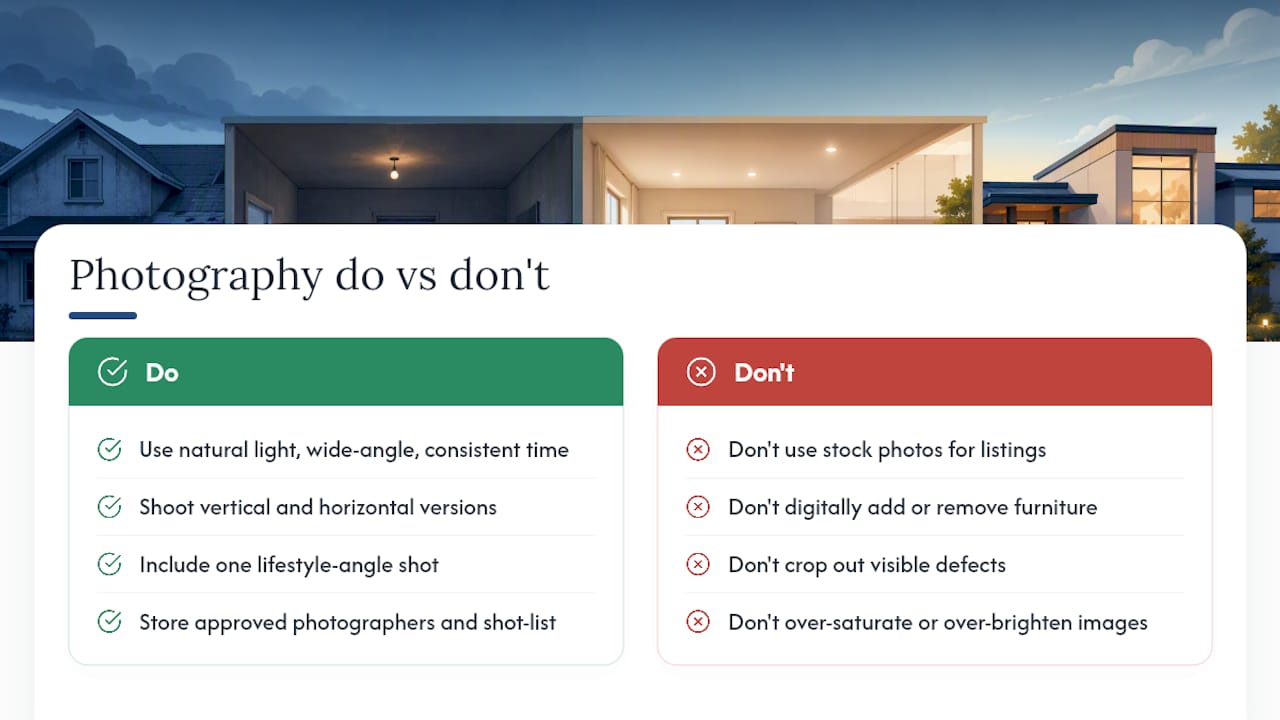
Photography is the first thing a buyer judges before reading a single word of copy, and inconsistent photo style across listings undercuts even the best-written descriptions. Set a consistent shooting standard: natural light wherever possible, wide-angle shots that show true room proportions, and a consistent time-of-day preference for exterior shots (most guidance favors late afternoon light for warmth without harsh shadows).
Document filter and editing rules explicitly. A brand built on credibility can’t run heavily saturated or artificially brightened photos that misrepresent a room’s actual condition, since that’s both a brand inconsistency and a potential misrepresentation issue if a buyer arrives and the space looks different in person. Keep edits limited to exposure correction, lens distortion fixes, and mild color balancing.
Do: shoot vertical and horizontal versions of every key room for different platforms, include at least one lifestyle-angle shot per listing (a set table, an inviting reading nook), and standardize on a consistent aspect ratio for social carousel posts.
Don’t: use stock photography to replace actual property images, digitally remove or add furniture without disclosure, or crop out visible defects that a buyer would notice on a walkthrough.
Store an approved-photographer list and a shot-list template so every listing gets the same coverage: exterior front, kitchen, primary suite, primary bath, and at least one lifestyle or detail shot, regardless of which team member is coordinating the shoot.
What Should a Brand Positioning Statement Say?
A brand positioning statement answers one question for every reader who encounters your marketing: why should they work with you instead of the next agent in their search results. The formula that works best is simple: for [target client], [brand name] is the [category] that [key differentiator], because [proof point].
A team specializing in first-time buyers in a competitive urban market might write: “For first-time buyers overwhelmed by a fast-moving market, [Team Name] is the local guide that turns confusing paperwork into a clear, step-by-step process, backed by a track record of closing in under 30 days.” Notice that statement never mentions the team’s personality or slogan. It states a specific audience, a specific promise, and a specific proof point.
Keep the positioning statement internal-facing in its raw form. It’s a strategy document, not marketing copy. What it does is give every piece of external copy, from a bio page to a listing description, a consistent underlying argument for why this brokerage or agent deserves the transaction. Without it, every agent on a team invents their own value proposition on the fly, and the brand ends up saying five different things to five different audiences.
Revisit the statement annually, since market conditions and client priorities shift, and a positioning statement built for a seller’s market often reads oddly two years into a buyer’s market.
How Do Brand Rules Change Across Print, Digital, and Merchandise?
The same logo, palette, and typography need adjustment depending on where they appear, and treating every medium identically produces predictably bad results. Print demands CMYK color values and higher-resolution logo files (vector format wherever possible) since a low-resolution web logo will look pixelated on a yard sign or postcard.
Digital placements need HEX values and web-optimized file formats, plus a mobile-specific check: a logo or headline that reads clearly on a desktop screen can become illegible on a phone if clear space rules get ignored in a responsive template.
Merchandise, from branded pens to open house yard flags, needs its own simplified logo version, often a single-color or reversed-out variant, since multi-color print processes on physical goods are expensive and prone to color drift. Document which logo variant applies to which merchandise category so a vendor doesn’t default to whatever version they find first in an old email thread.
Keep one master brand file, whether a shared drive folder or a brand portal, containing every approved logo variant, color code, and font file. When brand assets live in five different agents’ inboxes instead of one shared location, drift is inevitable within a year.
Compliance Rules Matter More Than Style Preferences
The conventional advice on real estate branding spends most of its energy on aesthetics: pick a nice font, choose a tasteful palette, write catchy headlines. That advice isn’t wrong, but it’s incomplete in a way that actually creates risk. A gorgeous brand guide with no Fair Housing checklist is worse than no guide at all, because it gives agents false confidence that “on-brand” and “compliant” are the same thing.
They aren’t. A listing can perfectly match your voice pillars and still contain proxy language that triggers a fair housing complaint. The teams that get this right treat compliance as the first filter and style as the second, not the other way around. That ordering is the single biggest thing most brokerages get backwards.
If you’re building guidelines from scratch, start with the forbidden-words table and the ad-targeting checklist before you touch fonts or color codes. Voice consistency is worth real money in buyer recognition, but it’s recoverable if you get it wrong for six months. A Fair Housing violation is not.
— Tyler
Try Agentwrite for Consistent, Compliant Listing Copy
Agentwrite is the direct route to everything this guide describes, without building a fifteen-page style manual from scratch. Enter a property’s details once, and it generates MLS remarks, a full listing description, a social caption, and an email draft, all in a voice you select and keep consistent across your entire team.
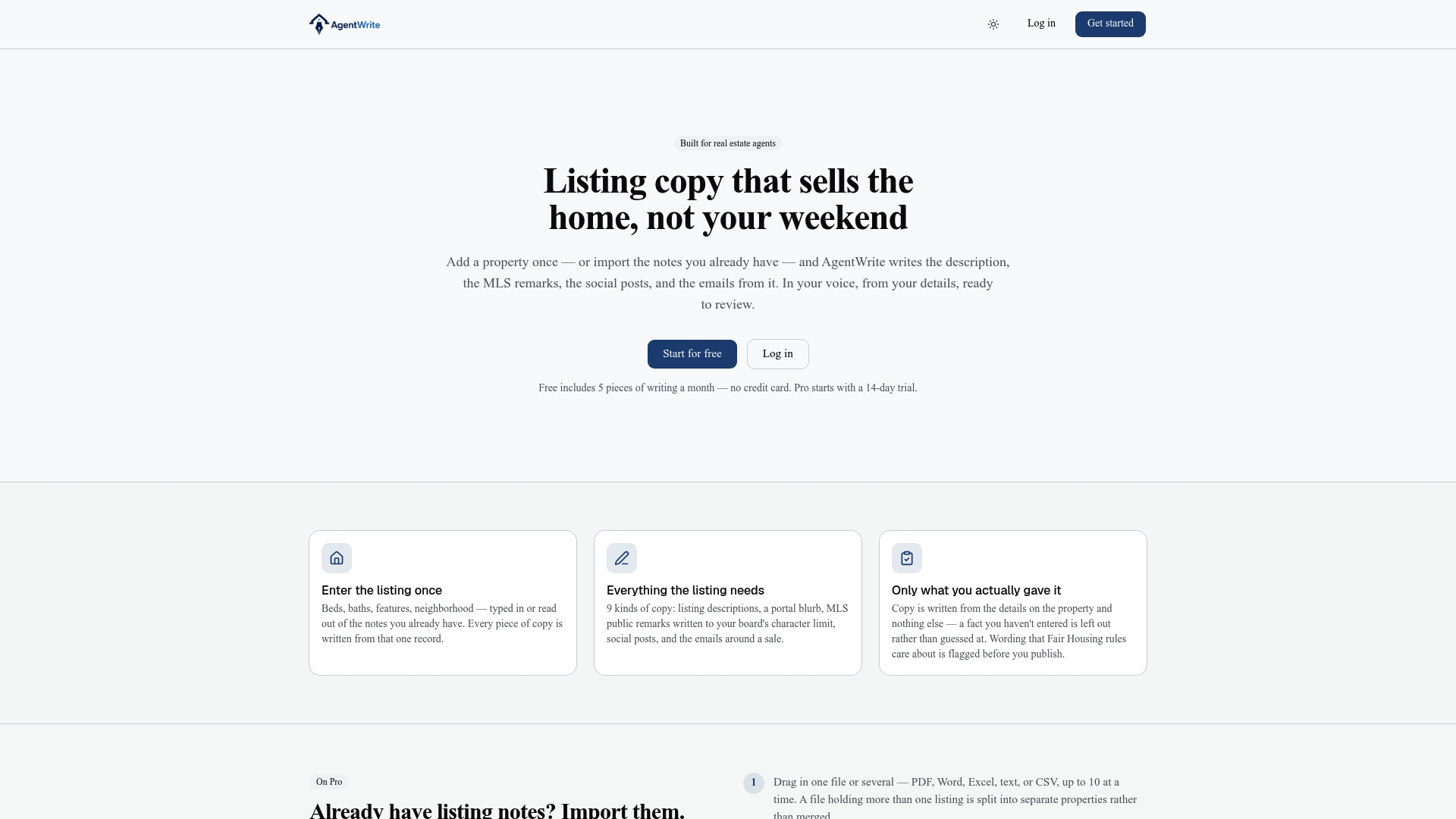
Every draft gets checked for language that could raise Fair Housing concerns before you ever paste it into MLS, which turns the compliance checklist from earlier into something the software does automatically rather than something an agent has to remember under deadline pressure. You can start with Agentwrite’s free trial and generate your next listing in the time it takes to brew coffee. Broker or legal review is still worth doing for anything unusual, a religious community, an age-restricted property, a complex ad campaign, but for standard listings, you’ll spend far less time editing and far more time selling.
Sources
- Guidance on Application of the Fair Housing Act to the Advertising of Housing, Credit, and Other Real Estate-Related Transactions through Digital Platforms
- Virginia Fair Housing advertising guidance (excerpt)
- How to Write a Real Estate Description — Zillow
FAQ
What Should Real Estate Brand Guidelines Include?
A usable set covers three areas: a brand voice framework with approved and forbidden vocabulary, Fair Housing compliance rules for copy and ad targeting, and channel-specific templates for MLS, social, and email.
How Long Should a Listing Description Be?
Aim for roughly 200 to 250 words for a full listing description, a 60-word version for MLS snapshot fields, and one to two lines for social captions, a structure recommended by Zillow’s listing guide.
What Words Should Agents Avoid in Listings?
Avoid any language referencing protected characteristics, including familial status, religion, national origin, or disability, along with proxy phrases like “perfect for a young family” or “walking distance to the church.”
Can AI Tools Help Keep Listing Copy Compliant?
Yes. Platforms like Agentwrite generate listing copy from a single input and flag language that could raise Fair Housing concerns before publication, though a broker or legal review is still advisable for unusual listings.
How Do You Keep Listing Voice Consistent Across a Team?
Document three voice pillars, such as credible, vivid, and concise, with concrete rules for each, and use the same approved-vocabulary list and templates across every agent so copy reads as one brand regardless of who wrote it.