

Mobile First Real Estate Email Subject Lines: Swipe File & A/B
Mobile First Real Estate Email Subject Lines: Swipe File & A/B

Keep it to 5 to 7 words, put the neighborhood, price, or status first, and skip the vague teaser. That’s the whole rule. Below you’ll find categorized templates for every email you send, from cold leads to past clients, along with a testing workflow that turns guesswork into a repeatable playbook.
TL;DR:
- Front-loading key details like neighborhood, price, or status ensures visibility in limited mobile preview space and improves open rates.
- Specific, verifiable information outperforms curiosity-based hooks, especially when tailored to segments’ real behavior and data accuracy.
- Testing subject lines with controlled variables on small segments over time reveals patterns that enhance overall email performance.
- Avoid spam triggers by using plain language, specific numbers, sentence case, and minimal punctuation, especially in preview text.
- Reusing generated, tested subject lines in a CRM and ensuring compliance with Fair Housing and legal standards maintains trust and reduces liability.
Table of Contents
- What Makes Real Estate Email Subject Lines Work
- Swipe File: Real Estate Email Subject Lines by Category
- Building an A/B Testing Workflow That Actually Improves Results
- Getting Subject Lines Past the Inbox and Onto the Screen
- Adapting Subject Lines by Segment Without Overdoing It
- How AgentWrite Speeds Up Subject Lines and Keeps Emails Compliant
- Legal and Ethical Lines Your Subject Lines Shouldn’t Cross
- When to Send and How Often to Email Without Burning Out Your List
- What Separates Agents Who Get Replies from Agents Who Get Ignored
- Skip the Guesswork: Generate and Test Subject Lines Faster with AgentWrite
- Sources
- FAQ
What Makes Real Estate Email Subject Lines Work
Nearly 60% of real estate emails get opened on mobile devices, where most inboxes cut subject lines off at 35 to 40 characters. That’s not a suggestion, it’s a hard visibility ceiling. Write past it and your carefully crafted hook just doesn’t exist for most of your list.
The fix is front-loading. Put the detail that matters most in the first 30 to 35 characters, before a phone screen has a chance to truncate it. “Maple Ridge: New Listing at $412K” beats “You Won’t Believe What Just Hit the Market in Maple Ridge” every time, because the second version buries the useful part under filler.
Front-loading works with almost any subject line goal:
- Neighborhood first: “Oakwood Heights: 3 New Listings This Week”
- Price first: “$375K, 4BR, Move-In Ready in Elmhurst”
- Status first: “Just Listed: Riverside Ranch, $299K”
- Deadline first: “Offer Deadline Friday: 214 Birchwood Ln”
Spam filters and skeptical readers both flag the same words. “Free,” “guarantee,” “act now,” ALL CAPS, and stacked exclamation points read as noise, not urgency. Swap “ACT NOW!!! Free Home Valuation!!!” for “Curious What Your Home Is Worth This Spring?” and you keep the intent without tripping filters or looking desperate.
Specificity beats cleverness almost every time. Research on real estate email performance consistently shows that a concrete detail, a neighborhood name, a price point, an actual number, outperforms a vague curiosity hook. Curiosity has its place (more on that below), but it’s a seasoning, not the main dish.
Statistic Callout: Personalized subject lines using a first name or a specific neighborhood can lift open rates by roughly 10% to 26%, but only when the underlying contact data is accurate. Bad data personalization (“Hi [First Name]”) does more damage than no personalization at all.
Pro Tip: Write your subject line last. Draft the email body first, then pull the single most compelling detail from it into a 5 to 7 word subject line. You’ll waste less time guessing at hooks that don’t match the content.
Swipe File: Real Estate Email Subject Lines by Category
These are organized by the reason you’re sending the email, because a subject line for a cold lead should sound nothing like one for a client you closed with three years ago. Swap in your own neighborhood, price, and timeframe before you hit send.
1. New leads
New leads haven’t decided you’re worth their time yet. Skip the pitch and sound like a person asking a real question.
- “Still Looking in Brookfield?”
- “Saw You Downloaded the Elm Street Listing”
- “Quick Question About Your Home Search”
- “What’s Your Timeline for Moving to Ashford?”
- “Found 3 Homes That Match What You Wanted”
Personalization here means referencing the specific listing or search they engaged with, not just their first name.
2. Active buyers
Buyers already in motion want facts fast: what’s new, what dropped, what’s about to disappear.
- “New Match: 118 Cedar Ave, $329K”
- “Price Drop: The Listing You Saved”
- “Off-Market Opportunity in Thornbury”
- “3 New Homes Under $400K This Week”
- “This One Won’t Last: Open Sat 11am”
Keep these transactional and immediate. Buyers who’ve toured with you respond better to status updates than to marketing language.
3. Sellers
Sellers respond to movement and money. Reference market shifts, valuation, or a deadline they can act on.
- “Homes in Your Area Sold 8% Over Ask”
- “Free Valuation: What’s 214 Maple Worth Now?”
- “3 Offers Came in on a Similar Home”
- “Inventory Just Dropped in Your Neighborhood”
- “Is Now the Time to List?”
A subject line that references comparable sales works because it’s specific and verifiable, not because it sounds exciting.
4. Past clients and sphere of influence
These contacts already trust you. The job here is staying visible without sounding like a sales pitch every single time.
- “One Year in Your Home Already!”
- “Your Home’s Value Just Changed”
- “Thinking of Renting It Out? Quick Numbers”
- “Anniversary Check-In: How’s the House Treating You?”
- “Curious What Your Street Looks Like Now?”
Anniversary and market check-in templates work well here because they give you a legitimate reason to email without asking for anything.
5. Open houses and events
Open house subject lines succeed or fail on urgency and exclusivity. Give people a reason to show up this weekend, not “someday.”
- “This Saturday Only: 45 Birchwood Ln”
- “You’re Invited: Private Preview Before Open House”
- “Doors Open 12pm: Tour 3 Homes in One Trip”
- “Last Chance to See This Before It’s Gone”
- “RSVP: Wine & Walkthrough at 88 Fairview”
6. Market updates and reports
Data-first subject lines outperform generic “market update” language because they let the recipient self-select based on a number they actually care about.
- “Median Price in Lakeview: Up 6% This Quarter”
- “Inventory Fell 12% Last Month. Here’s What It Means”
- “Interest Rates Moved. Your Buying Power Changed”
- “5 Charts That Explain This Month’s Market”
- “Your Neighborhood’s Sale Price Trend, Explained”
7. Follow-ups and appointment requests
Follow-up emails need almost no hook at all. Directness reads as respect for the recipient’s time.
- “Following Up on Your Showing Request”
- “Still a Good Time for Saturday?”
- “Quick Follow-Up: Any Questions on 302 Willow?”
- “Confirming Our 2pm Tomorrow”
- “Ready to Move Forward on the Offer?”
8. Newsletters and nurture
Newsletter subject lines fail when they describe the newsletter instead of the value inside it. Lead with the payoff, not the format.
- “3 Renovation Tips That Add Real Value”
- “What $350K Buys You in Riverdale Right Now”
- “The Mortgage Rate Shift Buyers Should Know About”
- “5 Questions to Ask Before You List”
- “How Long Homes Are Sitting on the Market Now”
9. Re-engagement
Cold contacts need a low-pressure reason to look again, not a guilt trip about going quiet.
- “Still Thinking About Moving? No Pressure”
- “Checking In: Has Your Search Changed?”
- “New Listings Since We Last Talked”
- “Is Riverside Still on Your Radar?”
- “It’s Been a While. Anything Changed?”
Each category above works because the subject line matches what the recipient actually expects to find inside. A buyer alert that delivers a buyer alert builds trust. A newsletter subject that oversells a routine update erodes it.
Building an A/B Testing Workflow That Actually Improves Results
Testing subject lines only works if you isolate one variable at a time and run it long enough to mean something.
- Pick a segment of at least 50 to 100 contacts. Smaller lists make the results noise, not signal.
- Send at the same time of day and day of week for both versions so timing doesn’t skew the comparison.
- Keep preview text identical across both versions in the first test, then test preview text separately once you’ve found a subject-line winner. This isolates which element actually drove the lift.
- Track more than open rate. Reply rate, click-through rate, and appointments booked tell you whether the subject line attracted the right kind of attention, not just any attention.
- Log every test in a simple spreadsheet: subject line, segment, open rate, reply rate, date sent.
After 10 to 15 logged tests, patterns start to show up that a single send never reveals. Some lists respond better to questions. Others respond only to hard numbers. You won’t know which is which until you’ve built the data.
Watch for two common mistakes. First, testing on a Monday morning and a Thursday evening and blaming the subject line for the gap. Second, sending both versions to the same overlapping contacts across different campaigns, which contaminates your sample and makes the results unreliable.
Pro Tip: Don’t retire a losing subject line format entirely after one test. Test it again on a different segment before you rule it out. Sellers and buyers often respond to opposite styles of subject line, so what fails with one list can win with another.
Getting Subject Lines Past the Inbox and Onto the Screen
A great subject line that never renders is worthless. Deliverability and mobile display deserve as much attention as the words themselves.
The visibility window is roughly 35 to 40 characters on most phone screens, sometimes less depending on the email client. Front-load the neighborhood, price, or status so the truncation happens after the useful information, not before it.
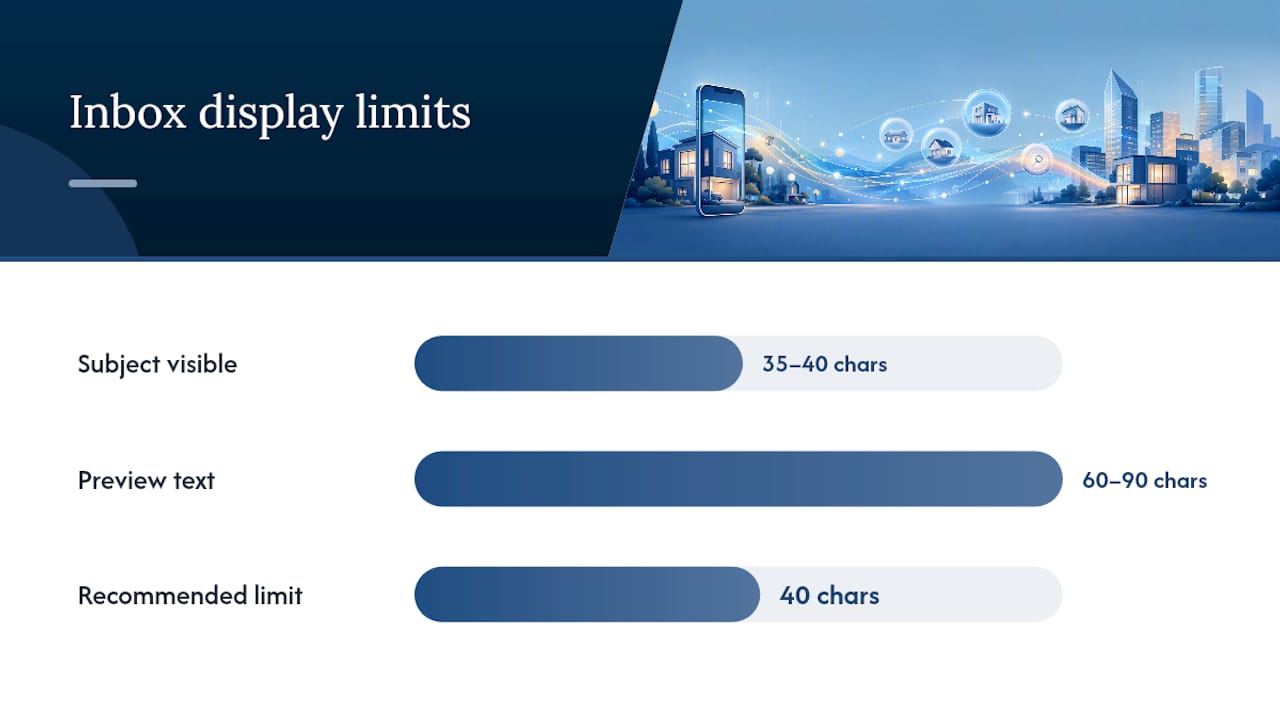
Preview text is the most underused tool in real estate email. Most clients display 60 to 90 characters of preview text right next to or below the subject line. Use it to carry the detail you had to cut. If your subject line is “Just Listed: Maple Ridge,” your preview text can say “4BR, 2.5BA, finished basement, walk to schools.”
Spam filters watch for a predictable list of red flags:
- Skip: “FREE,” “GUARANTEE,” “ACT NOW,” multiple exclamation points, ALL CAPS words
- Use instead: specific numbers, plain language, sentence case
- Avoid: dollar signs stacked with emojis or excessive punctuation (“$$$ SAVE NOW!!!”)
- Use instead: a clean price figure written normally (“$299K”)
Statistic Callout: One well-placed emoji can modestly lift open rates in listing alerts, particularly a house emoji or a location pin. But stacking two or three emojis reads as unprofessional and can trip spam filters that flag excessive symbol use.
Before you schedule any send, run a quick check: does the subject line fit in 40 characters, does the preview text add new information rather than repeat the subject, and does the send avoid every word on the spam-trigger list.
Adapting Subject Lines by Segment Without Overdoing It
The same subject line rarely works for a first-time buyer, a seasoned investor, and a seller who’s lived in their home for twenty years. Segment based on what they’ve actually done, not just who they are on paper.
Useful segmentation signals include search behavior (what price range and area they’ve clicked on), past interactions (opened but never replied, or replied but never scheduled), and stated property interests (single-family versus condo, specific school districts). These beat generic demographic guesses because they’re based on real behavior.
Localization works best at three levels: neighborhood name, price band, and property type. “New in Fairview Under $350K” tells a specific buyer segment exactly why the email is relevant before they open it. A detailed look at rising local prices shows how much weight market-specific framing can carry when sellers are deciding whether to list.
Personalization backfires the moment your data is wrong. A misspelled name, an outdated neighborhood, or a price range someone no longer qualifies for damages trust faster than generic language ever would. Keep a clean fallback template, “New Listings in Your Search Area,” for any contact whose data you’re not fully confident in.
- Match subject line specificity to data confidence: high confidence, use the name and neighborhood; low confidence, stay general.
- Pair subject line, preview text, and send timing as one unit per segment, not three separate decisions.
- Send buyer alerts same-day when a matching listing goes live; sellers respond better to a Tuesday or Wednesday market update than a weekend blast.
Pro Tip: Build one “clean data” template and one “safe fallback” template for every category in your swipe file. When in doubt about a contact’s data quality, default to the fallback. It’s a smaller lift than the personalized version, but it never damages trust.
How AgentWrite Speeds Up Subject Lines and Keeps Emails Compliant
Writing five subject-line variants for every campaign, for every segment, adds up to hours most agents don’t have. AgentWrite generates multiple subject-line options and a full email draft from a single property input, so you’re editing and testing instead of starting from a blank screen every time.
The platform also flags potential Fair Housing wording concerns before you send, which matters most in exactly the moments described above: urgency-driven seller emails, neighborhood-specific buyer alerts, and market update language that can unintentionally cross into steering if you’re not careful with word choice.
A workflow that works well in practice:
- Generate 4 to 5 subject-line variants from one listing or market update.
- Send the top 2 to a small test segment using the A/B process outlined earlier.
- Import the winning subject line and email draft into your CRM template library for reuse.
This turns the swipe file above from a static reference into a rotating set of templates that improve every time you test one.
Legal and Ethical Lines Your Subject Lines Shouldn’t Cross
Subject lines carry real legal exposure, not just a professionalism risk. Commercial email in the United States falls under the CAN-SPAM Act, which requires that the subject line not be deceptive about the email’s contents. A subject line promising “Your Offer Was Accepted” when no offer exists isn’t just bad practice, it’s a compliance violation.
Fair Housing considerations apply to subject lines just as much as listing descriptions. Language that signals a preference for or against a protected class, even subtly through neighborhood framing (“family-friendly,” “perfect for retirees”), can create liability. Keep subject lines focused on property facts and market data rather than the type of buyer you imagine living there.
Curiosity-driven subject lines raise a related ethical question: how far can you stretch a hook before it becomes misleading? “You Won’t Believe This Price” is fine if the price genuinely is surprising. It becomes a problem when the email doesn’t deliver on the specific thing the subject line promised. That mismatch doesn’t just annoy one recipient, it trains your entire list to distrust future subject lines from you.
The safest standard is simple: if you’d be uncomfortable explaining the subject line’s claim to the recipient in person, don’t send it. Every category in the swipe file above was built around specific, verifiable details for exactly this reason. Specificity isn’t just a performance tactic, it’s also the easiest way to stay honest.
When to Send and How Often to Email Without Burning Out Your List
Timing affects open rates almost as much as the subject line itself, and the two work together rather than separately.
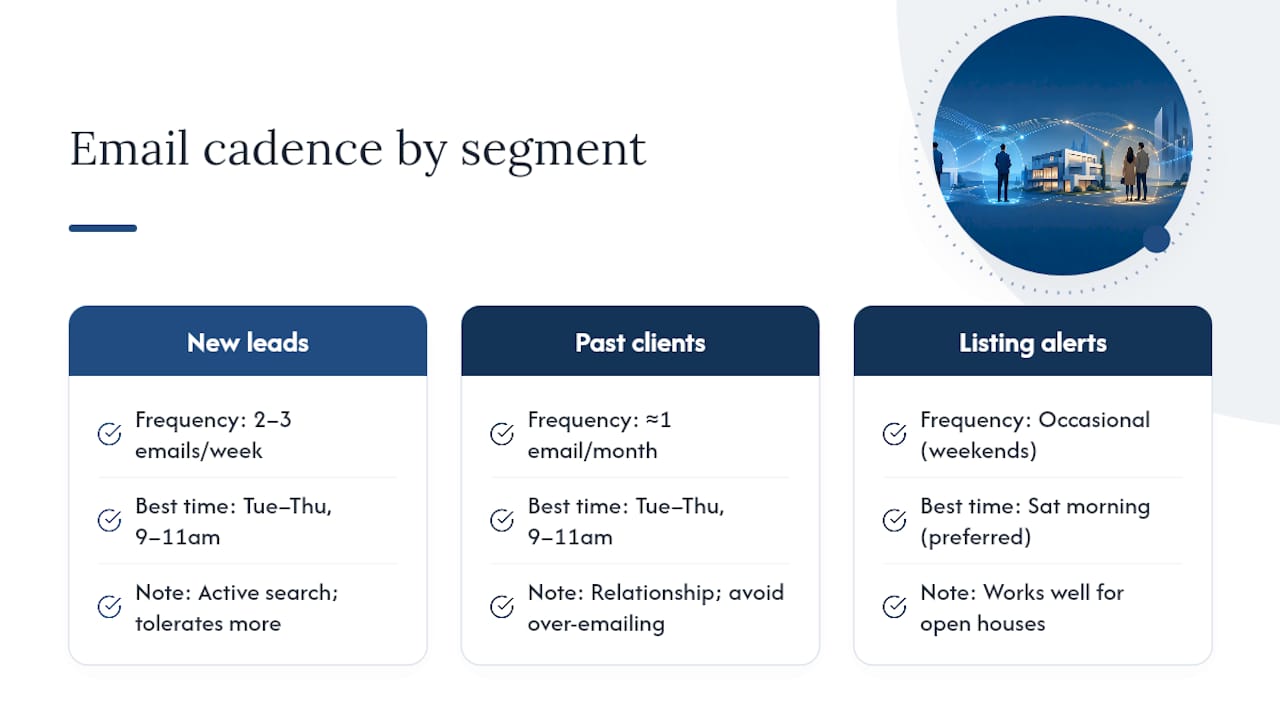
Tuesday through Thursday mornings, roughly 9 to 11am local time, tend to outperform Monday (inbox overload) and Friday afternoon (attention already checked out) for most real estate segments. Weekend sends work specifically for open house invitations and new listing alerts, since buyers browse listings on Saturday morning far more than they check work email.
Frequency depends entirely on the segment. New leads can tolerate 2 to 3 emails per week during an active search without feeling harassed, because the emails answer a question they’re actively asking. Past clients and sphere of influence contacts should hear from you far less often, maybe once a month, because the relationship isn’t transactional and over-emailing turns a warm contact cold.
Match your subject line’s urgency to how often you’re actually sending. A subject line that screams urgency every single week trains recipients to tune out the word “urgent” entirely. Save the deadline-driven, high-urgency subject lines (“Offer Deadline Friday,” “Last Chance”) for genuinely time-sensitive events, and let your routine market updates sound routine.
If you’re testing send times as part of your A/B workflow, change one variable at a time here too. Testing a new subject line format on a Tuesday and comparing it to an old format sent on a Friday tells you nothing useful about which one actually won.
What Separates Agents Who Get Replies from Agents Who Get Ignored
The agents who consistently get opens and replies aren’t the ones with the cleverest hooks. They’re the ones who kept a written record of what worked and built on it, campaign after campaign, instead of reinventing the subject line from scratch every time they sat down to write one.
Document every test, even the boring wins. A subject line that performs 3 points better on open rate might not feel dramatic, but stack ten of those small wins over a year and the gap between you and an agent who’s guessing every send becomes real.
The one rule I’d push back on if I could only give one: never let the subject line promise something the email doesn’t deliver. Curiosity gaps work exactly once per recipient before they learn not to trust your inbox line. Specificity, neighborhood, price, status, holds up every time, because it’s the truth on the page before the reader even clicks.
— Tyler
Skip the Guesswork: Generate and Test Subject Lines Faster with AgentWrite
Manually drafting five subject-line variants for every listing, market update, and buyer alert eats into the hours you’d rather spend showing homes. AgentWrite turns one property input into a full set of subject-line options, email drafts, and even MLS remarks, all written in your voice, so testing the swipe file above stops being a chore you skip when you’re busy.
Start with a listing you’re about to email out. Generate 5 subject-line variants using AgentWrite, pick two that lean on different tactics (one specificity-driven, one curiosity-driven), and send them to a small test segment of your list using the A/B process covered earlier. Track which one wins, then import that winner into your CRM as a reusable template for the next similar listing.
The platform also checks generated copy for potential Fair Housing wording issues before it reaches a client’s inbox, which matters most on exactly the segments this article covers: neighborhood-specific alerts, urgency-driven seller emails, and open house invitations. Try AgentWrite and generate your next batch of subject lines in the time it currently takes to write one.
Sources
FAQ
What is a good subject line for an email to a realtor?
Be direct and specific: “Interested in 214 Maple Ave, Ready to Discuss” works better than a vague greeting because it tells the agent exactly why you’re writing before they open it.
What is a catchy subject line for an email?
The catchiest real estate subject lines aren’t clever, they’re specific: a neighborhood name, a price, or a status update (“Just Listed,” “Price Drop”) consistently outperforms wordplay or generic teasers.
What is the 3-3-3 rule in real estate?
Definitions vary by market and use case, and the article’s research doesn’t cover a standardized version of this rule, so it’s best to verify the specific framework with a local trainer or brokerage resource before applying it.
What is a good real estate email address?
A professional address using your name at your brokerage domain (like jsmith@brokeragedomain.com) builds more trust than a generic personal email, and it keeps your subject lines from landing in spam filters that flag unfamiliar domains.
How short should a real estate email subject line be?
Aim for 5 to 7 words, roughly 35 to 40 characters, since about 60% of real estate emails are opened on mobile devices where longer subject lines get cut off.