

Real Estate Hashtags for Agents: Copy-Ready Sets & Rules
Real Estate Hashtags for Agents: Copy-Ready Sets & Rules

Use one broad industry tag, one to two post-specific tags, and one to two hyper-local tags, then stop. That four-to-five tag stack outperforms the old “paste 30 hashtags and pray” approach on every platform that still supports hashtag search. On Instagram and TikTok, that means landing in the 3 to 5 range total, not per category.
For a listing post: #RealEstate #JustListed #AustinTexasHomes #ZilkerNeighborhood. For a personal-brand post: #RealtorLife #FirstTimeHomebuyer #DenverRealtor. Both follow the same architecture: one wide net, one or two tags describing what the post actually is, and one or two that only someone searching your specific market would type.
Key Takeaways
The most effective real estate hashtag strategy combines a small, tiered stack of 3 to 5 tags with consistent hyper-local targeting and quarterly performance reviews.
| Point | Details |
|---|---|
| Use a tiered stack | Combine 1 broad tag, 1–2 post-specific tags, and 1–2 hyper-local tags per post. |
| Match counts to platform | Stay at 3–5 on Instagram and TikTok, 2–5 on LinkedIn/X/YouTube, and — on Facebook. |
| Prioritize hyper-local tags | Neighborhood-specific tags like #HighlandsDenver reach smaller, more motivated audiences. |
| Rotate and measure | Refresh hashtag sets quarterly and track profile visits and hashtag-driven contacts. |
| Speed drafting with AgentWrite | AgentWrite pairs captions with matched hashtag sets and flags Fair Housing wording risks before you post. |
Table of Contents
- How Many Real Estate Hashtags Should You Use in 2026?
- What Are the Best Real Estate Hashtags by Category?
- How Do You Use Hashtags Differently on Each Platform?
- What’s the Best Hashtag Strategy for Long-Term Growth?
- Can You Automate Hashtag Creation Without Losing Quality?
- What Exactly Are Real Estate Hashtags For?
- Are There Legal Risks to Watch for With Real Estate Hashtags?
- How Do Hashtags Fit Into a Broader Social Media Plan?
- How Do You Find Trending and Niche Real Estate Hashtags?
- How AgentWrite Speeds Up Caption and Hashtag Creation
- Frequently Asked Questions
- Sources
How Many Real Estate Hashtags Should You Use in 2026?
The count varies more by platform than most agents realize, and using too many is now a bigger risk than using too few. Instagram caps posts and Reels at 5 hashtags as of December 2025, so anything beyond that simply gets truncated or ignored. TikTok performs similarly at 3 to 5. Facebook is the outlier: its algorithm treats hashtags as a minor signal at best, and posts with zero or one tag often outperform tag-heavy ones.
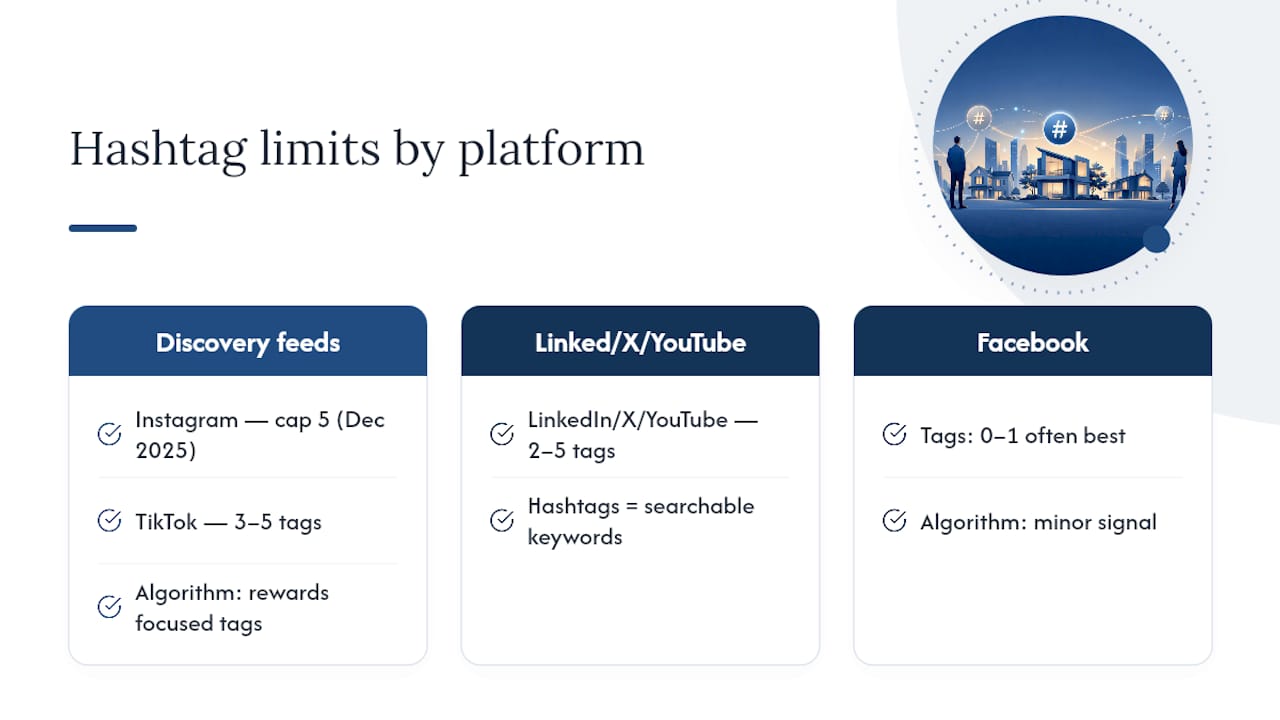
LinkedIn, X, and YouTube sit in a middle zone of 2 to 5, where hashtags function more like searchable keywords than discovery boosts. The pattern makes sense once you think about how each platform’s algorithm actually reads a hashtag: visual, discovery-first feeds (Instagram, TikTok, Pinterest) reward focused tagging, while text-first or professional networks treat extra tags as clutter, not signal.
Adding a sixth or seventh tag on Instagram doesn’t just get wasted. It can read as a spam signal to the algorithm, which quietly suppresses reach on posts that look like they’re gaming discovery instead of genuinely describing content.
What Are the Best Real Estate Hashtags by Category?
Every agent needs a mental filing cabinet of tags, not one giant list to paste everywhere. Curated, categorized lists beat generic ones because you can pull exactly what a specific post needs in seconds. Here’s how to organize yours.
General industry tags (your broad tier): #RealEstate #RealEstateAgent #RealEstateLife #PropertyForSale #HomeSweetHome
Listing-post tags: #JustListed #NewListing #ForSaleByAgent #OpenHouse #DreamHome
Just-sold and milestone tags: #JustSold #SoldByMe #ClosingDay #HomeownersClub
Buyer-focused tags: #FirstTimeHomebuyer #HomeBuyingTips #BuyersMarket #MortgageReady
Seller-focused tags: #SellersMarket #HomeStaging #PriceItRight #TimeToSell
Luxury and investment tags: #LuxuryRealEstate #LuxuryHomes #InvestmentProperty #PassiveIncome #RealEstateInvesting
Lifestyle and staging tags: #HomeDecor #InteriorDesign #CurbAppeal #HomeImprovement #BeforeAndAfter
Branded tags: build one around your name or team, like #[YourName]Realty or #[TeamName]Homes, and use it consistently so past clients and referrals can find your full listing history in one search.
Hyper-local tags are where the real leverage sits. Build them with a simple find-and-replace pattern: #[City]RealEstate, #[Neighborhood]Homes, #[City]HomesForSale, #[County]Living. So a Denver agent working the Highlands neighborhood might use #DenverRealEstate and #HighlandsDenver. A broad tag like #RealEstate competes against millions of posts; a specific one like #HighlandsDenver puts you in front of maybe a few hundred, most of whom actually live near or want to live near that listing.

The discipline here matters more than the list itself: pick 3 to 5 tags across different tiers for every post, and never paste the same block on your fifteenth post in a row. Instagram’s algorithm can tell.
Pro Tip: Keep a running spreadsheet with four columns, one per tier, and swap in a fresh local or niche tag every few posts. It takes ten minutes to build and saves you from ever staring at a blank caption box wondering what to type.
How Do You Use Hashtags Differently on Each Platform?
A single hashtag set copied across five platforms is a missed opportunity, because each network reads tags differently. Instagram and TikTok remain the most hashtag-friendly platforms for real estate content, so that’s where your best category tags should live. On Instagram, place them at the end of your caption or drop them into the first comment if you want a cleaner caption look. TikTok works better with tags woven right into the caption text alongside a hook line.
X rewards timing more than volume. A tag on a trending local topic, like a market report or a neighborhood event, does more work than a generic one. LinkedIn hashtags should skew professional: #RealEstateInvesting outperforms #DreamHome there. On YouTube, tags belong in the description, not the title, and they help with search more than discovery. Pinterest treats hashtags almost like keywords in the pin description field, so descriptive local tags perform better than trendy ones. Facebook is the platform to go light on. Skip hashtags entirely or use one at most.
Cross-posting checklist: swap generic tags for platform-native ones, drop hashtags from Facebook versions, and never reuse the identical five-tag block on every single post that week.
Pro Tip: If you batch-schedule content, build three versions of your hashtag stack, one Instagram-length, one LinkedIn-appropriate, one Facebook-light, so you’re not editing on the fly at 11 PM.
What’s the Best Hashtag Strategy for Long-Term Growth?
The architecture stays simple: one broad tag, one or two post-specific tags, one or two hyper-local tags. Luxury and investment posts are the exception. Those audiences respond better to a slightly heavier niche tilt, sometimes swapping the second local tag for a second niche one like #LuxuryListings alongside #InvestmentProperty.
- Build three to five hashtag sets by category (listing, buyer, seller, luxury, lifestyle) and store them somewhere you can copy from fast.
- Rotate sets every few weeks so you’re not repeating identical tags on every post.
- Refresh the entire library quarterly, or sooner if a set’s performance drops.
Track three numbers to know when a set is working: impressions from hashtag discovery, profile visits, and direct messages or contacts that mention finding you through a tag. Rotating and measuring this way over time beats guessing.
Watch for these red flags: pasting the same 20-tag block on every post, using tags unrelated to your actual content just because they’re trending, and reusing banned or misleading tags that platforms actively suppress.
Pro Tip: Set a quarterly calendar reminder to audit your top-performing hashtags. Ten minutes every three months keeps your sets from going stale.
Can You Automate Hashtag Creation Without Losing Quality?
Generating fresh, compliant hashtag sets for every listing gets repetitive fast, especially once you’re juggling a dozen active properties. A practical workflow: generate combinations of location, property type, and post type, preview the resulting set, then do a quick human review before publishing.

That human check matters for one reason above all others: hashtags and captions both need a Fair Housing pass, since even a casual phrase like #PerfectForFamilies can raise discriminatory-language concerns in listing marketing. Automated generation speeds the first draft; it shouldn’t replace the final read-through.
Tools like AgentWrite build caption and hashtag bundles together from the same property details, flagging language that could trip Fair Housing rules before you hit publish, and leaving every draft editable rather than locked.
What Exactly Are Real Estate Hashtags For?
Real estate hashtags are searchable keyword tags attached to social posts that group content around a topic, location, or property type, making it discoverable to people who aren’t already following you. Think of them as a filing system layered on top of public search. Someone searching #AustinCondos on Instagram sees every public post tagged that way, yours included, whether or not they’ve ever heard of you.
That’s the entire function: extending reach past your existing follower list. Hashtags still measurably affect interaction rates, which is why they’re worth the small effort of tagging thoughtfully rather than skipping them or dumping in dozens at random.
They’re not a replacement for good photography, a compelling caption, or an actual local market presence. A tag gets a stranger to stop scrolling for half a second. What keeps them looking is the listing itself. Agents who treat hashtags as their entire social strategy usually see the reach numbers climb while inquiries stay flat, because a hashtag brings a stranger to your post, not necessarily a stranger who’s ready to buy in your zip code.
The American Marketing Association frames hashtags this way too: a discovery layer that only works alongside real content quality, not a substitute for it.
Are There Legal Risks to Watch for With Real Estate Hashtags?
Fair Housing law is the biggest one, and it applies to hashtags exactly as it applies to listing copy. A tag like #PerfectForYoungCouples or #GreatForChristianFamilies isn’t a harmless caption flourish. It’s discriminatory language that references a protected class, and the fact that it’s a hashtag instead of a sentence doesn’t change the legal exposure.
Steer clear of any tag referencing familial status, religion, national origin, race, disability, or similar protected categories, even when the intent feels innocent. #WalkableNeighborhood describes a location; #PerfectForRetirees describes people, and that’s the line to watch.
Trademark issues come up less often but still matter. Using a builder’s or developer’s branded community name as a hashtag is usually fine for genuine listing content, but co-opting a well-known brand tag to ride its traffic for unrelated content can draw a takedown request or worse.
Honesty in tagging matters too. Tagging a post #LuxuryEstate for a starter home to chase impressions isn’t just bad practice, it’s the kind of mismatch that erodes trust the moment a viewer clicks through and feels misled. The same logic applies to location tags. Don’t tag a listing 20 minutes outside a desirable neighborhood with that neighborhood’s hashtag just because it’s a stronger search term. That’s a fast way to burn credibility with the exact local audience you’re trying to build.
How Do Hashtags Fit Into a Broader Social Media Plan?
Hashtags work best as one component of a system, not a standalone tactic bolted onto whatever you post. Build a simple content calendar: listing launches, market updates, client testimonials, and lifestyle or neighborhood content, each with its own default hashtag tier already assigned before you write the caption.
A just-listed post pulls from your listing-tag tier plus hyper-local tags for that address. A market-update post pulls from your general and branded tiers. This turns hashtag selection into a five-second decision instead of a blank-page problem every time you post.
Pair hashtags with strong local market data where you can. Referencing actual comparable sales or neighborhood trends, the kind of analysis covered in CMA-focused market guides, gives your captions substance that a hashtag alone never will. A post that says something real about the market and tags it well outperforms a pretty photo with 15 tags and no context, every time.
Consistency compounds here more than any single clever tag. An agent who uses the same three or four branded and local tags across six months of posts builds a searchable archive; a new follower finding you via one post can scroll your tagged history and see a track record, not a single lucky shot.
How Do You Find Trending and Niche Real Estate Hashtags?
Start inside the platform itself. Instagram’s search bar shows post counts next to each tag as you type, which tells you instantly whether a tag is oversaturated (millions of posts, your content vanishes in minutes) or genuinely niche (a few thousand posts, real staying power).
Check what agents in comparable but non-competing markets are using. If you sell in a mid-sized suburban market, look at how agents in similarly sized cities elsewhere tag their listings rather than copying big-city agents whose tag volume and audience size don’t match yours.
Local event and neighborhood association hashtags are underused. If your city runs an annual home tour or a neighborhood association has an active tag, using it on relevant posts puts you in front of an audience that’s already primed to think about homes and neighborhoods, not just scrolling for entertainment.
Revisit your list every few months. A tag that performed well two years ago can go stale as algorithms shift and audiences move on, which is exactly why quarterly refreshes matter more than most agents assume when they build a “final” hashtag list and never touch it again.
An Agent-Marketer’s Take
I’ve watched agents burn an hour crafting a caption, then paste a random hashtag block from a blog post with zero connection to the property. Try the four-tag stack on your next listing and actually watch the reach numbers before and after.
How AgentWrite Speeds Up Caption and Hashtag Creation
Building a fresh caption and a properly tiered hashtag set for every listing eats time you’d rather spend showing homes, especially when you’re managing several active properties at once. AgentWrite generates both together from the same property details you’d already enter for MLS remarks, pairing a listing caption with a matched hashtag stack in one pass.
Two places this saves real time: bundling captions and hashtags for a listing launch across Instagram, Facebook, and your MLS description at once, and building a branded hashtag archive your whole team can pull from instead of everyone inventing their own tags from scratch. Every draft stays editable, and the platform flags language that could raise Fair Housing concerns before you publish. If you’re tired of rebuilding the same caption-and-tag combination from zero every time you list a property, try AgentWrite on your next listing.
Frequently Asked Questions
How many hashtags should a real estate Instagram post have? Stick to 3 to 5 tags. Instagram caps posts and Reels at 5 as of late 2025, and mixing one broad, one or two post-specific, and one or two hyper-local tags performs better than filling all five slots with generic terms.
Do hashtags actually help sell homes? Hashtags extend a post’s reach beyond your followers, which can bring in new eyes on a listing. They don’t replace good photography, pricing, or local market knowledge, and treating them as your entire strategy usually leaves inquiries flat even when reach improves.
What are the best hashtags for a just-listed post?
Combine a general tag like #JustListed, a listing-specific tag like #OpenHouse or #NewListing, and one or two hyper-local tags built from your city and neighborhood, such as #AustinHomes and #ZilkerListing.
Can hashtags create legal problems in real estate marketing?
Yes, if they reference a protected class under Fair Housing law, such as #PerfectForFamilies or #GreatForRetirees. Stick to tags describing the property or location, never the type of person you imagine living there.
How often should agents update their hashtag sets? Refresh sets quarterly, or sooner if impressions and profile visits from hashtag discovery start dropping. Rotating a handful of pre-built category sets keeps content from looking copy-pasted while saving you from rebuilding tags for every single post.
Sources
- Instagram algorithm: how it works and how to use it (Sprout Social)
- 100+ Best Real Estate Hashtags for Instagram (2026 Trending & Tested) | Hashtag Tools
- Real Estate Hashtags: Copy-Paste Lists That Work in 2026 - Apaya