

49 Real Estate Newsletter Ideas Agents Can Use to Boost Opens
49 Real Estate Newsletter Ideas Agents Can Use to Boost Opens

Every newsletter you send should hit four notes: one market update, one curated listing, one community item, and one how-to or evergreen piece. Segment your list first, past clients, active buyers, sellers, investors, so each group gets relevant content, and close with a single clear call to action instead of five competing ones.
Three subject lines you can steal today, one per tone:
- Urgent: “Rates just moved. Here’s what it means for your next 90 days.”
- Helpful: “3 things to fix before you list this spring”
- Curious: “The house down the street sold for $40K over asking. Here’s why.”
That mix, one market signal, one property, one neighborhood story, one practical tip, consistently outperforms a wall of listings, according to agents who treat their newsletter as a small local magazine rather than a sales flyer.
Key Takeaways
A segmented, modular newsletter built around one goal per send consistently outperforms a single generic blast sent to an entire list.
| Point | Details |
|---|---|
| Segment before writing | Split your list into past clients, buyers, sellers, investors, and local prospects, then match content to each. |
| One goal per send | Choose market update, listing, community, or how-to, not all four crammed together. |
| Build modular templates | Reuse a header, market-stat block, listing card, and CTA footer instead of designing from scratch each month. |
| Compliance is non-negotiable | Check every send for Fair Housing language, opt-out links, and consent before scheduling. |
| Speed up drafting with AgentWrite | AgentWrite turns property details into modular newsletter copy and flags Fair Housing wording before you send. |
Table of Contents
- Why Real Estate Newsletter Ideas Still Drive Real Business
- How Should You Segment Your Newsletter Audience?
- How Often Should You Send a Real Estate Newsletter?
- What Are the Best Practices for Real Estate Emails?
- What Should You Actually Send? 49 Ideas by Goal
- Templates You Can Reuse Every Month
- Which Tools Do You Need to Run This System?
- How Do You Know If Your Newsletter Is Working?
- What Compliance Rules Apply to Real Estate Newsletters?
- How Can AI Speed Up Your Newsletter Production?
- What I’ve Learned From Testing This Playbook
- Let AgentWrite Handle the Repetitive Part of Every Send
- Sources
- FAQ
Why Real Estate Newsletter Ideas Still Drive Real Business
Newsletters still work because they’re one of the only channels where a past client actively expects to hear from you months after closing. A text feels intrusive. A newsletter feels like a service, especially when it answers the question they’re already asking themselves: is now a good time to sell, refinance, or wait?
The content that earns that trust needs real numbers behind it. Mortgage-rate context pulled from FRED’s 30-year fixed rate series gives your market commentary a grounding that generic “the market is hot” language never will. Pair it with the National Association of Realtors’ research hub for national trend framing, and your newsletter starts reading like analysis instead of marketing.
Newsletters keep your name in front of the two groups that generate the least expensive leads you’ll ever get: past clients and referral sources. A HousingWire playbook on real estate newsletters points out that agents who maintain consistent, locally relevant sends see repeat and referral business climb, precisely because they’re the agent who showed up with something useful in month eight, not just at closing.
What actually moves the needle:
- Consistency beats frequency. A monthly send you never miss outperforms a weekly one you abandon in March.
- One measurable goal per email. Pick opens, clicks, or inquiries, not all three, and design the content around it.
- Local specificity. A citywide market update reads as noise; a specific zip code trend reads as insider knowledge.
How Should You Segment Your Newsletter Audience?
Start with three to five segments: past clients, active buyers, active sellers, investors, and local prospects who haven’t transacted yet. Sending the same market update to a first-time buyer and a landlord with six units wastes the one advantage a newsletter has over a billboard: relevance.
Segmentation doesn’t require enterprise software. Most CRMs let you tag contacts by transaction status and trigger sends off simple behavior. A few rules worth setting up immediately:
- Tag by lifecycle stage. Past client (closed within 24 months), active buyer (opened a search or toured in the last 60 days), active seller (listed or inquired about listing), investor (owns 2+ properties), local prospect (subscribed but no transaction history).
- Trigger on behavior, not just demographics. Someone who clicks three listing links in a row should move into a more listing-heavy sequence automatically.
- Use days-since-sale as a filter. A client at the 11-month mark should get a “your home’s value today” email; one at 3 years might get a “is it time to move up” piece instead.
- Watch saved-search activity. If your ESP or CRM tracks saved searches, a spike in a specific neighborhood is a signal to send that buyer a hyperlocal spotlight, not a generic county-wide report.
A basic automation flow looks like this: a new subscriber enters a welcome series (three emails over two weeks introducing you, your process, and one piece of local value), which feeds into an ongoing market update sequence (monthly, segmented by buyer/seller/investor), with a re-engagement flow kicking in after 90 days of no opens, usually a shorter, punchier email testing a different subject-line angle before you consider removing them from the list.
Match content to segment, not the other way around. Sellers want price trends and days-on-market data. Buyers want curated listings and financing context. Investors want cap-rate math and rental trend data. Local prospects who haven’t transacted respond best to community content, they’re not ready for a market report yet.
Pro Tip: Build your segments before you build your content calendar. It’s far easier to write one market update and adapt the framing for three audiences than to write three separate newsletters from scratch.
How Often Should You Send a Real Estate Newsletter?
Monthly is the safe default for most agents. Weekly or daily sends only make sense if you can guarantee unique value every single time, otherwise you’re training your list to skim or unsubscribe.
Solo agent calendar: one monthly newsletter (market update + one listing + one community note), supplemented by triggered emails (new listing alert, price drop, closing anniversary).
Team or brokerage calendar: biweekly base cadence, alternating a market-focused send with a community or education-focused send, plus a weekly “quick hit” module (one listing, one stat, one CTA) for agents with larger, more engaged lists.
Dos and don’ts that matter more than the exact frequency:
- Don’t turn every send into a listing dump. Feature one or two properties with real narrative, not fifteen with a photo and price.
- Do respect list fatigue. If opens drop two months running, cut frequency before you cut the list.
- Don’t skip a month without warning. Consistency is the entire value proposition of a newsletter.
- Do batch content creation. Write four months of market-update frameworks in one sitting and just swap in fresh numbers each cycle.
Pro Tip: If you’re unsure whether to go monthly or biweekly, start monthly for 90 days and watch your open-rate trend. A rising trend means you have room to increase frequency; a flat or falling one means you need better content before more of it.
What Are the Best Practices for Real Estate Emails?
Six things matter more than anything else: write the subject line first, write real preview text (not a repeat of the subject), give every email exactly one call to action, build in modular blocks, design mobile-first, and check accessibility before you hit send.
Subject-line formulas that consistently perform:
- Number + benefit: “3 signs it’s time to sell before spring”
- Local + urgency: “[Neighborhood] inventory just dropped 12%”
- Question: “Should you wait for rates to drop?”
- Curiosity gap: “The renovation that didn’t pay off”
- Direct value: “This month’s market snapshot for [City]”
- Personal/seasonal: “Getting your home ready for fall showings”
- Social proof: “Why 4 of my clients sold this month”
- Contrarian: “Everyone says wait. Here’s the case against it.”
Rotate tone across a quarter so your list doesn’t get the same rhythm every send. A subject line that works for past clients (calm, informative) usually flops with active buyers (who respond better to urgency and specificity).
Mobile and deliverability checklist:
- Preview on at least one phone before sending, over 60% of real estate email opens happen on mobile.
- Keep your primary CTA button large enough to tap without zooming.
- Use a single-column layout, multi-column designs break on smaller screens.
- Authenticate your sending domain (SPF, DKIM, DMARC) so your emails land in the inbox, not spam.
- Keep image file sizes small; a slow-loading email gets abandoned before the market stats even render.
- Include real alt text on images. It helps accessibility and gives you something useful when images don’t load.
A modular layout, header, one market stat block, one listing card, one community block, one CTA footer, lets you rebuild each send fast without redesigning from scratch. That structure also happens to be the same rotation practitioners describe when they compare a strong newsletter to a small local magazine. Consistent sections, fresh content inside them.
Personalization goes beyond “Hi [First Name].” Dynamic content blocks that swap the featured listing based on a subscriber’s saved-search criteria, or that show local stats for their specific zip code instead of the whole metro, lift engagement because the email feels built for that one reader. Preview-text A/B testing is one of the easiest wins available: test a stat-led preview against a question-led one for a full send cycle before picking a winner.
Pro Tip: Test one variable per send, subject line, preview text, or CTA copy, never all three. Otherwise you won’t know which change actually moved your open rate.
What Should You Actually Send? 49 Ideas by Goal
Pick one goal per send, then choose one or two ideas from that category. Trying to cram a market update, a listing spotlight, and a how-to guide into a single email is how newsletters become the thing people scroll past.
Market updates (1–8)
- Monthly market snapshot — median price, days on market, inventory count for your core zip codes. “[City] market snapshot: what changed in [Month]”
- Mortgage rate check-in — pull the current rate from FRED and translate it into monthly payment impact. “What today’s rate means for a $400K home”
- Inventory trend alert — flag a notable shift in listings available. “Inventory just hit a 6-month low in [Neighborhood]”
- Price-per-square-foot comparison — across two or three neighborhoods buyers are weighing. “[Neighborhood A] vs. [Neighborhood B]: where your dollar goes further”
- Seller’s market vs. buyer’s market explainer — plain-language breakdown of current conditions. “Is it a buyer’s market right now? Here’s the honest answer”
- Days-on-market trend — what’s selling fast, what’s sitting, and why. “These homes sold in under a week. Here’s what they had in common”
- Regional price trend using FHFA data — longer-view context using the FHFA House Price Index. “5-year price trends for [Region]: the full picture”
- New construction pipeline update — permits filed, projects breaking ground nearby. “3 new developments coming to [Area] this year”
Curated listings (9–16)
- Single listing spotlight — one property, told as a story, not a spec sheet. “The kitchen renovation that made this listing pop”
- Just listed roundup — three to five hand-picked new listings. “5 new listings worth a look this week”
- Price drop alert — a curated list of recent reductions. “3 homes just dropped in price”
- Open house digest — this weekend’s open houses in your farm area. “This weekend’s open houses in [Neighborhood]”
- Off-market or coming-soon teaser — build anticipation before a listing goes live. “Coming next week: a listing you’ll want to see first”
- Under-budget picks — homes below a psychological price threshold. “5 solid homes under $350K right now”
- Investment property spotlight — cap rate, rent estimate, and neighborhood rental trend. “This duplex pencils out at a 7% cap rate”
- Sold spotlight — a recent closing with a short story on how it came together. “Sold in 4 days: here’s how we priced it right”
Community and hyperlocal (17–24)
- Local business spotlight — a nearby café, shop, or service worth a mention. “The new bakery everyone in [Neighborhood] is talking about”
- Neighborhood mini-guide — parks, schools, and commute info for a specific area. “Everything you need to know about living in [Neighborhood]”
- Local events calendar — farmers markets, festivals, school fundraisers. “5 things happening in [City] this month”
- Resident interview — a short Q&A with a longtime local. “Meet the neighbor who’s lived here for 30 years”
- School district update — ratings, new programs, boundary changes. “What’s new at [School District] this year”
- Local nonprofit or volunteer spotlight — tie community goodwill to your brand. “How [Local Nonprofit] is helping [City] families”
- New development or infrastructure news — road projects, new transit lines, zoning changes. “The new transit line that could change [Neighborhood] property values”
- Community milestone roundup — anniversaries, awards, notable local news. “[City] just made a ‘best places to live’ list. Here’s why”
How-to and education (25–32)
- Home prep checklist for sellers — pre-listing tasks that matter most. “5 things to fix before you list (and 3 you can skip)”
- First-time buyer walkthrough — demystify the process step by step, echoing the kind of practical guidance Redfin publishes on selling a home for the buy side. “Buying your first home? Start here”
- Financing 101 — explain pre-approval, rate locks, and closing costs. “Pre-approval vs. pre-qualification: what’s the difference?”
- Renovation ROI breakdown — which upgrades actually pay off at resale. “The 3 renovations worth doing before you sell”
- Moving checklist — practical logistics content unrelated to buying or selling directly. “Your 60-day moving checklist”
- Property tax explainer — how assessments work and what triggers reassessment. “Why your property tax bill just changed”
- Staging tips — low-cost changes that improve showings. “5 staging tricks that cost under $200”
- Understanding contingencies — plain-language breakdown of common contract clauses. “What ‘subject to inspection’ actually means for you”
Seasonal content (33–38)
- Spring market preview — why spring inventory shifts happen. “Why spring is (still) the best time to list”
- Summer moving guide — logistics for the busiest moving season. “Moving this summer? Here’s your timeline”
- Fall home maintenance checklist — gutters, heating systems, weatherproofing. “7 fall maintenance tasks before the weather turns”
- Winter market myths — debunk the idea that nothing sells in winter. “Does anything actually sell in December? Yes.”
- Holiday hosting and home prep — lighter, relationship-focused content. “Hosting this year? 5 quick refresh ideas”
- Year-end market recap — a look back at the past 12 months. “[Year] in review: how [City]'s market actually performed”
Lead magnets (39–43)
- Home valuation offer — a direct CTA to request a free estimate. “What’s your home worth right now?”
- Buyer’s guide download — a PDF checklist in exchange for an email. “Download: the complete first-time buyer’s checklist”
- Relocation guide — for prospects moving into your market from elsewhere. “New to [City]? Start with this guide”
- Market report opt-in — a deeper report available only to subscribers who click through. “Get the full [Neighborhood] market report”
- Refinance calculator or rate-alert signup — capture intent from rate-sensitive readers. “Get notified the moment rates drop”
Agent credibility and interactive (44–49)
- Client success story — a short case study on a tricky transaction you solved. “How we got this seller $22K over asking”
- Behind-the-scenes look at your process — build trust through transparency. “What actually happens between offer and closing”
- Poll or quick survey — ask subscribers what they want more of. “Quick question: what’s your home worth to you right now?”
- FAQ roundup — answer the questions you get asked most. “The 5 questions every seller asks me”
- Referral request with a value-add — ask for referrals while giving something useful. “Know someone thinking of moving? Here’s something to share with them”
- Anniversary or milestone email — closing anniversaries, birthdays, home purchase anniversaries. “Happy home anniversary! Here’s what your place is worth today”
Templates You Can Reuse Every Month
Three modules cover most of what a real estate newsletter needs to do. Build them once, then swap the content inside each block for every send.
Monthly market update template. Header with your branding and a one-line hook. A market snapshot block: three stats (median price, days on market, inventory) presented as a simple three-column layout, ideally 600px wide so it renders cleanly on mobile. A short paragraph interpreting the numbers, tying them to mortgage-rate context where relevant. Close with a single CTA button: “Get a free home valuation” or “See this month’s full report.”

Listing spotlight template. A large hero image (1200x800px works well across most email clients) of the featured property. Three to four bullet points on standout features, not a full spec sheet. A short narrative paragraph, why this home, why this price, what makes it different. CTA: “Schedule a private showing” or “See more photos.”
Community hub template. A local photo or graphic header. Two to three short blocks: one business spotlight, one event listing, one neighborhood note. Keep each block under 40 words. CTA here should be softer: “Reply and tell us your favorite local spot” tends to outperform a hard sales push in a community-focused send.
Swapping blocks between segments is simple once you have the structure. Send the market-update template to sellers with seller-relevant stats emphasized; send the same template to buyers with financing context swapped in instead. The header and footer stay identical, only the middle block changes, which is what makes modular design fast to produce on a monthly cadence.
Pro Tip: Save each block as a separate reusable snippet in your email platform rather than duplicating an old email. It’s the difference between a five-minute build and starting from a blank page every time.
Which Tools Do You Need to Run This System?
Five tool categories cover the entire workflow: a CRM for contact and segment management, an email service provider (ESP) for sending and automation, a design tool for visual assets, a market-data source for credible numbers, and an analytics layer to track what’s working.

For the ESP itself, Mailchimp handles automation and segmentation well and suits agents who want built-in analytics without stitching together separate tools. Flodesk is worth a look if design flexibility and a cleaner, more visual template builder matter more to you than deep automation logic, it’s popular with agents who lean heavily into a lifestyle-brand aesthetic. For visual assets, Canva covers listing graphics, social crossposts, and email header images without needing a design background. For market data at the neighborhood level, Altos Research provides weekly inventory and pricing data that goes deeper than most public sources, useful when you want numbers more current than a monthly government release.
Integration examples that save real time: connect your CRM’s segment tags directly to your ESP so a contact tagged “active seller” automatically drops into the seller-specific automation sequence. Pull fresh listing data from your MLS into a template so new listings populate a module without manual copy-paste. None of this requires custom development, most CRM-to-ESP pairings support this through native integrations or a connector like Zapier.
Pro Tip: Pick one ESP and one CRM and commit to learning their automation features deeply before adding a third tool. A simple two-tool stack you actually use beats a five-tool stack you half-configure.
How Do You Know If Your Newsletter Is Working?
Match your primary metric to the newsletter’s job: open rate for brand and market-update content, click-through rate and inquiries for listing-focused sends, and replies or referral mentions for community pieces.
Simple A/B tests worth running every quarter:
- Subject line test. Send the same content to a split list with two different subject lines; track which drives more opens.
- CTA copy test. Try “See the full report” against “What’s my home worth?” and compare click-through.
- Image vs. no-image test. Some segments, particularly past clients, respond better to a cleaner, text-forward layout than a photo-heavy one.
A simple 90-day plan: month one, establish a baseline across your segments. Month two, run one A/B test per send and note the winner. Month three, apply the winning variables as your new default and start testing the next variable. Rotate your content categories on the same cycle so you’re never repeating the same idea back to back within a quarter.
What Compliance Rules Apply to Real Estate Newsletters?
Every send needs three things: Fair Housing-safe language, a working opt-out link, and confirmation that recipients actually consented to marketing email. Skipping any of the three creates legal exposure that isn’t worth the shortcut.
Red flags to strip from listing language and CTAs: describing a neighborhood as suited to a particular family type, religion, or lifestyle group; phrases like “perfect for a young family” or “walking distance to [specific religious institution]” used as a selling point; and any wording that implies preference based on a protected class. When in doubt, describe the property and the neighborhood amenities, not the kind of person who should live there.
If your email platform uses tracking pixels to measure opens, disclose that in your privacy policy the way tools like Matomo document their own tracking practices, transparently and in plain language. Link your privacy policy in the footer of every send, and keep your list segmented by actual consent status, not just by contact records imported from an old spreadsheet.
Pro Tip: Run every listing description and CTA through a Fair Housing check before scheduling a send, not after. Catching a problem phrase after 2,000 people have already opened the email is too late.
How Can AI Speed Up Your Newsletter Production?
A repeatable AI-assisted workflow looks like this: input property and market data once, generate modular content blocks, run an editorial review, run a compliance pass, then schedule. Each step matters, skipping the review steps is where AI-generated content gets agents into trouble.
Before you schedule anything, run this checklist: verify every price and date against your MLS record, confirm any market statistic against its actual source rather than trusting the AI’s phrasing, and scan listing language for Fair Housing red flags. Tools built specifically for real estate, rather than general-purpose writing assistants, tend to ask clarifying questions about audience and goals before drafting, an approach some AI newsletter generators use specifically to reduce inaccurate or invented claims about a market.
AI speeds up the drafting stage significantly, turning a property’s raw details into a listing spotlight or market blurb in minutes instead of an hour of staring at a blank template. It does not replace the fact-check pass. Automation handles repetition; it doesn’t verify that a price is current or that a phrase is compliant. That’s still on you, every time.
What I’ve Learned From Testing This Playbook
The agents who get the best results treat their newsletter like a small local publication, not a sales channel. One habit worth stealing: pick a single content rotation, market insight, listing, education, local note, and stick with it for a full quarter before you touch it. Most agents change their format too often to know what’s actually working. Test one subject line variable per send, segment before you write a single word, and give yourself permission to cut a section that isn’t earning opens.
Let AgentWrite Handle the Repetitive Part of Every Send
AgentWrite is the shortcut for agents who believe in this whole 49-idea system but don’t have four extra hours a month to write it. Enter a property’s details once, and it generates the listing spotlight copy, the market-update blurb, and the social caption to match, all in your own voice, with Fair Housing wording flagged automatically before you ever hit send.
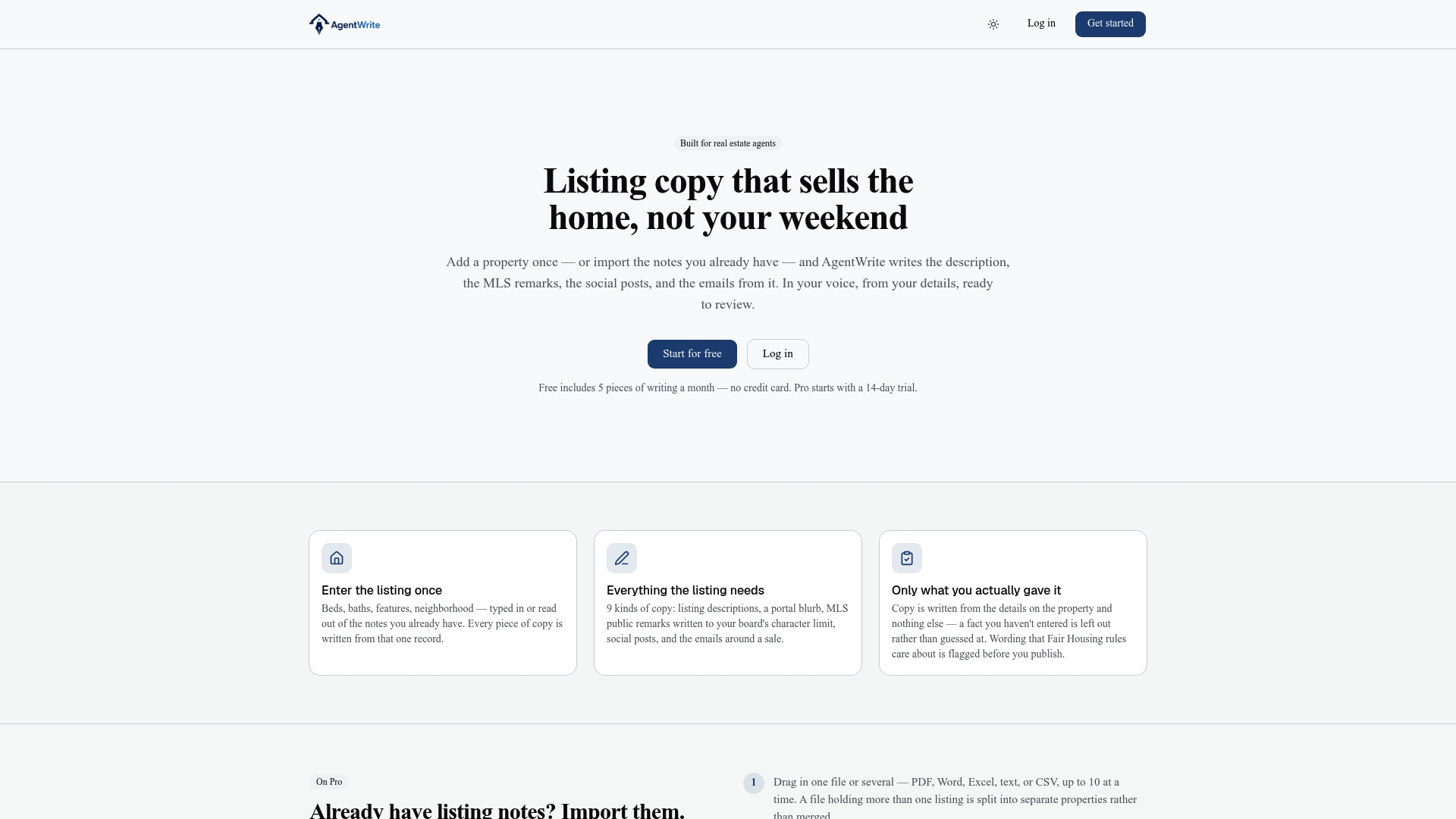
That’s the gap most newsletter advice skips: knowing what to send is only half the job. Writing 49 different content types, month after month, segment after segment, is what actually burns agents out and leads to skipped sends. AgentWrite turns the property data you already have into modular copy blocks you can drop straight into a market update, a listing spotlight, or a community template, then reviews the language for compliance before it goes out. If you’re ready to stop starting every newsletter from a blank page, try AgentWrite and generate your next send from a listing you’re already working on.
Sources
- Real Estate Newsletters — The Ultimate Playbook for 2026
- National Association of Realtors — Research and Statistics
- FRED: 30-Year Mortgage Rate (MORTGAGE30US)
- FHFA — House Price Index downloads
FAQ
How much does a real estate agent make on a $500,000 sale?
Commission structures vary widely by market and brokerage, but on a typical percentage-based split, an agent’s share after brokerage fees is usually a fraction of the total commission paid at closing. Check your specific brokerage split and local commission norms rather than assuming a fixed rate.
What are the 4 P’s of real estate marketing?
The 4 P’s commonly used in real estate marketing are Product (the property itself), Price, Place (location and distribution channels), and Promotion (how you market the listing, including newsletters, social media, and open houses).
Can a real estate agent realistically make $1 million a year?
It’s possible for top-producing agents, particularly team leads and brokers working in high-value markets, but it typically requires years of building a referral pipeline, a strong repeat-client base, and consistent lead-generation systems like the newsletter playbook outlined above.
What are the 7 P’s of marketing applied to real estate?
Beyond the core 4 P’s (Product, Price, Place, Promotion), real estate marketing often extends to People (your team and client relationships), Process (how you guide clients through a transaction), and Physical evidence (your branding, materials, and communications like a newsletter, which signal professionalism and consistency).
How often should I actually send a real estate newsletter?
Monthly is the safest default for most agents, since it’s sustainable and gives you time to gather genuine market data and local content. Move to a biweekly cadence only once you have the systems, templates, and segmentation, to support unique content every time.