

MLS Safe Templates to Write Listing Descriptions That Sell for Agents
MLS Safe Templates to Write Listing Descriptions That Sell for Agents

Lead with the single fact a buyer can’t get anywhere else, in the first 12 words. For practical standards on structuring MLS-ready property descriptions, see Selling My Home: A Practical Plan to Maximize Proceeds. Then follow a four-part shape: hook, four to six fact-based bullets, a short neighborhood note, and a one-line call to action. Skip the adjectives and replace them with years, brands, and dimensions. Screen every sentence for Fair Housing risk before you hit publish.
TL;DR:
- Listing headlines should highlight unique features or recent updates, such as renovation years or brand-name appliances, to capture attention in limited space.
- Fact bullets must focus on verifiable details like square footage, room counts, and structural upgrades, rather than vague adjectives or emotional appeals.
- Descriptions should avoid language implying buyer preferences or demographic characteristics to ensure compliance with Fair Housing laws.
- Rewriting examples show replacing generic praise with specific features, such as “fully renovated in 2024 with new roof and HVAC” for better clarity and credibility.
- Use a verified fact sheet to generate compliant drafts, review claims critically, and prioritize unique, defensible property attributes for effective listings.
Table of Contents
- How Do You Structure a Listing Description That Converts?
- What Words Should You Use Instead of “Charming” and “Cozy”?
- What Can’t You Say in a Real Estate Listing?
- What Are Some Real Listing Description Examples?
- How Do You Proofread a Listing Before Publishing?
- Can AI Help You Draft Listings Without Risking Compliance?
- Why the Differentiator You Pick Matters More Than the Words You Use
- Draft Faster Without Sacrificing Accuracy
- Sources
- FAQ
How Do You Structure a Listing Description That Converts?
A four-part structure maps to how buyers actually scan listings, and it’s the shape behind most high-performing MLS copy: hook, feature bullets, neighborhood note, call to action. Aim for a moderate length of around 150 to 250 words on the MLS side. Portals like Zillow give you more room, but the same skeleton still applies.
1. The hook (first 12 to 15 words). This is the only part guaranteed to survive mobile truncation, so front-load it with property type, size, and the one feature a competitor listing can’t claim. “Updated 1920s bungalow with a permitted ADU and a new 2024 roof” beats “Charming home in a great location” every time.
2. Four to six fact bullets. Pull these straight from your fact sheet, not your imagination:
- Square footage, bedroom and bathroom count, lot size
- Renovation years and named brands (roof, HVAC, appliances, flooring)
- Structural or system upgrades (electrical panel, water heater, windows)
- Standout amenities (primary suite layout, garage size, outdoor living space)
3. Neighborhood note. One or two sentences on walkability, named landmarks, or transit distance. Keep it factual, not aspirational.
4. CTA. A single line: “Schedule your private tour today” or “Contact [agent name] for a showing.”
For MLS, write tight: no more than one clause per bullet. For portals, you can expand each bullet into a full sentence and add a paragraph on lifestyle or layout flow, since Zillow and similar sites don’t truncate the way MLS remarks fields do. Either way, put your best fact first. Mobile users see maybe 100 characters before they have to tap “more.”
What Words Should You Use Instead of “Charming” and “Cozy”?
Vague adjectives don’t sell homes. Verifiable facts do, and industry data backs this up: specific details about renovation years, brand names, and measurements build buyer trust in a way generic superlatives never do.
Replace vague phrases with verifiable facts such as renovation years, exact measurements, and named brands where appropriate.
The real skill is translating features into utility, not just swapping words. A kitchen island isn’t “beautiful.” It adds prep space and seating for four. A fenced yard isn’t “wonderful.” It gives a defined, contained outdoor space for pets or kids. South-facing windows aren’t “gorgeous.” They flood the living room with afternoon light. Every sensory claim should hang on a fact a buyer could verify by walking through the door.
Pro Tip: Keep a running list of banned adjectives on a sticky note next to your fact sheet. If a word describes a feeling instead of a feature, cut it and ask “compared to what, measured how?”
What Can’t You Say in a Real Estate Listing?
Fair Housing compliance isn’t optional, and it trips up more agents than almost any other part of listing copy. The rule of thumb: describe the property and the neighborhood, never the people who might live there.
Avoid language that implies preferences or exclusions based on protected classes, like describing an ideal buyer or using terms that suggest family status or safety; instead, focus on factual descriptions of the property and neighborhood amenities.
Safe alternatives exist for nearly every one of these. Instead of “safe, quiet street,” name the actual distance to the nearest park or grocery store. Instead of “great schools,” reference the school district by name and let buyers research ratings themselves. Instead of “family-friendly,” describe square footage, bedroom count, or a fenced yard: facts about the property, not assumptions about who should buy it.
This is guidance, not legal advice. When in doubt, run copy past your broker or legal counsel, and check your state licensing board’s advertising rules, since some states publish specific FAQs on what’s permitted in listing marketing.
What Are Some Real Listing Description Examples?
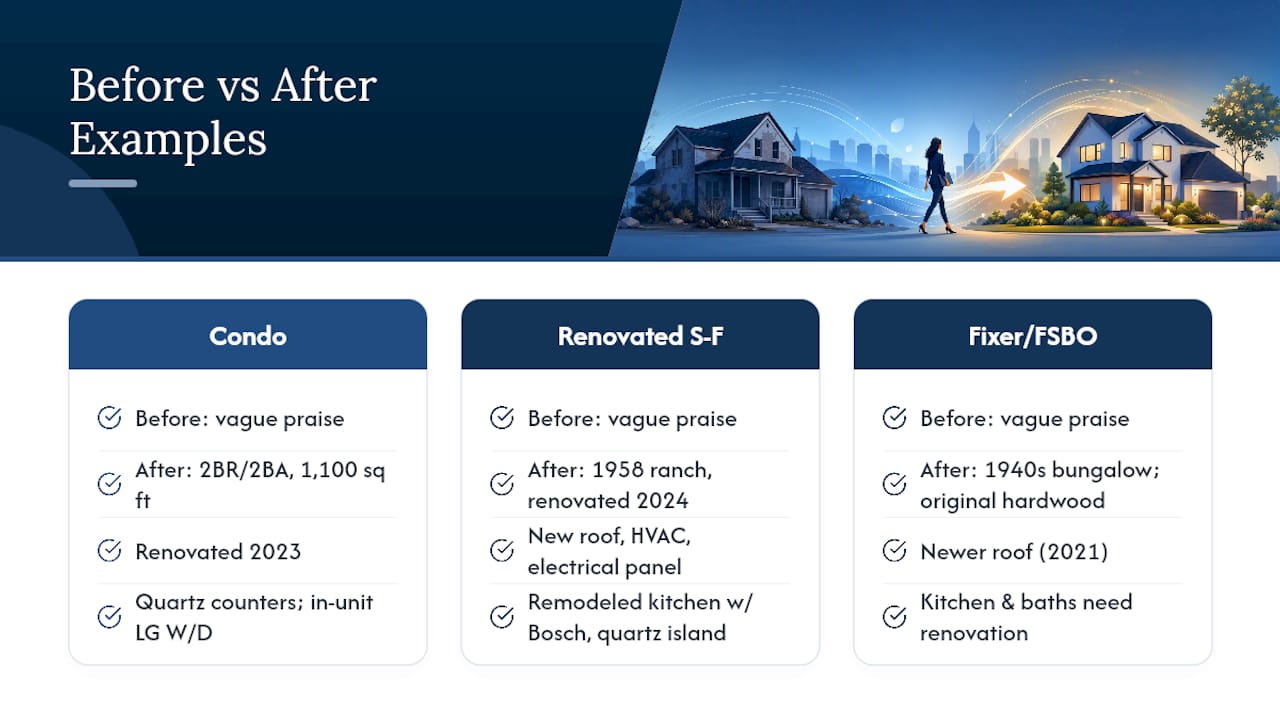
Seeing the rewrite pattern in action makes it easier to apply to your own listings. Here are three before-and-afters covering the property types agents deal with most.
1. Condo (MLS-safe, compact). Before: “Beautiful condo in a great building with amazing amenities!” After: “2BR/2BA condo, 1,100 sq ft, renovated 2023. Quartz counters, in-unit LG washer/dryer, secured parking. Building amenities: gym, rooftop deck. 0.4 miles from downtown transit hub. Schedule a tour today.”
2. Renovated single-family (expanded portal version). Before: “Gorgeous updated home you have to see to believe.” After: “This 1958 ranch was fully renovated in 2024: new roof, HVAC, and electrical panel, plus a remodeled kitchen with Bosch appliances and a quartz island that adds prep space and seating for four. The fenced backyard includes a covered patio, ideal for outdoor dining. Located 0.6 miles from Maple Elementary and a 10-minute walk to the Riverside Trail. Contact us for a private showing.”
3. Fixer/FSBO (honest opportunity framing). Before: “Handyman special, needs some TLC, priced to sell!” After: “Solid 1940s bungalow with original hardwood floors and a newer roof (2021). Kitchen and bathrooms are original and ready for your renovation vision. Detached garage, corner lot, zoned for a possible ADU addition. Priced below recent comparable sales. Cash or renovation-loan buyers welcome to schedule a viewing.”
Each rewrite follows the same before/after pattern: replace vague praise with one specific fact, then pair it with a concrete benefit.
How Do You Proofread a Listing Before Publishing?
Most MLS systems and portals strip all-caps and emojis automatically, so write in plain, scannable text from the start rather than relying on formatting for emphasis.
Run every listing through the same four steps: a grammar tool for typos, a read-aloud pass to catch awkward phrasing, a side-by-side comparison against your fact sheet to catch invented claims, and a final broker or compliance check before it goes live.
| Check | What to verify |
|---|---|
| Dates | Renovation years match permits or receipts |
| Brands | Appliance and system brands are spelled correctly |
| Measurements | Square footage and lot size match county records |
| HOA/fees | Dues and special assessments are current |
| Parking | Garage vs. driveway vs. street is accurate |
| Showing instructions | Contact method and access notes are clear |
Can AI Help You Draft Listings Without Risking Compliance?
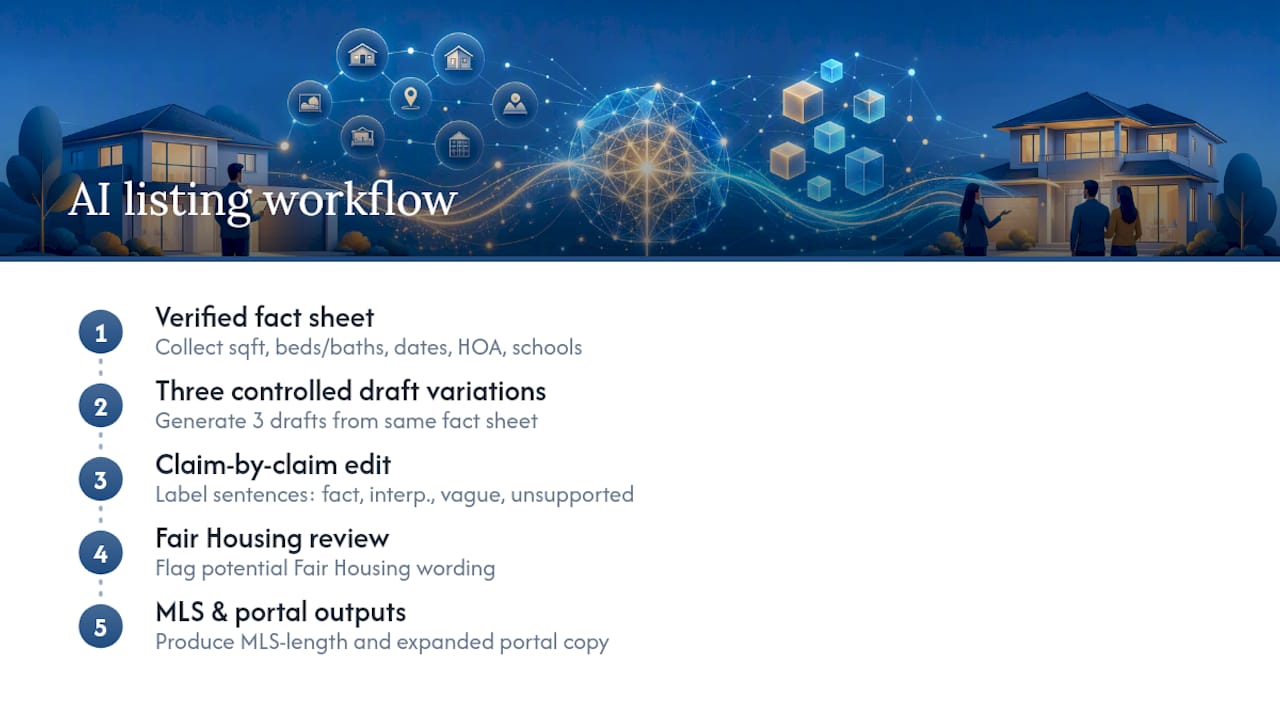
A safe AI workflow starts with a verified fact sheet, not a blank prompt. Capture square footage, bed/bath count, renovation years, brand names, lot features, HOA details, and school district before you write a single word. Then generate three controlled draft variations using those verified facts, feeding the same fact sheet into each version so you can compare tone and emphasis side by side.
From there, run a claim-by-claim edit: label each sentence as fact, interpretation, vague adjective, or unsupported claim, and cut anything that doesn’t hold up. AgentWrite builds this workflow in directly. It flags potential Fair Housing wording as you draft and automatically produces MLS-length versions alongside the expanded portal copy, so you’re not manually trimming word counts twice.
Pro Tip: Never publish an AI draft on the first pass. Treat it as a first draft written by a fast, well-informed assistant, not a finished listing.
Why the Differentiator You Pick Matters More Than the Words You Use
Most agents obsess over adjectives when the real leverage is in choosing what to lead with. The differentiator that’s hardest for a competitor listing to copy quickly, a permitted ADU, a full remodel with permits on file, a lot feature nobody else on the block has, will outperform any clever phrasing. When facts compete for the opening line, pick the one buyers can’t find anywhere else. Favor defensible description over sales hyperbole, and save a fact-sheet template so you’re not rebuilding this process from scratch on every new listing.
— Tyler
Draft Faster Without Sacrificing Accuracy
If you’re tired of rebuilding the same fact sheet into five different formats for MLS, social, and email, This platform is built to close that gap. Enter property details once and it generates MLS-safe listing descriptions, social posts, and seller communications from the same verified facts.
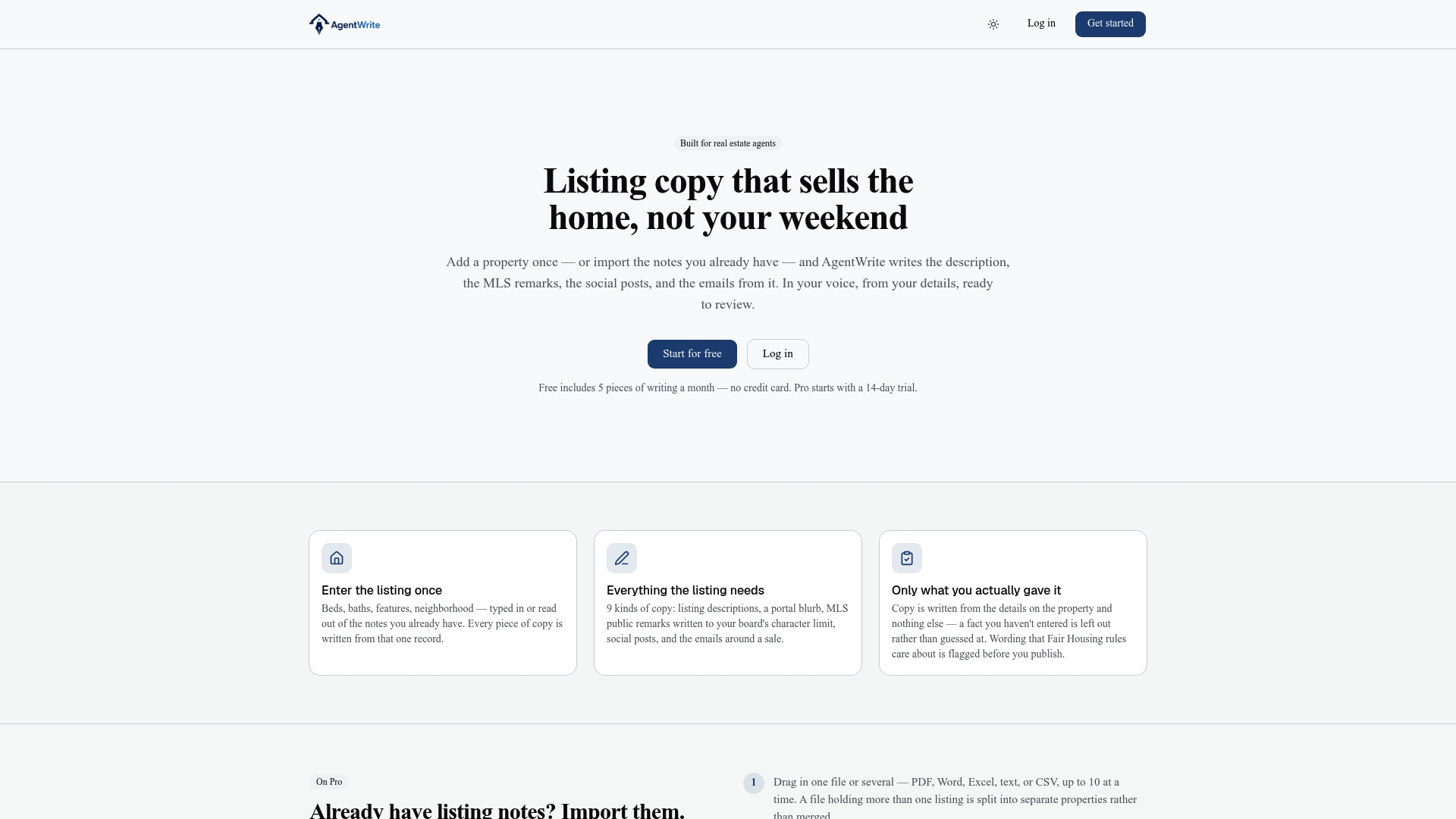
The platform flags potential Fair Housing wording as you draft, so compliance review can happen before publishing instead of after a complaint. The recommended workflow is simple: generate three draft variations, run a claim-by-claim edit against your fact sheet, then publish the version that holds up. Try AgentWrite and generate your next listing draft in minutes instead of an hour.
Sources
- How to Write a Listing Description That Sells (Opendoor)
- How to Write Real Estate Listing Descriptions (McKissock)
FAQ
What Is the 3-3-3 Rule in Real Estate?
There’s no single standardized “3-3-3 rule” tied to listing description writing. If you’ve seen the term used for pricing or negotiation strategy, that’s a separate concept from the structure and compliance guidance covered here.
What Do I Put for a Property Description?
Lead with your strongest differentiator in the first 12 words, then list four to six fact-based bullets covering size, renovation years, brands, and standout features, followed by a short neighborhood note and a call to action.
Can You Give Some Creative Listing Description Examples?
Yes. A condo might open with “2BR/2BA condo, renovated 2023, secured parking, 0.4 miles from transit,” while a fixer-upper could read “Solid 1940s bungalow with original hardwood floors and a newer roof, ready for your renovation vision.”
What Shouldn’t You Say When Selling a House?
Avoid describing an ideal buyer, using phrases like “family-friendly” or “safe neighborhood,” or referencing nearby places of worship. All of these risk Fair Housing complaints and possible MLS removal.
Can AgentWrite Write MLS-Compliant Listings?
AgentWrite generates listing descriptions from your verified property facts and automatically produces MLS-length versions while flagging language that could raise Fair Housing concerns before you publish.